80% Indian engineers unfit for any job: Study

New Delhi: It's been nearly a decade since career assessment and research solutions firm Aspiring Minds first published its annual employability report in 2010.
According to one of its early reports published in 2011, 82 per cent Indian engineers were unemployable.
In 2012, the report further noted that 50 per cent Indian engineers lacked basic English skills.
The latest Annual Employability Survey 2019 (external link) report released by Aspiring Minds reveals that "80 per cent Indian engineers are not fit for any job in the knowledge economy."
According to the same report, only 2.5 per cent of them possess industry relevant tech skills in Artificial Intelligence (AI).
The findings are based on data collected from 1,70,000 students from across 750 plus colleges in India.
For the first time, the employability report includes comparitive data with inputs from engineers in the US and China.
The 2019 survey states that only a handful of Indian engineers possess coding expertise.
"Good coding skills are possessed by 4.6 per cent of Indian job applicants."
It says that Indian engineers (4.6 per cent) can code correctly compared to their Chinese counterparts (2.1 per cent) but lag behind American peers (18.8 per cent) who can write codes correctly.
The annual report also identifies some of the reasons why there is a skill gap.
"Engineering is an applied discipline. Engineers learn primarily by doing, not only by reading and listening."
"Only 40 percent of engineering students in India perform internships and only 36 per cent undertake projects outside their assigned coursework."
It stresses on the lack of industry relevant curriculum and exposure.
"Students are trapped in a college bubble," it points.
"Sixty percent of faculty do not discuss how engineering concepts apply to industry. Only 47 per cent of students report the opportunity to attend a talk by industry personnel during their college career. Most talks that students attend are intra-departmental, rather than seminars, workshops, conferences or webinars that typically feature outside experts and scholars who present complementary or alternative perspectives."
Engineering students in India further struggle during their placements.
Approximately 40 per cent of students reported that their primary challenge is finding the right company or the most suitable job profile to apply.
Their second challenge was to secure and pass an interview.
"Our students need counseling to understand the kinds of jobs that are available; how to determine which job profiles match their interests and skills; the skill gaps that may disqualify them; and how to address those skill gaps," the report suggests.
courtesy: rediff.com
Let the Truth be known. If you read VB and like VB, please be a VB Supporter and Help us deliver the Truth to one and all.
Youth Congress demands Pradhan's resignation over NEET question paper leak
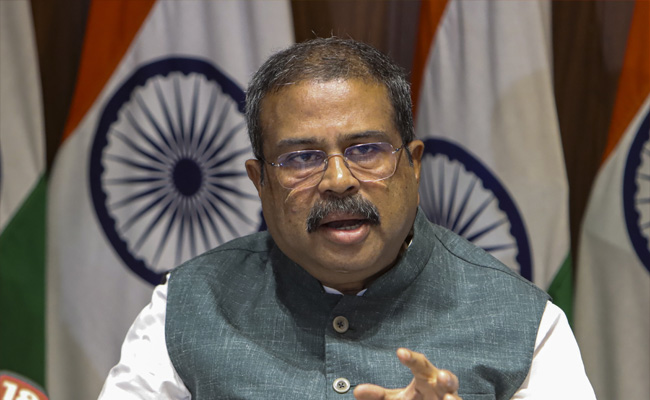
Bhubaneswar (PTI): Youth Congress activists on Friday staged a protest here demanding the resignation of Union Education Minister Dharmendra Pradhan over the NEET question paper leak.
Holding posters, banners and party flags, the Youth Congress activists took out a protest rally in Bhubaneswar from the state Congress office to Master Canteen Square and burnt effigies of Pradhan and Prime Minister Narendra Modi.
The education system has collapsed during the tenure of the BJP-led NDA government, Youth Congress leader Laxmipriya Nayak alleged.
During the past 12 years of Modi's rule, there have been 89 paper leaks and 48 examinations retested, she claimed.
"About 2 crore youths have been affected by the question paper leaks in the last 7-10 years. And, 24 lakh students have been affected by the recent NEET question paper leak incident," another protester, Shilpishree Harichandan, claimed.
"The Union government is playing with the future of the youths of the country. So, Pradhan has no moral right to continue in his position. He should step down," Harichandan said.
The National Testing Agency (NTA) had cancelled the NEET-UG exam, held on May 3, after a paper leak. The Union education minister on Friday announced that the NEET-UG re-exam will be conducted on June 21.