“Green Visionary” of India Dr. Prem C. Jain passes away
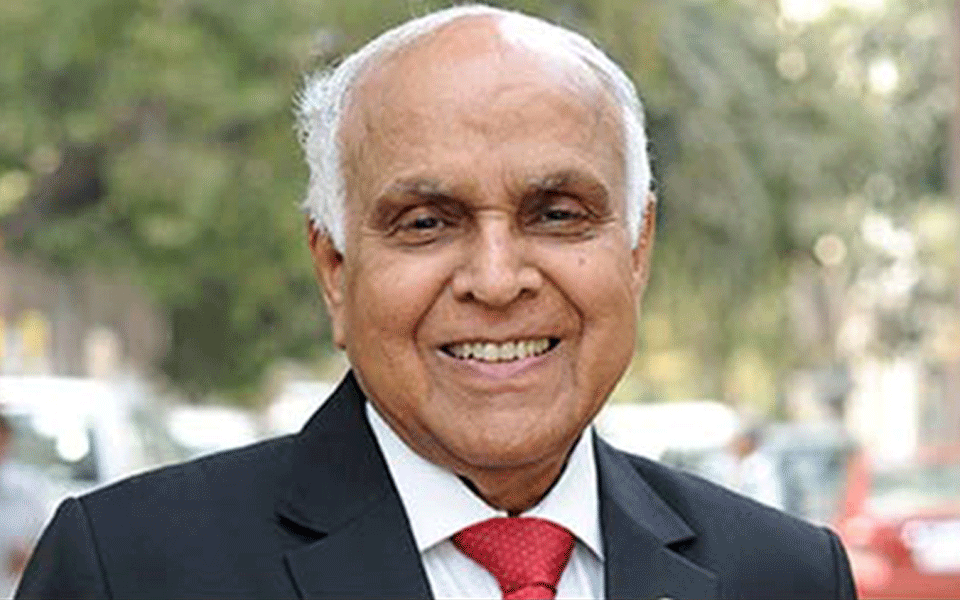
New Delhi : Dr. Prem C. Jain, famous for decades of service to the environment, earning him a reputation as a “green visionary” has passed away on early Thursday. He was aged 82 years.
Dr. Jain has served as adviser to the President and to the Prime Minister of India; has chaired the International Green Building Congress in Chennai, Bangalore and Mumbai from 2006 to 2011; and since 2007, has chaired the Indian Green Building Council. He founded the Indian Society of Heating, Refrigerating and Air Conditioning Engineers in 1980, and the India Chapter of the American Society of Heating, Refrigerating and Air Conditioning Engineers in 1989. He also rewrote the section on air conditioning, heating and ventilation for the National Building Code of India-NBC 2005, bringing it up to the international level of codes, standards and practices.
Dr Jain who had a master’s degree and a doctorate in mechanical engineering. Upon returning to India in 1970 after post-graduate studies in the U.S., he served as a visiting professor at IIT Kanpur, where he taught post-graduate studies and set up a laboratory for environmental engineering. He has also been on the visiting faculty for the School of Planning and Architecture at Delhi University since 1973.He is known as the most admired teacher par excellence. He has been awarded the best visiting faculty award in 1990.
In addition to his academic accomplishments, Dr Jain was a business entrepreneur, founding Spectral Services Consultants Private Limited (now an AECOM company) in 1980 with the mission of providing energy-efficient, fire safe, fully-coordinated Mechanical, Electrical, Plumbing (MEP) services design for all varieties of planned buildings in India. The firm grew from four employees to a staff of more than 600 in 10 offices.
His name is synonymous with the science of air-conditioning and he is known as one of the most outstanding consulting engineers with design experience spanning more than 45 years. He was a Member of American Society of Mechanical Engineers (ASME-USA), National Fire Protection Association (NFPA-USA), Illuminating Engineering Society of North America (IES-USA), International Solar Energy Society (ISES-GERMANY) and Consulting Engineers Association of India (CEAI-India). He has been listed in Marquis 'Who's Who in the World' from 1997 and in Marquis 'Who's Who in Science & Engineering' since 2000. He has also featured in Baron's 'Who's Who (USA)', 'The Asia 500 Leaders for the New Century' published in the USA in 2000, and in Marquis 'Who's Who in Asia' 1997. Furthermore, he has been honoured with the Rashtriya Gaurav Award at the All India Achievers' Conference in 1997. For his special merits and numerous contributions to the society, he was awarded ASHRAE's highest honour - Louise and Bill Holladay 'Distinguished Fellow' award. He is the Fellow of a large number of International Societies, namely, Institute of Refrigeration (IR-London), Institution of Engineers (IE-India), Institution of Energy Engineers (IEE India) and Indian Society of Lighting Engineers (ISLE-India).
Syed Mohamed Beary, Chairman of IGBC Bengaluru Chapter and Bearys Group has expressed shock over the demise of Dr Prem Jain. He said " Dr Jain was
the most respected Green Building figure in Asia . With his passing away, the green building movement of India has been orphaned. Now the rest of us have to work so much more harder in his absence to make his dreams to make Bharat as the world leader in green buildings".
Let the Truth be known. If you read VB and like VB, please be a VB Supporter and Help us deliver the Truth to one and all.
Poll official found dead in Assam amid assembly elections

Tezpur (PTI): A poll official was found dead in Assam's Sonitpur district on Thursday amid assembly elections in the state, officials said.
Deben Horo (45) was deputed as the second polling officer in the Naduar constituency, they said.
"Hore was deputed in polling station no 230 in Dolapani LP School. He was found unconscious in his bed this morning. He was taken to a nearby hospital by ambulance, but he was pronounced dead by the doctors," an official said.
The cause of death is yet to be confirmed, though doctors suspect an underlying medical condition led to it, he said.
Hore hailed from Dopdopi Kachari Gaon in the Chariduar revenue circle. He was an assistant teacher at a government school, officials said.
The incident did not affect polling, which began at the booth at the scheduled time of 7 am. A reserve personnel was deputed in Hore's place, they said.
Polling for the 126-member assembly will continue till 5 pm. The votes will be counted on May 4.