Slain Australia beach shooting suspect native of Hyderabad: T'gana police
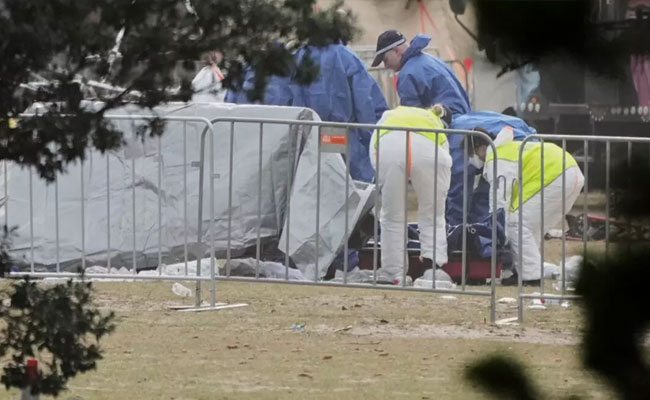
Hyderabad/Melbourne (PTI): Sajid Akram, the 50-year-old slain suspect in a mass shooting at a Hanukkah celebration at Bondi Beach in Australia, was an Indian citizen hailing from Hyderabad, Telangana Police revealed on Tuesday.
While he had migrated to Australia 27 years ago, Akram carried an Indian passport. Akram, along with his 24-year-old son Naveed Akram, recently travelled to the Philippines on an Indian passport.
Akram, one of the two suspects in the mass shooting that has left 15 people dead and dozens injured, migrated to Australia in 1998 and had limited contact with his family here since then, the Telangana DGP's office said in a statement.
"Sajid Akram (50) is originally from Hyderabad, India. He completed his B.Com degree in Hyderabad and migrated to Australia in search of employment, approximately 27 years ago, in November 1998," it said.
ALSO READ: BJP accuses Karnataka govt of 'failing' to prevent noise pollution caused by 'azaan'
He married a European-origin woman before settling permanently in Australia. The couple have one son, Naveed (the second suspect who is in custody at a hospital in Australia) and one daughter, it said.
Naveed and Akram's daughter were born in Australia and are citizens of that country, the statement said.
On Tuesday, Australian Federal Police Commissioner Krissy Barrett described the mass shooting as "a terrorist attack inspired by the Islamic State."
According to Australian authorities, the suspects were a father and son, aged 50 and 24. The older man, who was identified as Sajid Akram, was shot dead.
The Telangana police said Akram visited India on six occasions after migrating to Australia, primarily for family-related reasons such as property matters and to meet his elderly parents.
It is understood that he did not travel to India even at the time of his father's demise, the statement said.
The family members have further expressed no knowledge of his radical mindset or activities, nor of the circumstances that led to his radicalisation, police said.
"The factors that led to the radicalisation of Sajid Akram and his son, Naveed, appear to have no connection with India or any local influence in Telangana," Telangana police said.
Telangana Police further said it has no adverse record against Akram during his stay in India before his departure in 1998.
The state police said it remains committed to cooperating with central agencies and other counterparts, as and when required, and urged the public and media to avoid speculation or attribution without verified facts.
Quoting security sources, Australia's ABC News reported that Akram and Naveed travelled to the Philippines to receive "military-style training".
"Investigators are now examining the Akrams' ties to an international jihadist network, after discovering the pair travelled to Manila in early November," it said, quoting officials briefed on the investigation.
The Philippines Bureau of Immigration confirmed the pair arrived in the Philippines from Australia on November 1, declaring the southern city of Davao - a hotbed for Islamic militants since the 1990s - as their destination, it said.
"They left the country on November 28, 2025, on a connecting flight from Davao to Manila, with Sydney as their final destination," ABC News quoted the Philippines' Bureau of Immigration spokesperson Dana Sandoval as saying.
Sandoval said Akram entered the country on an Indian passport, while his son, Naveed, entered on an Australian passport.
In the Philippines, Undersecretary of the Presidential Communications Office and Press Officer for Malacanang Palace Claire Castro said that the National Security Council (NSC) is currently looking into reports that the father and son duo travelled to the country a month before the attack.
Let the Truth be known. If you read VB and like VB, please be a VB Supporter and Help us deliver the Truth to one and all.
EAM Jaishankar meets Jamaican PM, gifts over 10 BHISHM Cubes
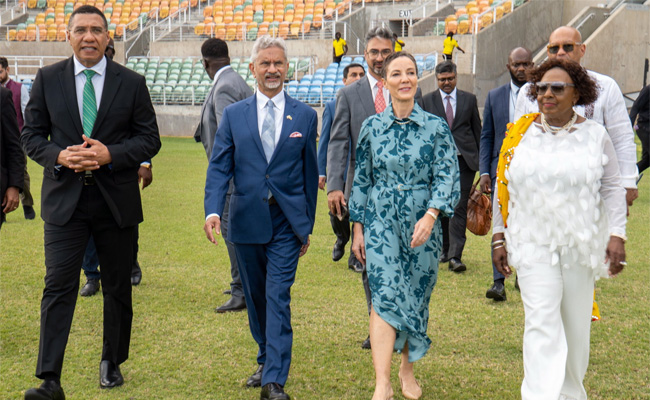
Kingston (PTI): External Affairs Minister S Jaishankar on Monday met Jamaican Prime Minister Andrew Holness and discussed ways to further deepen "political, economic and people-to-people cooperation."
Jaishankar also conveyed greetings from Prime Minister Narendra Modi to Holness.
"Pleased to call on Prime Minister @AndrewHolnessJM in Kingston. Conveyed the greetings of PM @narendramodi," Jaishankar posted on X.
"Discussed deepening our political, economic and people-to-people cooperation. Value his commitment towards further strengthening India-Jamaica relations," the post further read.
Also, the external affairs minister handed over 10 BHISHM (Bharat Health Initiative for Sahyog Hita & Maitri) Cubes as a gift to Jamaica.
"Formally handed over 10 BHISHM Cubes as a gift from India to Jamaica, in the presence of PM @AndrewHolnessJM, Health Minister @christufton and FM @kaminajsmith," Jaishankar posted on X.
"The BHISHM Cube mobile hospital system, designed for rapid deployment, will help Jamaica during disasters and emergencies. The gift of these cubes is a statement of friendship, a commitment to disaster preparedness, and an outcome of innovation," the post said.
Jaishankar arrived in Kingston on Saturday evening, marking the first leg of his nine-day tour of Jamaica, Suriname, and Trinidad and Tobago, aimed at further strengthening India's strategic and cultural ties with the Caribbean nations.
Earlier in the day, he interacted with the Indian diaspora and discussed India's ongoing transformation in infrastructure, human development and technology-driven governance and entrepreneurship with them.
He also highlighted the cricket bond between both countries as India gifted a scoreboard to Jamaica.
A scoreboard was dedicated at Sabina Park in Kingston. It is the home of the Jamaica cricket team and is the only Test cricket ground in the Caribbean island nation.
The minister expressed hope that the new scoreboard would witness many memorable innings, including those symbolising the enduring friendship between the two countries.
Cricket has long been a strong cultural bridge between India and Jamaica, which is part of the West Indies cricket team.
Jamaican players, including Chris Gayle, Courtney Walsh and Michael Holding, have played a major role in shaping the legacy of West Indies cricket in the international arena, contributing to its dominance in earlier decades and its continued global appeal.