Hubballi: Locals allege police high-handedness triggered stone pelting
Muslims didn’t gather at Hubballi mosque for Friday prayers, say locals
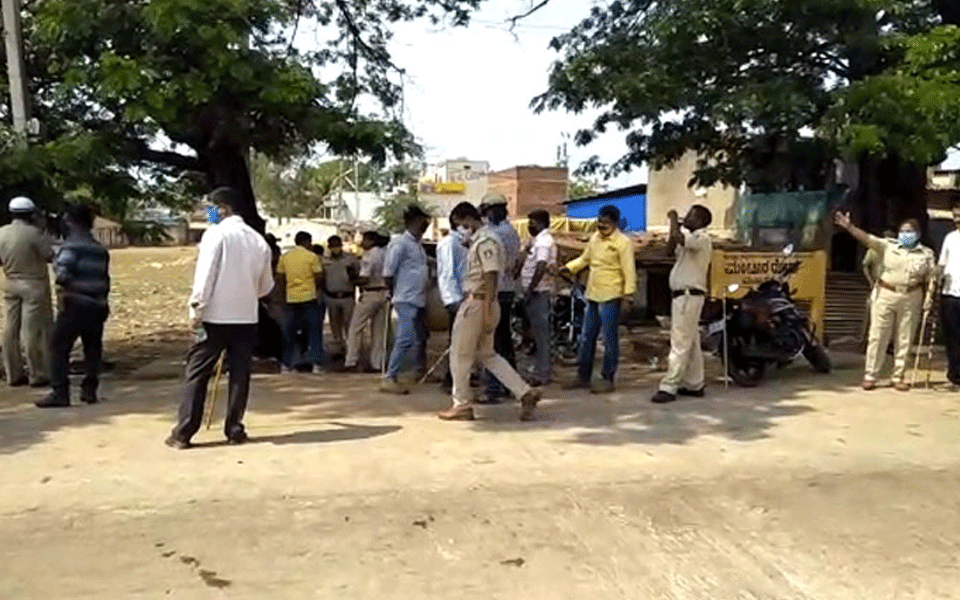
Hubballi: The stone-pelting incident at Hubballi that the police blamed on Muslims who gathered for the Friday prayers in defiance of the lockdown was actually triggered by the police themselves, locals have claimed.
Overzealous policemen entered the mosque by wearing shoes and assaulted the staff, sparking off tension in the predominantly Muslim area of Aralikatti Oni, off Mantoor Road, according to several residents.
Over a dozen people, including some women, have been arrested over the incident that the media quickly blamed on lockdown-defying Muslims.
Speaking to Vartha Bharati, several residents said the incident was incorrectly portrayed as a result of the police stopping Muslims from offering Jumu’ah prayers at Masjid-e-Hazrat Bilal.
Currently only Muazzin (One who gives call to prayers and stays inside or nearby the mosque) and Imam (One who leads the prayers at mosque) are allowed to offer prayers at mosque and congregational prayers are suspended due to country-wide lockdown due to Coronavirus spread.
Aslam, the muazzin of the mosque, recounted how it all started: “I was alone in the masjid and giving azaan (the call to prayer, as giving Azaan is allowed and only congregational prayers are banned). Some policemen just barged into the mosque wearing shoes and started beating me up”.
The police then took Aslam to the Town Police Station, along with the mosque’s chairman (mutavalli) Dawal Nadaf and a local resident named Basha, who were both standing outside the mosque.
Shaista, an eyewitness, confirmed that the police beat up Aslam, Nadaf and Basha before her very own eyes and took them all to the police station.
“I and my sister pleaded the police to spare them. But the police were so brazen that they dragged my sister by her hair and took her away,” Shaista said.
Local Congress leader Altaf Halwoor, who said he also witnessed the incident, said the police later warned the three men and dropped them back at about 150 metres from the masjid. By then, an angry mob, including several women, had gathered there. A woman then started abusing the police. A police constable retaliated by brandishing his lathi, Halwoor said.
“Women and some young men started to pelt stones at the police as a retaliation for their atrocities” Halwoor said, adding that many local residents, including women, and police personnel sustained injuries.
Scared of police department and their atrocities, many residents have locked their houses and moved elsewhere.
Police, have, however, denied the allegation that they beat up anyone at the mosque.
Hubballi Town police inspector M S Patil claimed that when the muazzin was giving the azaan, people started gathering there, violating the lockdown.
“When our officers asked them not to gather there and offer prayers at home, they abused them and started throwing stones,” Patil told Vartha Bharati.
The inspector said that a total of 13 people have been arrested so far over the incident under IPC sections 324, 353, 504, and 332.
Let the Truth be known. If you read VB and like VB, please be a VB Supporter and Help us deliver the Truth to one and all.
Two-wheeler rider killed after ramming tanker near Arkula Bridge in Mangaluru

Mangaluru: A two-wheeler rider was killed on Sunday morning after his vehicle collided with a tanker from behind near Arkula Bridge, police said.
The deceased has been identified as Muhammad Ashfaq (22), a resident of Farangipete.
According to reports, the tanker was heading towards BC Road when the two-wheeler rammed into it from behind near a furniture shop close to Arkula Bridge. Ashfaq sustained severe injuries.
He was immediately shifted to a private hospital in Padil where he recived initial treatment. However, he succumbed to his injuries while being taken to another private hospital in the city for further treatment, police added.
Traffic police have registered a case in connection with the incident.