More bodies found as death toll from Indonesia quake nears 2,000
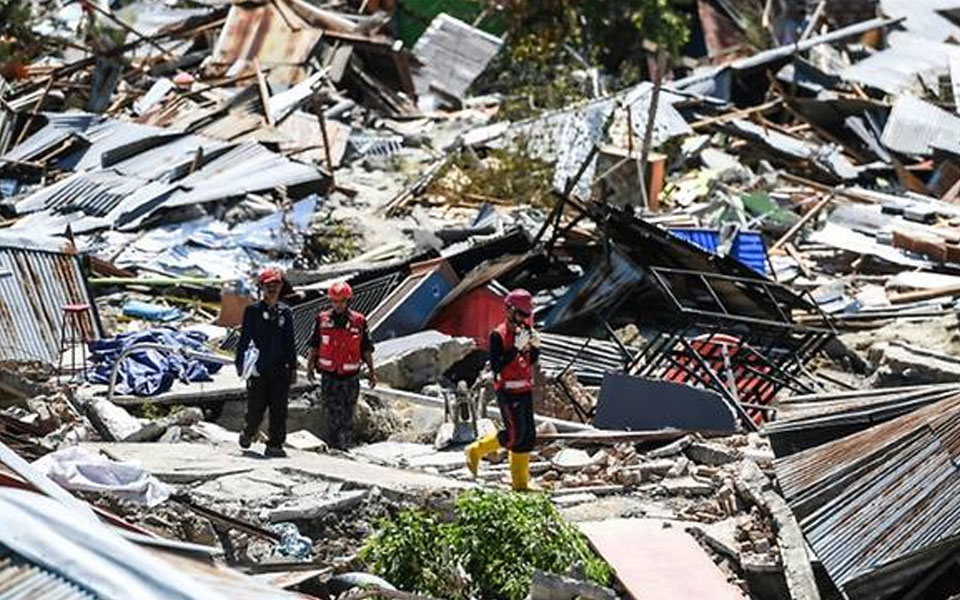
Palu, Oct 8 : Nearly 2,000 bodies have been recovered from Indonesia's disaster-ravaged Palu city, an official said Monday, as the search for victims ended at a hotel destroyed in the powerful earthquake and tsunami.
The death toll from the twin disaster on Sulawesi island that erased whole suburbs in Palu has reached 1,944, said local military spokesman M. Thohir.
"That number is expected to rise, because we have not received orders to halt the search for bodies," Thohir, who is also a member of the government's official Palu quake taskforce, told AFP.
Authorities have said as many as 5,000 are believed missing in two hard-hit areas since the September 28 disaster -- indicating far more may have perished than the current toll.
Hopes of finding anyone alive have faded and the search for survivors amid the wreckage has turned to gathering and accounting for the dead.
The disaster agency said the official search for the unaccounted would continue until October 11 at which point they would be listed as missing, presumed dead.
But rescuers called off the search Monday at Hotel Roa-Roa, which was reduced to a tangled mess of twisted rebar and smashed concrete by the force of the quake.
The hotel emerged as an early focus of efforts to extract survivors, with seven people pulled alive from its mangled ruins in the immediate aftermath.
But nobody else was saved as the days passed, and optimism faded as corpses surfaced from the wreckage.
"The SAR (search and rescue) operation at Hotel Roa-Roa has ended, because we have searched the entire hotel and have not found any more victims," Bambang Suryo, SAR field director in Palu, told AFP.
Agus Haryono, another SAR official at the scene who confirmed the search was off, said 27 bodies were recovered from the hotel including three pulled from the debris Sunday.
Among the confirmed dead were five paragliders in Palu for a competition, including an Asian Games athlete and a South Korean, the only known foreign victim in the disaster.
Authorities believed the 80-room hotel was near capacity when the district was ravaged by a 7.5 magnitude quake and tsunami and estimated 50 to 60 people could be trapped inside.
Rescuers have struggled to extract bodies from the wreckage of Palu, a job made worse as mud hardens and bodies decompose in the tropical heat.
The government has said some flattened areas will be declared as mass graves, and left untouched.
Balaroa resident Sarjono agreed with sealing off the obliterated neighbourhood where vast numbers of bodies are believed trapped beneath the ruins.
"But only if they help us relocate elsewhere. If they don't, where will we live?" the 50-year-old told AFP near the debris of his former home.
Gopal, whose aunt and uncle were missing in Balaroa, picked through wreckage knowing just days were left to find his loved ones.
"Even if they (search teams) stop looking, we will still try to find them ourselves," said the 40-year-old who, like many Indonesians, goes by one name.
"When we can no longer do it ourselves, we leave it to Allah." Excavators and rescuers combed Balaroa on Monday, where a massive government housing complex was all but swallowed up by the disaster.
Officials say as many as 5,000 people were feared buried at Balaroa and Petobo, another decimated community.
Petobo, a cluster of villages, was subsumed when vibrations from the 7.5-magnitude quake turned soil to quicksand -- a process known as liquefaction.
Relief efforts have escalated to assist 200,000 people in desperate need. Food and clean water remain in short supply, and many are dependent entirely on handouts to survive.
Helicopters have been running supply drops to more isolated communities outside Palu, where the full extent of the damage is still not entirely clear.
The Red Cross said Monday it had treated more than 1,800 people at clinics and administered first aid to a similar number in the immediate disaster zone.
Indonesia sits along the world's most tectonically active region, and its 260 million people are vulnerable to earthquakes, tsunamis and volcanic eruptions.
Let the Truth be known. If you read VB and like VB, please be a VB Supporter and Help us deliver the Truth to one and all.
Gujarat voted for development & good governance, says Pradhan as BJP sweeps local body polls
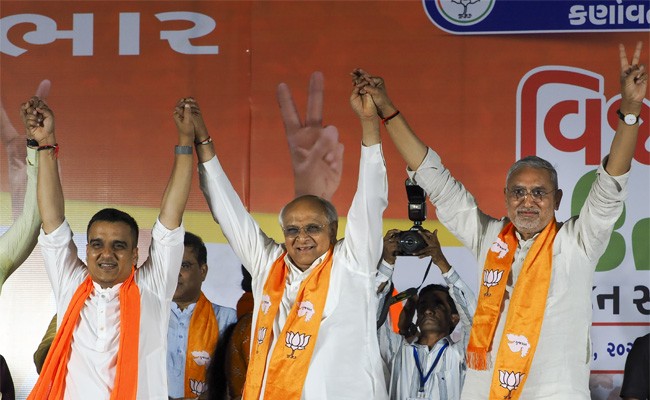
New Delhi (PTI): Union minister Dharmendra Pradhan on Tuesday said the people of Gujarat have reaffirmed their faith in the politics of development, stability and good governance as the BJP swept the local body elections by winning all 15 municipal corporations and 33 out of 34 district panchayats in the state.
Thanking the voters, Pradhan said the result is a testament to the people's unwavering trust in the BJP, the relentless hard work of the party workers and the strength of the organisation under the guidance of Prime Minister Narendra Modi and the leadership of Chief Minister Bhupendra Patel.
“The people of Gujarat have once again made it clear that their trust remains firmly aligned with the politics of development, stability and good governance. I express my heartfelt gratitude to the people of Gujarat for the support received by the BJP in the local body elections,” Pradhan posted on X.
“Under the guidance of the Hon'ble Prime Minister Narendra Modi and the leadership of Gujarat's Chief Minister Bhupendra Patel, this result is a remarkable testament to the people's unwavering trust, the relentless hard work of the Gujarat BJP workers, and the strength of the organisation,” he added.
Earlier, Prime Minister Narendra Modi thanked the people of Gujarat for what he termed a "sweeping mandate" in the local body polls, saying the bond between the state and the BJP has grown even stronger.
Modi said people have voted for the politics of good governance, and assured that the party would work harder to take Gujarat to new heights of progress.
Though final results for 250 taluka panchayats and 84 municipalities were awaited, data from the State Election Commission (SEC) showed that the ruling BJP won most of these local bodies while some were bagged by the Congress, AAP and Independents.
Polling was held on Sunday for 15 municipal corporations, 84 municipalities, 34 district panchayats and 260 taluka panchayats.
The BJP emerged a clear winner in the municipal corporations of Ahmedabad, Vadodara, Surat, Bhavnagar, Jamnagar and Rajkot, besides the newly created municipal corporations of Navsari, Gandhidham, Morbi, Vapi, Anand, Nadiad, Mehsana, Porbandar and Surendranagar.