
Arunima Sinha World's first Indian woman amputee to scale Everest gets honorary doctorate in UK

London, Nov 7: Arunima Sinha, the Indian mountaineer who became the world's first woman amputee to climb Mount Everest in 2013, has been awarded an honorary doctorate by a prestigious UK university for her inspirational achievements.
Sinha, 30, was conferred with the honorary doctorate by the University of Strathclyde at a graduation ceremony in Glasgow on Tuesday.
She was honoured in the Barony Hall for her inspirational achievements in mountaineering.
"I'm very happy and grateful to receive this honorary degree from the University of Strathclyde. This award delivers a good message to the youth of India and the world over that if you strive to reach your goals in life your achievements will be recognised," Sinha said.
A former Indian national Volleyball player, Sinha had her left leg amputated below the knee after being thrown from a train while resisting a robbery.
While recovering she resolved to climb Mount Everest and later trained with Bachendri Pal, the first Indian women to climb the world's highest peak.
On May 21, 2013, Sinha became the world's first female amputee to climb the 8848-meter peak.
She has gone on to be the first female amputee to climb the tallest mountains in Africa, Europe, Australia and South America.
In 2015, she was presented with the Padma Shri, India's fourth-highest civilian award.
"Arunima is an inspiration to amputees around the world. Not only has she shown real spirit, courage and determination in overcoming adversity, she is using her compassion and positivity to help other people," said Professor Jim McDonald, Principal and Vice-Chancellor of the University of Strathclyde
"Arunima embodies the values of Strathclyde and we are delighted to recognise her achievements by making her an Honorary Doctor of the University," McDonald said.
The award also recognises Sinha's charitable work through the Arunima Foundation, which seeks to empower women, disabled people and generally improve the health and social and economic situation for poorer communities.
Let the Truth be known. If you read VB and like VB, please be a VB Supporter and Help us deliver the Truth to one and all.
Notices seeking CEC's removal refer to Rahul's dissent note, incidents of voter-list manipulation
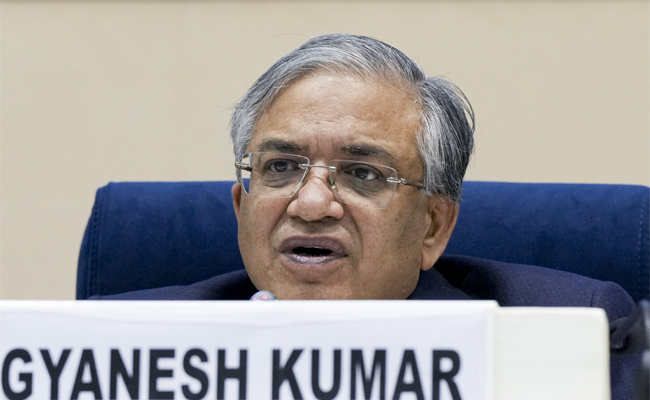
New Delhi (PTI): Notices seeking a motion for the removal of Chief Election Commissioner (CEC) Gyanesh Kumar flag issues ranging from the appointment process to his public attack on Rahul Gandhi and instances of alleged manipulation of votes in recent elections, an opposition leader said on Monday.
The notices, submitted in both Houses of Parliament on Friday, seek a motion for Kumar's removal from the CEC's post, as opposition MPs have cried foul over the Special Intensive Revision (SIR) of the electoral rolls and raised concerns over the alleged manipulation of voters' lists on multiple occasions.
The process to remove the CEC is similar to that for the removal of a Supreme Court or high court judge, meaning an impeachment can be effected only on the ground of "proven misbehaviour or incapacity".
According to the opposition leader, the around-10-page-long notices refer to a dissent note submitted by Gandhi in February 2025, when Kumar was picked for the post. Gandhi, the leader of opposition in the Lok Sabha, is a member of the panel that appoints the CEC, along with Prime Minister Narendra Modi and Home Minister Amit Shah.
ALSO READ: Over 13,000 teaching posts vacant in KVs, Navodaya schools: Education ministry
In his dissent note, the LoP had said, "It is both disrespectful and discourteous for the PM and HM to have made a midnight decision to select the new CEC, when the very composition of the committee and the process is being challenged in the Supreme Court and is due to be heard in less than forty-eight hours."
The notices also mention the CEC's public ultimatum to Gandhi from a press conference in August 2025. Amid allegations of "vote theft" by the opposition, a combative Kumar had asked the LoP to either apologise or back his claims with a signed affidavit, as required under electoral rules.
The notices also refer to allegations of manipulations in the voters' list raised by opposition parties in Karnataka's Aland and Mahadevapura.
The notices have been signed by around 130 members in the Lok Sabha and 60 in the Rajya Sabha. The signatories include leaders of the INDIA bloc parties, the Aam Aadmi Party (AAP) and some independent MPs.
According to sources, the notices list seven charges against Kumar, including "partisan and discriminatory conduct in office", "deliberate obstruction of investigation of electoral fraud" and "mass disenfranchisement".
The opposition parties have accused the CEC of aiding the Bharatiya Janata Party (BJP) on several occasions, especially with the SIR exercise, which they have alleged aims at helping the ruling party at the Centre.
If the motion is admitted in both Houses, a committee will be constituted jointly by the Lok Sabha speaker and the Rajya Sabha chairman.
The committee will consist of the chief justice of India (CJI) or a Supreme Court judge, the chief justice of one of the 25 high courts and a "distinguished jurist".
The proceedings of the committee are like any court proceedings where witnesses and the accused are cross-examined.
The CEC, too, will get a chance to speak before the panel.
According to rules, once the committee submits its report, it will be tabled in the House and discussions will commence for impeachment.
A motion to remove a judge or, in this case, the CEC, will have to be passed by both Houses.
When the House discusses the motion, Kumar will have the right to defend himself standing at the entrance of the House chamber.


