Apple CEO 'very bullish' on India; confident of opening more stores in Indian market

New York, Nov 2: Apple CEO Tim Cook voiced optimism that the Indian government will at some point agree to allow the technology giant to bring in its stores as he lauded the country's bold reforms, saying he is a "big believer" and "very bullish" on India.
Cook was responding to a question on whether Apple is at a disadvantage in India, as compared to other markets, in terms of ability to own stores and manufacture its products.
We've had really great productive discussions with the Indian government and I fully expect that at some point, they will agree to allow us to bring our stores into the country. We've been in discussions with them and the discussions are going quite well," Cook said during the fourth quarter 2018 earnings call Thursday.
Cook said that in India there are import duties in some or most of the product categories that Apple is in and in some cases they compound.
"This is an area that we're giving lots of feedback on. We do manufacture some of the entry iPhones in India and that project has gone well. I am a big believer in India. I am very bullish on the country and the people and our ability to do well there," he said.
Cook said that despite the challenges, including currency weakness, he was very optimistic about his company's future growth in the Indian market.
With the rupee touching 74 to a dollar, Cook said the currency weakness has been part of Apple's challenge in India, "as you can tell from just looking at the currency trends, but I sort of view these as speed bumps along a very long journey though, and the long term is, I think is very, very strong there (India).
"There's a huge number of people that will move into the middle class. The government has really focused on reform in a major way and made some very bold moves and I applaud them for doing that, and sort of can't wait for the future there," he said.
On some deceleration in key emerging markets, Cook said the emerging markets that Apple is seeing pressure in are Turkey, India, Brazil, Russia.
"These are markets where currencies have weakened over the recent period. In some cases, that resulted in us raising prices and those markets are not growing the way we would like to see," he said.
Cook said Apple's business in India in Q4 was flat.
"Obviously, we would like to see that be a huge growth. Brazil was down somewhat compared to the previous year. And so I think, or at least the way that I see these, is each one of the emerging markets has a bit of a different story, and I don't see it as some sort of issue that is common between those for the most part," he said.
The company said it saw great response to the new MacBook Pro models launched in July, with strong double digit revenue growth driving an all time quarterly record for Mac revenue.
We were especially pleased with Mac momentum in emerging markets with strong growth in Latin America, in India, the Middle East and Africa, and Central and Eastern Europe, Apple's Chief Financial Officer Luca Maestri said.
Apple sold 9.7 million iPads during the quarter, gaining share in nearly every market it tracked. However, on a year-to-year basis, there was a six per cent decrease in the number of iPads sold, from 10.3 million in Q4, 2017.
"We generated iPad growth in a number of key regions around the world, including Latin America, Europe, Japan, India and South Asia. Among customers around the world purchasing iPads during the quarter, nearly half were new to iPad, and our active installed base of iPads reached a new all-time high," Maestri said.
Let the Truth be known. If you read VB and like VB, please be a VB Supporter and Help us deliver the Truth to one and all.
CM Siddaramaiah alleges ‘criminal conspiracy’ in Sringeri recount, vows legal action
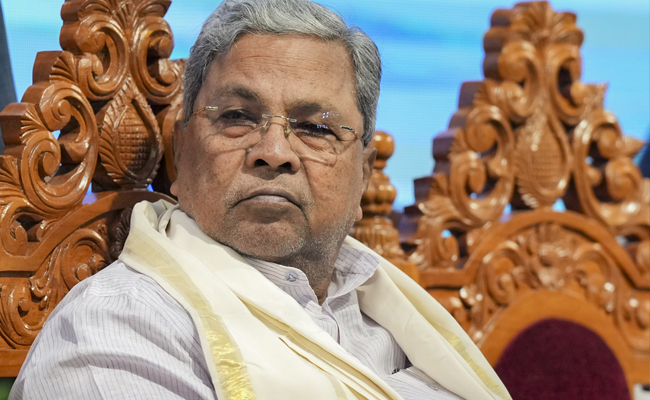
Bengaluru (PTI): Alleging a “criminal conspiracy” by BJP candidate D N Jeevaraj in the Sringeri Assembly poll recounting, Karnataka CM Siddaramaiah on Tuesday said the outcome was manipulated after valid postal ballot votes in favour of Congress leader T D Raje Gowda were tampered with during the recounting process.
Following a Karnataka High Court order on an election petition filed by Jeevaraj, challenging Raje Gowda’s election, the reverification and recounting were conducted on Saturday.
After the reverification and recount of postal ballots for the Sringeri Assembly constituency, votes polled in favour of Raje Gowda were reduced by 255, the returning officer said.
A report on the matter has been submitted to the Election Commission of India for further action, the officer added.
Congress leader Raje Gowda had won the 2023 Assembly polls from Sringeri by 201 votes, defeating his nearest rival Jeevaraj.
Addressing a press conference in Bengaluru, Siddaramaiah said the High Court had directed the recounting of postal ballots and that irregularities were noticed during the exercise conducted on May 2.
“This is a clear case of criminal conspiracy,” Siddaramaiah said, alleging that valid votes cast in favour of Raje Gowda were altered after being accepted by counting agents of all parties, including Congress, BJP, and JD(S).
He claimed that during the recounting of postal ballots, 255 votes were initially accepted as valid by all agents but were later tampered with by subordinate officials.
“There is a second mark on the votes polled in favour of Raje Gowda. They had accepted these as valid votes. Subsequently, another mark was made by officials. This is a clear case of criminal conspiracy,” he said.
When asked who was behind the alleged conspiracy, the CM replied, “It was hatched by Jeevaraj and others. It is planned.”
Siddaramaiah further alleged that the returning officer acted improperly by declaring the result despite the presence of an Election Commission observer during the recounting.
“Immediately after the counting, the returning officer announced the result. He should not have done so; this is against the law,” he said.
He pointed out that Raje Gowda had originally won by 201 votes, but after the recounting, the BJP candidate was declared the winner by 52 votes.
“The BJP has committed a criminal act of conspiracy. This is not vote chori but vote dacoity,” he alleged.
The CM said a police complaint had already been filed by Raje Gowda’s election agent, Sudhir Kumar, and emphasised the need for electoral integrity.
“We want transparency and free and fair elections. That is what our Constitution mandates,” he added.
Stating that the government would pursue legal remedies, Siddaramaiah said, “We are preparing an appeal challenging the returning officer’s announcement in a court of law.”
Responding to a separate query on elections in other states, the CM said there appeared to be an anti-incumbency factor in West Bengal, while results in Tamil Nadu were “surprising,” adding that Vijay’s party was emerging as the largest there.
Following the victory of party candidates in Bagalkote and Davanagere South, Siddaramaiah expressed confidence about future electoral prospects in Karnataka.
“Even in 2028, we will win the Assembly elections. We will come back,” the CM said.
Siddaramaiah added that he would order a forensic examination into the alleged tampering of postal ballots.