Apple sets record revenue in India, iPad sales soar in September quarter

New Delhi: Tech giant Apple has achieved an all-time revenue record in India, marking a double-digit growth in iPad sales during the September 2024 quarter, as reported by senior company officials. The company's total net sales globally grew by over 6% to $94.93 billion, up from $89.49 billion in the same period last year.
Apple CEO Tim Cook highlighted that the September quarter was successful across multiple regions, with record sales in the Americas, Europe, and parts of Asia-Pacific. He noted strong sales performance in countries such as the United States, Brazil, Mexico, the UK, and India, where Apple witnessed an unprecedented revenue spike. Cook also mentioned the recent opening of two new stores in India, located in Mumbai and Delhi, and announced plans for four additional stores in Pune, Bengaluru, Delhi-NCR, and Mumbai.
According to Counterpoint Research, Apple's iPhone held a 21.6% market share in India for the September 2024 quarter, placing it just behind Samsung. Product sales rose by 4.12% to $69.95 billion year-on-year (YoY), with iPhone sales up 5.5% to $46.22 billion. Service revenue saw a notable 12% growth, reaching an all-time high of $24.97 billion.
iPad sales in India were especially strong, increasing by approximately 8% YoY to $6.95 billion, with double-digit growth noted in emerging markets like Mexico, Brazil, and the Middle East, said Luca Maestri, Apple’s Senior Vice President and Chief Financial Officer.
Despite Apple’s global growth, sales in China remained flat for the quarter and declined by 8% annually. While annual product sales dropped slightly by 2% to $185.23 billion, services revenue rose marginally.
Let the Truth be known. If you read VB and like VB, please be a VB Supporter and Help us deliver the Truth to one and all.
Unreserved vacancies for candidates with disabilities open for all categories: SC
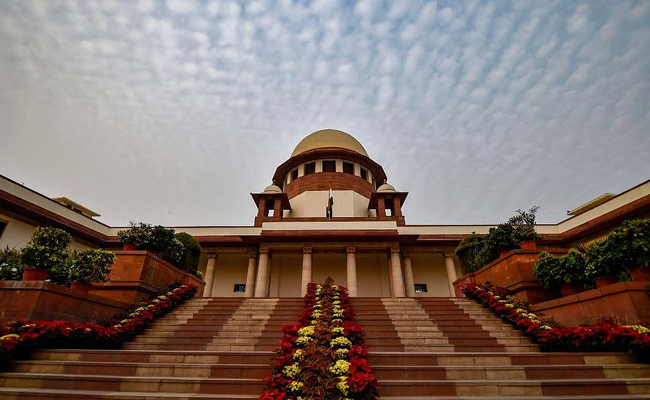
New Delhi (PTI): The Supreme Court on Tuesday said "unreserved" vacancies for Persons with Disabilities (PWD) are an open pool where merit remains the decisive factor and that eligible candidates belonging to any social or special category can be employed.
A bench of Justices Sanjay Karol and N Kotiswar Singh set aside a judgement of the Calcutta High Court, saying the "unreserved" category is not a separate "social category" but an open field for all.
It held that a more meritorious PWD candidate belonging to a reserved category like OBC, SC, or ST cannot be barred from an unreserved PWD post simply because a candidate from the "General" category is also available.
"In reservation law, it is well settled that the Unreserved/Open category does not refer to any social/communal category like SCs, STs or OBC. In other words, any post falling under the Unreserved or Open category does not pertain to any particular social category, it provides an open field or pool meant for the world at large, in the sense that it is open to all candidates, irrespective of whether one belongs to any social or special category or not," Justice Singh, who authored the verdict, said.
The court said if an unreserved or open post is meant for the special category of Persons with Disabilities, it means that the said post will be open to all candidates of all vertical social categories, whether Scheduled Castes (SCs), Scheduled Tribes (STs) or Other Backward Classes (OBC), provided such candidates are also PWD.
"Thus, all candidates, whether SC, ST or OBC, but who are Persons with Disabilities, are equally entitled to compete for the post meant for Persons with Disabilities falling under the Unreserved category, the rationale being that all those who are similarly situated must be treated equally," it said.
The case arose from a recruitment drive of the West Bengal State Electricity Transmission Company Limited (WBSETCL) for the post of Junior Engineer (Civil) Grade-II.
The notification included one post specifically earmarked for Unreserved (Persons with Disabilities -- Low Vision).
The controversy involved two candidates, an unreserved category candidate with low vision who scored 55.667 marks and an OBC candidate, also with low vision, who scored 66.667 marks.
The WBSETCL appointed the OBC candidate to the post based on his higher merit.
This was challenged by the general category candidate who said since he was a "qualified unreserved candidate", the vacancy should have gone to him and that reserved category candidates should only be considered if no unreserved PWD candidate is available.
While a single-judge bench of the high court dismissed the plea, a division bench reversed that decision, directing the employer to appoint the less-meritorious unreserved candidate.
The WBSETCL had then appealed to the Supreme Court.