Bharti Airtel to merge Indus Towers into Bharti Infratel and create the largest mobile tower entity

New Delhi, April 25: Bharti Airtel has approved to merge Indus Towers into Bharti Infratel to create the largest mobile tower entities worldwide with 1.63 lakh towers across 22 circles in India, a company statement said here on Wednesday.
The combined company will own 100 per cent of Indus Towers, it said.
Indus Towers was currently jointly owned by Bharti Infratel (42 per cent), Vodafone (42 per cent), Idea Group (11.15 per cent) and Providence (4.85 per cent).
The combined company, which will fully own the respective businesses of Bharti Infratel and Indus Towers, will change its name to Indus Towers Limited and will continue to be listed on the Indian Stock Exchanges.
"Taken together, Bharti Infratel and Indus Towers had over 163,000 towers and 367,000 tenancies as on March 31, 2018. With over Rs 253 billion ($3.8 billion) in revenues (for the financial year ended March 31, 2018).
"The combined company will be well placed to invest on a national basis to satisfy the future demand from all telecoms operators in India as they continue to densify their networks to support sustained data traffic growth and roll out new network technologies," the company statement said.
"Indus Towers currently operates in 15 telecom service areas (Circles) and Bharti Infratel's operations are focused on the remaining seven Circles.
"The combination of Bharti Infratel and Indus Towers, with their highly complementary footprints, will create a pan-India tower company with the ability to offer high quality passive infrastructure services to all operators on a non-discriminatory basis, needed to support the pan-India expansion of wireless broadband services using 4G/4G+/5G technologies," it added.
Bharti Airtel and Vodafone will have equal rights in the combined company. They have entered into a shareholders' agreement and it is expected that the combined company's articles of association will be amended at completion to reflect some of these rights.
"Following completion, the Board of the combined company will comprise of 11 directors, of whom three will be appointed by each of Bharti Airtel and Vodafone, one will be appointed by KKR/Canada Pension Plan Investment Board and four (including the Chairman) will be independent.
"The management team will be confirmed prior to closing," the statement clarified.
The transaction is subject to approvals from the relevant regulatory authorities, including from Competition Commission of India, Securities and Exchange Board of India, National Company Law Tribunal, Department of Telecommunications (FDI approval), approval from Bharti Infratel's shareholders, necessary corporate approvals from the companies involved, as well as closing conditions.
The transaction is expected to complete before the end of the financial year ending March 31, 2019, the statement added.
Let the Truth be known. If you read VB and like VB, please be a VB Supporter and Help us deliver the Truth to one and all.
NATO, others turn down US call for help in Hormuz: Trump
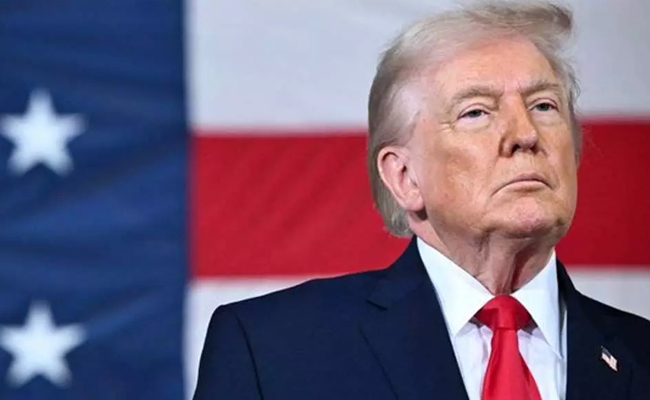
Washington (PTI): President Donald Trump on Tuesday said NATO and most of US' other allies have rejected his calls to help secure the Strait of Hormuz as the war with Iran entered the third week.
In a social media post, Trump asserted that Iran’s military has been “decimated” and he no longer felt the need for assistance from NATO countries or anyone else.
Last week, Trump had sought help from European nations and others who depend on oil supplies transiting from the Hormuz Strait to safeguard the critical waterway.
“The United States has been informed by most of our NATO “Allies” that they don’t want to get involved with our Military Operation against the Terrorist Regime of Iran, in the Middle East, this, despite the fact that almost every Country strongly agreed with what we are doing, and that Iran cannot, in any way, shape, or form, be allowed to have a Nuclear Weapon,” the US President said in a post on Truth Social.
Iran's attacks on Gulf nations and its grip on the Strait of Hormuz, through which a fifth of the world's oil is transported, have sparked increasing concerns of a global energy crisis and are unnerving the world economy.
“I am not surprised by their action, however, because I always considered NATO, where we spend Hundreds of Billions of Dollars per year protecting these same Countries, to be a one-way street — We will protect them, but they will do nothing for us, in particular, in a time of need,” Trump said.
He said Australia, Japan and South Korea too have turned down his call for help.
“Fortunately, we have decimated Iran’s Military – Their Navy is gone, their Air Force is gone, their Anti-Aircraft and Radar is gone and perhaps, most importantly, their Leaders, at virtually every level, are gone, never to threaten us, our Middle Eastern Allies, or the World, again,” Trump said.
He said that given the scale of recent military successes, the US no longer "need" or desires assistance from NATO countries, adding that it never relied on such support in the first place.
Speaking as President of the United States, the "most powerful" country in the world, "we do not need" help from anyone, Trump said.
The West Asia conflict began on February 28 when the US-Israeli combine conducted airstrikes on Iran.
The Strait of Hormuz, the narrow waterway that connects the Persian Gulf to the open ocean, has effectively been shut following the US and Israel attack on Iran and Tehran's sweeping retaliation.
However, Iranian Foreign Minister Abbas Araghchi had said that from Tehran's "perspective", the strait is "open". "It is only closed to Iran's enemies, to those who carried out unjust aggression against our country and to their allies.”
Earlier in the day, a second Indian-flagged LPG tanker, Nanda Devi, reached the country after safely sailing from the war-hit Strait of Hormuz. On Monday, the first ship, Shivalik, reached Mundra port in Gujarat.
As of now, 22 Indian vessels remain on the west side and two on the east side of the strait.
Indian authorities are in constant touch with all the relevant stakeholders in the region to secure the safe passage of the remaining ships, officials said.