Cabinet approves PLI scheme worth about Rs 2 lakh crore: Finance Minister
New Delhi: The government on Wednesday approved a Production-Linked Incentive (PLI) scheme for ten key sectors, including telecom, automobiles, and pharmaceuticals, taking the total outlay for such incentives to nearly Rs 2 lakh crore over a five-year period.
The scheme will help encourage domestic manufacturing, reduce imports, and generate employment as the government works to bolster economic growth. The financial outlay for the new scheme will be Rs 1,45,980 crore.
The five-year PLI scheme, which aims at making Indian manufacturers' competitive globally, was approved by the Union Cabinet, Information and Broadcasting Minister Prakash Javadekar told reporters here.
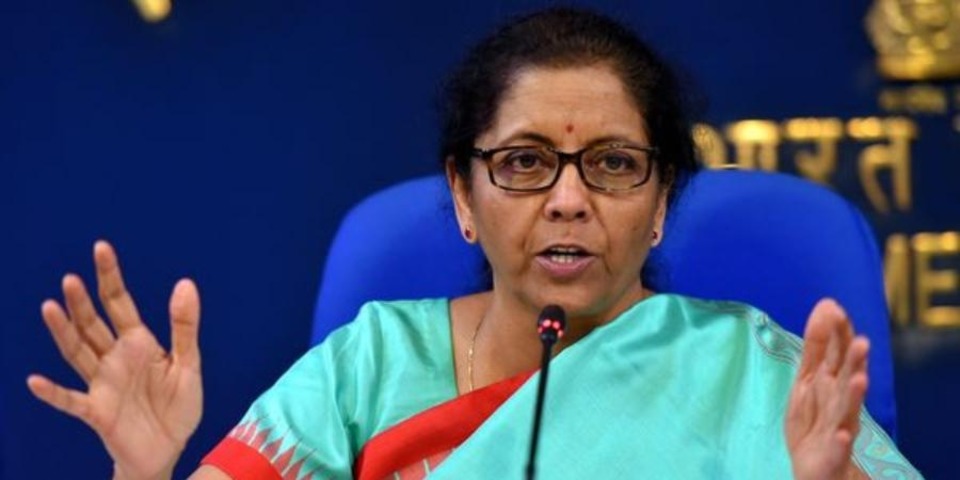
Elaborating on the decision, Finance Minister Nirmala Sitharaman said the PLI scheme will provide great incentives for manufacturers and help the country move towards the objective of 'Aatmanirbhar Bharat' (Self-Reliant India).
The Cabinet also decided to extend the viability gap funding scheme to the social infrastructure sectors. The scheme is currently available only for projects concerning economic infrastructure.
"The Cabinet has taken two very important decisions... both of which, if you ask me at a time like this, is going to give a right impetus to the economy, because we are looking at Aatmanirbharta," Sitharaman said, adding that they will help in making India part of the global value chain.
The PLI scheme, she said, will also provide encouragement to the critical sunrise sectors by ensuring necessary support from the government in addition to creating jobs and linking India to the global value chain.
The 10 sectors that will be entitled to get the incentives include Advance Chemistry Cell (ACC) battery. It is entitled to get Rs 18,100 crore. Other sectors are electronics and technology products (Rs 5,000 crore); automobiles and auto components (Rs 57,042 crore); pharmaceuticals and drugs (Rs 15,000 crore); telecom and networking products (Rs 12,195 crore); textiles products (Rs 10,683 crore); food products (Rs 10,900 crore); high efficiency solar PV modules (Rs 4,500 crore); white goods (Rs 6,238 crore) and speciality steel (Rs 6,322 crore).
"Over the next five years, this is today estimated, that the new PLIs that we are bringing in for these 10 identified sectors will involve an expenditure of about Rs 2 lakh crore. So this is something which we are very happy to announce that the Cabinet has given clearance for this...," Sitharaman said.
An official release said the approved financial outlay over the five-year period for these 10 sectors will be Rs 1,45,980 crore. Under another PLI scheme, an outlay of Rs 51,311 crore has already been approved.
"We are yet again proving that the policy that we are taking up even in PLI through which we want manufacturers to come to India is clearly to say we want to build on our strength but yet link with the global value chains.
"... so this PLI is also aimed at getting investments into the country. The government is giving financial support that these financial incentives will make it attractive to produce in India and selection of sectors have been based on that," Sitharaman said.
An official release said the scheme across these 10 sectors will make Indian manufacturers globally competitive, attract investment in the areas of core competency and cutting-edge technology, ensure efficiencies, create economies of scale, enhance exports and make India an integral part of the global supply chain.
The PLI scheme will be implemented by the concerned ministries/ departments. The final proposals of PLI for individual sectors will be appraised by the Expenditure Finance Committee (EFC) and approved by the Cabinet.
Savings, if any, from one PLI scheme of an approved sector can be utilized to fund that of another approved sector by the Empowered Group of Secretaries. Any new sector for PLI will require fresh approval of the Cabinet.
Let the Truth be known. If you read VB and like VB, please be a VB Supporter and Help us deliver the Truth to one and all.
Allen, Raghuvanshi, Green power KKR to 29-run win over GT
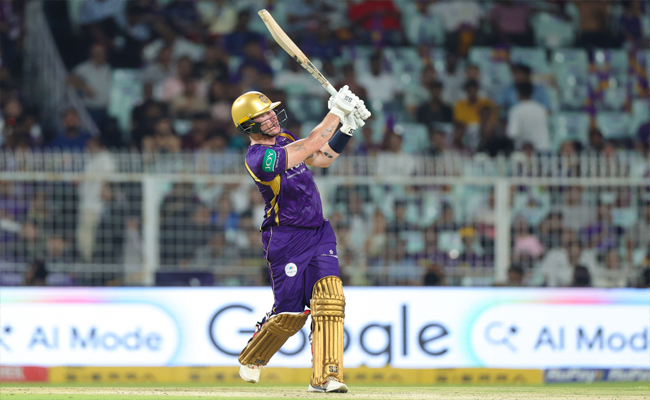
Kolkata (PTI): Finn Allen blasted a 35-ball 93, while Angkrish Raghuvanshi hit an unbeaten 44-ball 82 as Kolkata Knight Riders kept their playoff hopes alive with a 29-run win over Gujarat Titans in the IPL match here on Saturday.
Sent in to bat, Allen went on a six-hitting spree, smashing 10 maximums and four boundaries to add 95 off 41 balls with Raghuvanshi (82).
Raghuvanshi then shared another 108 off 53 balls with Cameron Green (52 not out) to power KKR to a challenging 247 for 2.
In reply, GT could manage 218-4, riding on skipper Shubman Gill's 49-ball 85 and a 35-ball 57 from Jos Buttler. Opener Sai Sudarsan was retired hurt but returned to make a 28-ball 53 not out.
Sunil Narine (2/29) claimed two wickets and Saurabh Dubey snapped one for KKR.
For GT, Mohammed Siraj (1/50), Sai Kishore (1/38) were the wicket-takers.
Brief Score:
KKR: 247 for 2 in 20 overs (Finn Allen 93, Angkrish Raghuvanshi 82 not out, Camero Green 52 not out; Mohammed Siraj 1/50).
GT: 218 for 4 in 20 overs (Shubman Gill 85, Sunil Narine 2/29).