Chennai Students from Ashtrix School of Robotics Shine at World Game Coding Competition 2026
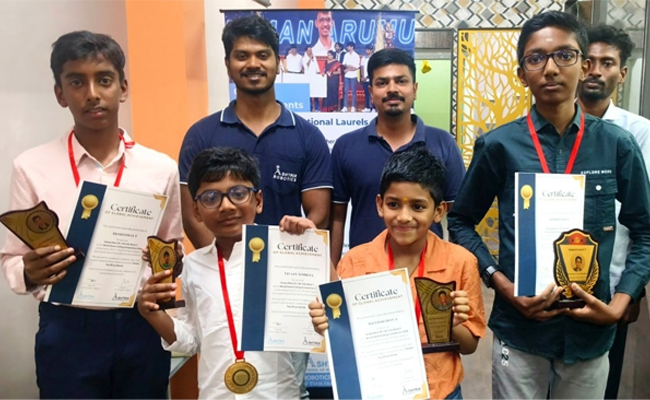
Chennai (Tamil Nadu): Students from Ashtrix School of Robotics, a leading robotics and coding academy for kids in Chennai and a unit of Ashtrix Robotics and Research Centre, delivered outstanding performances at the World Game Coding Competition 2026, conducted under the International Kids Coding Challenge (IKCC), a global coding competition that witnessed participation from students across 66 countries. The World Game Coding Competition evaluates student-created game development projects based on creativity, logical thinking, programming ability, and implementation, providing a global platform for young learners to showcase their coding and computational thinking skills.
Multiple learners from the academy secured top ranks among Indian participants across different age categories, highlighting the growing impact of hands-on robotics and coding education for young learners in India.
In the 13–14 years category, Ashtrix student Shrinivasan V secured an impressive Global Rank 15, emerging as the highest-ranked Indian participant (India Rank 1) in that category.
In the 7–8 years category, Vivaan Athreya secured India Rank 1, while Seetharaman A secured India Rank 3, placing both students among the leading Indian performers in their age group.
In the same age group, Elvin Chen, an international learner from Australia studying with Ashtrix School of Robotics, secured Global Rank 18 and Australia Rank 1 in the 7–8 years category, further highlighting the academy’s growing international student community.
The academy also recorded strong results in the 11–12 years category, where Heimithran T secured India Rank 2 among Indian participants.
Overall, seven students from Ashtrix School of Robotics featured within the Global Top 50, including five students within the Global Top 30, demonstrating consistent performance by students from a single robotics and coding academy on an international platform.
According to a representative from Ashtrix Robotics and Research Centre, the results reflect the importance of project-based learning and early exposure to global technology platforms.
“When students participate in international coding competitions, they learn to measure their work against global standards. These achievements demonstrate that students trained through structured robotics and coding programs in Chennai can compete confidently alongside peers from around the world,” the representative said.
Parents of participating students also highlighted the impact of global exposure through coding competitions and technology learning.
“Working on a game development project and seeing it evaluated on a global platform has been extremely motivating. It builds confidence and helps children understand how their ideas and skills compare internationally,” said a parent of one of the participants.
The IKCC 2026 results underline the growing role of academies such as Ashtrix School of Robotics in nurturing young innovators through hands-on learning in robotics, coding, artificial intelligence, and computational thinking.
The achievements also highlight how students from Chennai are increasingly representing India with pride on global technology platforms, showcasing creativity, innovation, and problem-solving abilities at an early age.
With increasing interest in robotics classes and coding classes for kids in Chennai, institutions like Ashtrix School of Robotics are helping students build strong foundations in programming, computational thinking, and technology innovation from an early age.
About Ashtrix School of Robotics
Ashtrix School of Robotics, a unit of Ashtrix Robotics and Research Centre based in Chennai, offers robotics classes, coding classes, and STEM learning programs for students through hands-on projects in robotics, programming, artificial intelligence, and technology innovation. The academy focuses on building future-ready skills for children through project-based learning and real-world technology exposure.
(Disclaimer: The above press release comes to you under an arrangement with PNN and PTI takes no editorial responsibility for the same.).
Let the Truth be known. If you read VB and like VB, please be a VB Supporter and Help us deliver the Truth to one and all.
KKR defeat LSG via Super Over

Lucknow (PTI): Kolkata Knight Riders edged Lucknow Super Giants via Super Overs in a battle between two bottom-placed teams in the IPL, here on Sunday.
Chasing a modest 156, LSG suffered a batting collapse and managed to tie the contest and take it to Super Over with No. 9 Mohammed Shami striking a last-ball six against a wayward Kartik Tyagi, who leaked 16 runs in the final over.
But Sunil Narine bowled a stunning Super Over conceding just one run and taking two wickets to give KKR an easy target.
Rinku Singh then finished the chase with a boundary off first ball from Prince Yadav.
Earlier the KKR were in deep trouble with 93/7 in 15 overs but Rinku smashed a sensational 83 not out from 51 balls including four sixes in a row in the final over to lift them to 155/7.
Cameron Green (34) was the only other batter to reach double-digit scores as KKR suffered a familiar batting meltdown with Mohsin taking his maiden fifer.
In reply, LSG continued their dismal show with the bat to succumb to their fifth loss in a row.
Brief Scores:
Kolkata Knight Riders 155/7; 20 overs (Rinku Singh 83 not out, Cameron Green 34; Mohsin Khan 5/23). Lucknow Super Giants 155/8; 20 overs (Rishabh Pant 42). KKR won via Super Over.