Cryptos are nothing but gambling, their value only make-believe: RBI governor Shaktikanta Das
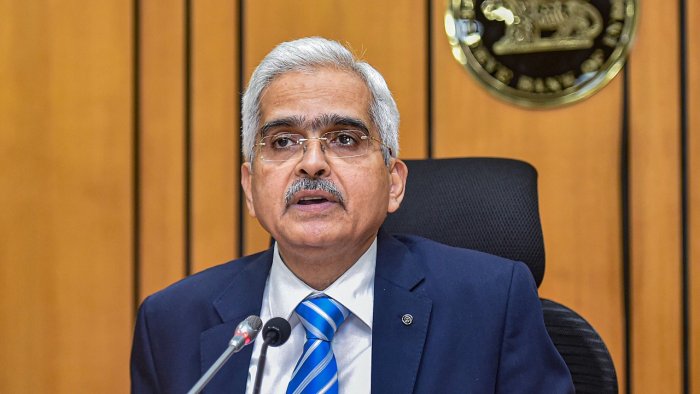
Reserve Bank governor Shaktikanta Das on Friday reiterated his call for an outright ban on cryptocurrencies, saying these are “nothing but gambling” and their perceived “value is nothing but make-believe.''
To further its opposition to such currencies and also to take a lead over other central banks, the RBI recently launched its own digital currency (central bank digital currency), in the form of e–rupee on a pilot mode, first for the wholesale in late last October and a month later for retail customers.
Speaking at a Business Today event this evening here, Das reiterated the need for an outright ban on cryptos saying though those supporting it call it an asset or a financial product, there is no underlying value in it not even a tulip (alluding to the Dutch tulip mania blow-up in the early part of the past century).
“Every asset, every financial product has to have some underlying (value) but in the case of crypto there is no underlying… not even a tulip…and the increase in the market price of cryptos, is based on make-believe. So anything without any underlying, whose value is dependent entirely on make-believe, is nothing but 100 per cent speculation or to put it very bluntly, it is gambling,” the governor said.
“Since we don't allow gambling in our country, and if you want to allow gambling, treat it as gambling and lay down the rules for gambling. But crypto is not a financial product,” Das asserted.
Warning that legalizing cryptos will lead to more dollarization of the economy, he said cryptos masquerading as a financial product or financial asset, is a completely misplaced argument.
Explaining it, he said the bigger macro reason for banning them is that cryptos have the potential to and the characteristics of becoming a means of exchange; an exchange of doing a transaction.
Since most cryptos are dollar-denominated, and if you allow it to grow, assume a situation where say 20 per cent of transactions in an economy are taking place through cryptos issued by private companies.
Central banks will lose control over that 20 per cent of the money supply in the economy and their ability to decide on monetary policy and to decide on liquidity levels. Central banks' authority to that extent will get undermined, it will lead to a dollarization of the economy.
“Please believe me, these are not empty alarm signals. One year ago in the Reserve Bank, we had said this whole thing is likely to collapse sooner than later. And if you see the developments over the last year, climaxing in the FTX episode, I think I don't need to add anything more,” Das said.
To a question whether he sees any threat to the safety and security of banking from the increased digitization of payments, Das said banks have to ensure that they are not swallowed by big tech which today control most digital transactions.
“Issues of data privacy and issues of robustness of the tech infrastructure of banks have to be the focus of banks. Since many banks are actively engaged with many big tech, their challenge is to ensure that this should not lead to a situation where banks are swallowed up by the big tech. Banks should take their own decisions and not to be allowed to be dominated by big tech,” Das said.
On the CBDC being piloted now, he said central banks issued digital currencies are the future of money and its adoption can help save on logistic and printing costs.
“I think CBDC is the future of money,” the governor said, adding “since lots of central banks are doing/working on it and we cannot be left behind but at the same time we have to ensure that its technology is robust and very safe and ensure that it's not cloned or counterfeited.”
Let the Truth be known. If you read VB and like VB, please be a VB Supporter and Help us deliver the Truth to one and all.
Bengaluru: Asia’s largest AI-based water command centre set to launch
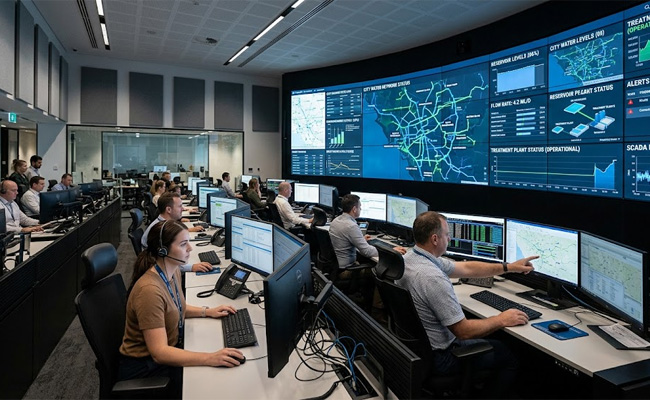
Bengaluru: The Bangalore Water Supply and Sewerage Board (BWSSB) is set to launch one of Asia’s largest AI-powered command centres to monitor water supply and sewage systems in real time, aiming to reduce leaks and improve efficiency, The Indian Express reported.
The Integrated Intelligent Water and Sewerage Management Centre, located at Shimsha Bhavan in Jayanagar, will use Artificial Intelligence (AI) to track, analyse and manage the city’s water network.
In addition to drinking water systems, all sewage treatment plants in the city are connected to the SCADA platform. The system checks if it adheres to National Green Tribunal (NGT) standards and tracks biogas generation from these facilities.
BWSSB Chairman Ram Prasath Manohar said the system will oversee the 775 MLD Cauvery Stage 5 water supply, which serves nearly 110 villages, while also integrating Bengaluru’s broader water distribution and wastewater systems.
A major feature of the system is its use of AI to estimate water demand across different parts of the city. The platform will also detect leakages in pipelines instantly, helping reduce water losses, often referred to as Unaccounted-for Water (UFW) or Non-Revenue Water (NRW). Officers say this will be a key step towards creating a digital replica of Bengaluru’s entire water network.
Bengaluru loses about 28 per cent of its water supply either to leakage or theft.
SCADA has been developed with the financial assistance of the Japan International Cooperation Agency (JICA). The facility is located at Shimsha Bhavan in Jayanagar and is expected to be inaugurated soon by Deputy Chief Minister D K Shivakumar.
BWSSB says the initiative reflects a shift towards a data-driven administration in urban water management. The centre is expected to improve transparency, improve efficiency, and strengthen service delivery in a city that has a continuously growing water demand and infrastructure challenges.
Describing the project as a milestone, Manohar said, “The SCADA centre would bring a new phase in how Bengaluru manages its water and wastewater systems, combining scale with advanced technology.”