Cybersecurity, data privacy biggest concerns for Indian businesses: Dell survey
New Delhi/Bengaluru, Sep 25: Most business leaders in India regard data privacy and cybersecurity concerns as the biggest barrier to their digital transformation, a new report from Dell Technologies said on Tuesday.
According to the research, 93 per cent of Indian businesses are facing major impediments to digital transformation today.
Almost half of Indian business leaders believe they will struggle to meet changing customer demands within five years, according to the report tilted "Digital Transformation Index" (DT Index).
Offering insights into the areas where Indian businesses are considering investment to drive their digital transformation, the research showed that regulation or legislative changes and lack of the right in-house skill sets and expertise are the other top concerns for Indian businesses.
The research also indicates that businesses are taking steps to overcome their barriers, along with the threat of being outmaneuvered from more nimble, innovative players.
Close to 75 per cent of Indian businesses -- 19 per cent more than in China -- intend to invest in cybersecurity in the next one to three years, according to the report.
Conducted in collaboration with Intel Corp, the research showed that 67 per cent of Indian businesses intend to invest in IoT (Internet of Things) technologies - 11 per cent more than that of Chinese companies.
While 62 per cent of Indian businesses intend to invest in multi-Cloud (7 per cent more than Chinese firms), 61 per cent of Indian businesses intend to invest in Artificial Intelligence (only one per cent more than companies in China), the findings showed.
For this study, independent research firm Vanson Bourne surveyed 200 business leaders in India from mid to large-size companies to gauge their organisations' place on the Dell Technologies Digital Transformation Index.
The global results of the report, based on 4,600 respondents from 42 countries, will be released in early 2019, Dell Technologies said.
The report said that 37 per cent of Indian businesses plan to invest in Blockchain, 31 per cent in quantum computing and 42 per cent in augmented reality/virtual reality (AR/VR) technologies in the next one to three years.
"The next digital era has arrived and it's reshaping the way we live, work and conduct business. Which means that time is of the essence. Genuine transformation needs to happen now, and it needs to be radical," Alok Ohrie, President and Managing Director - India Commercial, Dell EMC, said in a statement.
The findings showed that just 12 per cent of Indian businesses are "Digital Leaders" - companies that are digitally advanced - up from 8 per cent in 2016 when the previous edition of the report was published.
The share of "Digital Adopters" -- companies that have a mature digital plan, investments and innovations in place -- went up to 34 per cent this year, from 29 per cent in 2016.
The share of "Digital Evaluators", companies that are cautiously and gradually embracing digital transformation has grown to 40 per cent, from 37 per cent in 2016.
The percentage of "Digital Followers" (a digitally immature group) has also dropped, from 21 per cent in 2016, to 14 per cent in 2018, according to the survey.
Let the Truth be known. If you read VB and like VB, please be a VB Supporter and Help us deliver the Truth to one and all.
No need for guv: DMK leader Kanimozhi
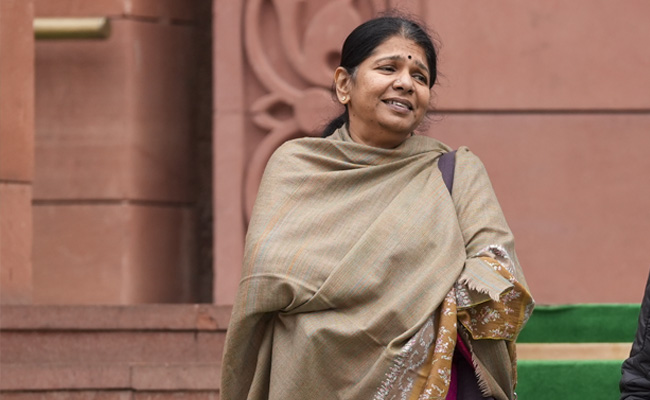
Chennai (PTI): Senior DMK leader Kanimozhi Karunanidhi on Friday reiterated her party’s opposition to the office of the governor amid uncertainty over government formation in Tamil Nadu after a fractured election mandate.
Speaking to PTI Videos, Kanimozhi emphasised that the DMK’s demand for the abolition of the governor’s post remained unchanged, especially as questions arise over constitutional propriety during the current political transition.
"Our position that we do not need a governor at all is something the DMK has never changed at any point in time," she said.
When asked about the governor’s actions following the election results—particularly the delay in inviting the leading party to form the government—Kanimozhi pointed to what she described as the "inherent friction" between the office of the governor and the political interests of the state.
She said the current situation "raises a lot of questions" and requires introspection regarding constitutional procedures.
Kanimozhi described the election results as lacking a "clear mandate", which she identified as the primary reason for the prevailing political uncertainty in the state.
"What the people decide is supreme," she said, adding that while the mandate was not decisive, it must be respected.
The Thoothukudi MP attributed the ongoing delays and "many confusions" to the absence of a decisive majority for any single party.
She firmly dismissed rumours about the DMK potentially supporting the AIADMK from outside to help stabilise the government.
She described such reports as mere "speculation" and "rumours".
"We can’t be responding to every rumour," she said, declining to comment on the AIADMK’s claims regarding its numbers to form the government.
The political situation in Tamil Nadu remains fluid as stakeholders await the governor’s next constitutional step in an Assembly where no party has secured a clear majority.
The DMK and AIADMK—both of which suffered significant losses to the TVK—are reportedly exploring tactical manoeuvres to navigate the hung Assembly.
The TVK, with 108 seats and the support of Congress’s five MLAs, is still short of the majority mark. The DMK and AIADMK secured 59 and 47 seats, respectively.