Gautam Adani replaces Ambani to become wealthiest Indian with networth of Rs 11.6 lakh cr
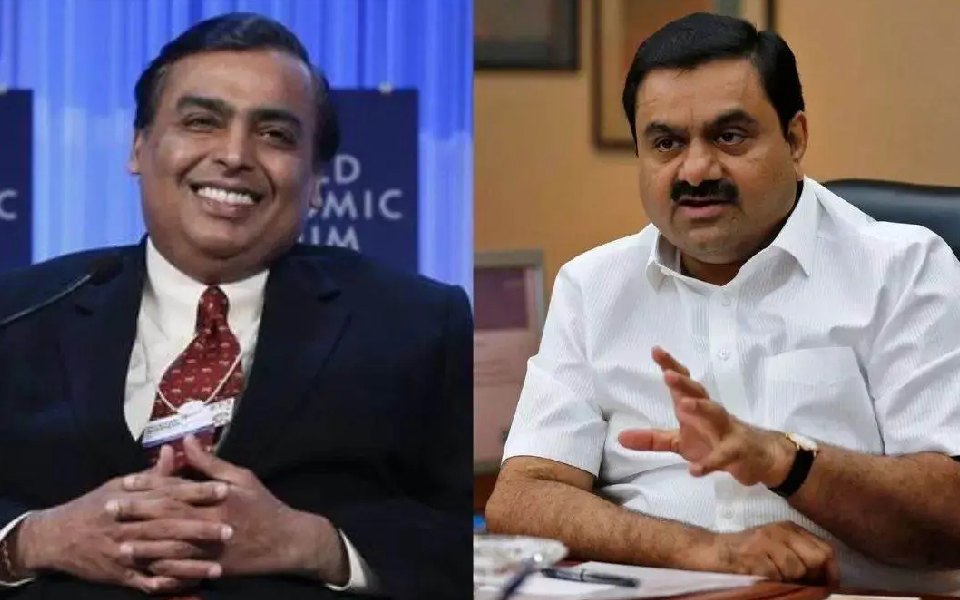
Mumbai: Recouping the dent caused by the Hindenburg Research report, Gautam Adani's networth shot up 95 per cent to Rs 11.6 lakh crore last year, which helped him replace Mukesh Ambani to become the richest Indian, a report said on Thursday.
Reliance Industries Chairman and Managing Director Ambani's overall networth increased by 25 per cent to Rs 10.14 lakh crore, as per the 2024 Hurun India Rich List.
In 2023's report, Adani's wealth declined by 57 per cent to Rs 4.74 lakh crore, and Ambani was way ahead with a fortune of Rs 8.08 lakh crore.
It can be noted that Adani's networth declined sharply following various allegations levelled by US-based short seller Hindenburg Research. The conglomerate has denied all the allegations.
In the 2014 edition, Hurun had pegged Adani's fortunes at Rs 44,000 crore, which made him the tenth richest Indian then.
Shiv Nadar and family of HCL gained one spot to be the third richest with a networth of Rs 3.14 lakh crore, while Serum Institute of India's Cyrus Poonawalla slipped by one notch to the fourth position with a networth of Rs 2.89 lakh crore in 2024.
Sun Pharmaceuticals' Dilip Shanghvi continued his ascent on the list, securing the fifth richest tag against sixth last year with a networth of Rs 2.50 lakh crore.
Radha Vembu of Zoho was the wealthiest among self-made women with a fortune of Rs 47,500 crore, while Zepto's co-founders Kaivalya Vohra and Aadit Palicha, who are in their early 20s, were the youngest on the list with a networth of Rs 3,600 crore and Rs 4,300 crore, respectively.
The list, which captures Indians having a networth of over Rs 1,000 crore, grew by 220 individuals to 1,539 people in 2024. The cumulative wealth has seen a 46 per cent jump in the year.
Actor Shah Rukh Khan made his debut on the list with a fortune estimated at Rs 7,300 crore, which was much higher than business partner Juhi Chawla with Rs 4,600 crore networth secured second place among the entertainers.
Interestingly, 16 professionals also made it to the list with Arista Networks' chief executive Jayshree Ullal being the wealthiest at Rs 32,100 crore and followed by D-mart chief executive Ignatius Navil Noronha at Rs 6,900 crore, according to the list.
Gera Developments' Kumar Pritamdas Gera's wealth grew the fastest at 566 per cent in the 2024 list, while Ambani and Adani had the biggest growth by quantum, the list said.
Let the Truth be known. If you read VB and like VB, please be a VB Supporter and Help us deliver the Truth to one and all.
Karnataka makes teenage pregnancies audit mandatory

Bengaluru (PTI): The Karnataka government on Tuesday issued an order mandating an audit of all adolescent pregnancy cases across the state, aiming to systematically track, review and address the underlying causes of pregnancies among girls aged 10 to 18 years.
The order makes adolescent pregnancy audit mandatory by the Taluk Health Officer (THO) for all pregnancies occurring among girls aged 10 to 18 years across the state.
The move is intended to strengthen early identification, counselling and preventive interventions by integrating efforts across health, education and social welfare departments, while leveraging existing programmes such as the National Health Mission (NHM) and Rashtriya Kishor Swasthya Karyakram (RKSK).
“Adolescent pregnancy remains a significant public health and social concern with implications for maternal health, neonatal outcomes, and socio-economic development,” the order said.
It noted that pregnancies among girls aged 10 to 18 years are associated with increased risks of maternal complications, adverse birth outcomes, school dropout and social vulnerability.
According to the order, all adolescent pregnancies identified in the state must be compulsorily reported by both government and private healthcare institutions on the Reproductive and Child Health (RCH) platform.
The audit framework will examine multiple socio-medical factors, including age at marriage, educational status, awareness of reproductive health, access to contraception, and family vulnerabilities.
It will also assess linkages with schemes such as RKSK, Integrated Child Development Services (ICDS) and school health programmes to identify service delivery gaps.
At the Taluk level, a dedicated audit committee will be constituted under the chairmanship of the Taluk Health Officer. Its members will be drawn from primary health centres, field health staff, Anganwadi services and schools.
The government further directed that counselling services, including those through Sneha Centres, access to contraceptives, and targeted outreach to vulnerable adolescent groups—such as school dropouts, migrants and socially disadvantaged households—must be strengthened.
“The audit shall examine age at marriage, educational status, awareness on reproductive health, access to contraception and counselling services, socio-economic and family vulnerabilities,” the order said.
The order mandates strict confidentiality in handling all cases, in compliance with child protection laws, while also ensuring adherence to legal reporting requirements.