Ghosn gone: Nissan drives out chairman after arrest
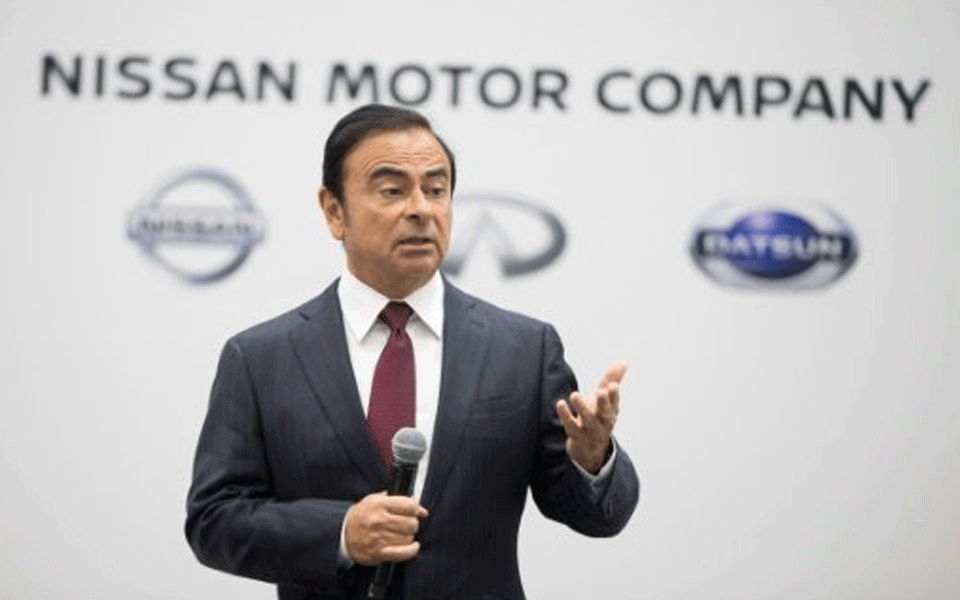
Tokyo, Nov 22: Nissan board members voted unanimously to sack Carlos Ghosn as chairman on Thursday, a spectacular fall from grace for the once-revered boss whose arrest for financial misconduct stunned the car industry and the business world.
Ghosn stands accused of under-reporting his income by millions of dollars and a host of other financial irregularities, alleged after a months-long internal Nissan probe following a whistleblower report.
His ouster as chairman represents an astonishing turnaround for the titan of the auto sector who revived the Japanese brand and forged an alliance with Renault and Mitsubishi Motors, which sold a combined 10.6 million cars last year more than any other firm.
It also throws the future of the alliance into doubt, as Ghosn was the architect of the fractious tie-up -- which employs 450,000 people globally -- and the glue holding it together.
"After reviewing a detailed report of the internal investigation, the board voted unanimously ... to discharge Carlos Ghosn as Chairman of the Board," the statement said.
Nissan also stressed its "long-standing... partnership with Renault remains unchanged" and that "the mission is to minimise the potential impact and confusion on the day-to-day cooperation" between the firms.
Prosecutors intercepted the Brazil-born tycoon Monday as he landed in Tokyo on a private jet, accusing him and another executive Greg Kelly of understating the chairman's income by around 44 million between June 2011 and June 2015.
His fate as Nissan chairman appeared sealed just hours later as his hand-picked successor as CEO, Hiroto Saikawa launched an impassioned broadside at his former mentor, muttering about a "dark side" to the Ghosn era and urging his sacking.
Even after being jettisoned as chairman, Ghosn remains technically a member of the board as a full shareholders' meeting is required to remove him.
Nissan said it would study the creation of a "special committee" to take advice from a third party on improving its internal governance and executive pay.
Ghosn is being held custody in a Tokyo detention centre and has not been seen in public nor made any comments since his arrest.
He received a visit from Brazilian consul Joao de Mendonca on Thursday who told AFP that Ghosn "sounded very well, in good health".
However, his conditions are likely to be a far cry from what the millionaire businessman is used to. Inmates at the centre are typically allowed 30 minutes exercise per day and only two baths a week.
Ties and strings are removed to prevent suicide attempts and former guards and lawyers said Ghosn was almost certain to be held in a cramped cell on his own.
On Wednesday, prosecutors successfully applied to extend his custody for an additional 10 days as they step up their questioning.
Deputy chief prosecutor Shin Kukimoto said that the type of crime Ghosn is accused of is "one of the most serious types of crime" under Japan's Financial Instruments Act and Ghosn could face a 10-million-yen fine and/or a 10-year prison sentence.
Under the law, companies themselves can also be held accountable for the falsified documents, Kukimoto said, following reports that prosecutors believe Nissan also has a case to answer.
Public broadcaster NHK said Nissan had paid "huge sums" to provide Ghosn with luxury homes in Rio de Janeiro, Beirute, Paris and Amsterdam "without any legitimate business reason".
Ghosn had a reputation as a hard-nosed workaholic with no qualms about closing factories and slashing jobs -- earning the nickname "Le Cost Killer" in France, where 47,000 employees work for Renault.
But his exorbitant salary and flashy lifestyle at odds with Japanese corporate culture drew fire.
According to the Financial Times, Ghosn's fall from grace came as he was working on a full-blown merger of Nissan and Renault.
This was opposed by executives in the Japanese firm that has ended up being the most profitable player in the partnership and the FT said Ghosn's departure could be used as a pretext to rebalance the alliance in Nissan's favour.
Renault has held off jettisoning Ghosn, pointedly saying Nissan had failed to share the evidence it had gathered with its sister company.
Governments in Paris and Tokyo have been scrambling to contain the fallout from the arrest, with President Emmanuel Macron saying France would be "extremely vigilant" about the stability of Renault and the alliance.
Analysts said that despite clear tensions between the two firms headquartered 10,000 kilometres apart, neither company has the financial might alone to make the heavy investments in electric vehicles considered to be the industry's future.
"It would be like a couple divorcing after 20 years it would be complicated, very expensive and not easy to do," said Gaetan Toulemonde, an analyst at Deutsche Bank.
"Honestly, I don't know if it's even possible."
Let the Truth be known. If you read VB and like VB, please be a VB Supporter and Help us deliver the Truth to one and all.
Focus on Vijay's poll promises; TVK assured 8 gm gold for women
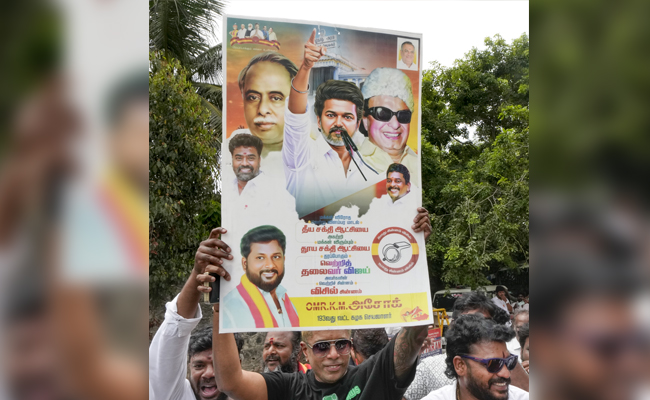
Chennai (PTI): As the new-entrant TVK appears likely to emerge as the single largest party and form the government, the focus has now turned into actor-politician Vijay's poll promises, including 8 gm gold for marriage, which is worth about Rs 14,000 per gram (22 carat).
Vijay's assurances in the party manifesto include Rs 2,500 monthly assistance for women below 60 years, 8 gm gold for marriage and six free cooking gas cylinders a year, per family.
By 3 PM, as per EC data, Vijay's party is leading in 105 constituencies and it falls short of a simple majority (118) in the Assembly.
The actor-turned-politician also assured a quality silk saree in addition to gold for indigent brides and interest-free loans up to Rs 5 lakh for women-run SHGs. He assured corruption-free good governance if voted to power in his maiden electoral fight.
The manifesto also laid importance on education. To prevent school dropouts, mothers or guardians of children studying in government and state-aided schools will receive Rs 15,000 annually.
Vijay promised 100 special residential schools named after iconic leader K Kamaraj, credited with revolutionising education in the state, and higher education loans of up to Rs 20 lakh. The TVK founder also assured AI Ministry, AI University and AI City.
The manifesto placed a strong emphasis on agrarian welfare, too.
The party promised a full waiver of agricultural cooperative crop loans for farmers owning less than five acres of land, while those holding more than five acres will receive a 50 per cent waiver. Additionally, the party promised a Minimum Support Price (MSP) of Rs 3,500 per quintal for paddy and Rs 4,500 per tonne for sugarcane.
Addressing youth unemployment, Vijay pledged to create five lakh new government jobs and offer as many stipendiary internships. Unemployed graduates will be provided a monthly aid of up to Rs 4,000. For government employees, the party assured consideration of the Old Pension Scheme and the regularisation of contract workers, including nurses.
On the health front, he promised a drug-free Tamil Nadu. Vijay also committed to modernising hospitals, providing free annual health checkups, and introducing a Rs 25 lakh family health insurance scheme.
The manifesto also included a Rs 3,000 monthly pension for the elderly and the differently-abled, 200 units of free power, patta (land deed) regularisation, and 100 per cent piped drinking water supply for all households.
Some of the policy intereventions promised by TVK include a legal guarantee to provide essential government services like community certificates, and land pattas, within a strictly specified timeframe.
Vijay also promised doorstep delivery of governance by implementing a system to deliver services, such as ration supplies, directly to the people. He also assured that ease of doing business will be paramount to his government and promised a strict guarantee that business licences will be issued within 21 days.
Elections to 234 Assembly seats in Tamil Nadu were held on April 23.