Gold crosses Rs 33,000-mark, silver firms up
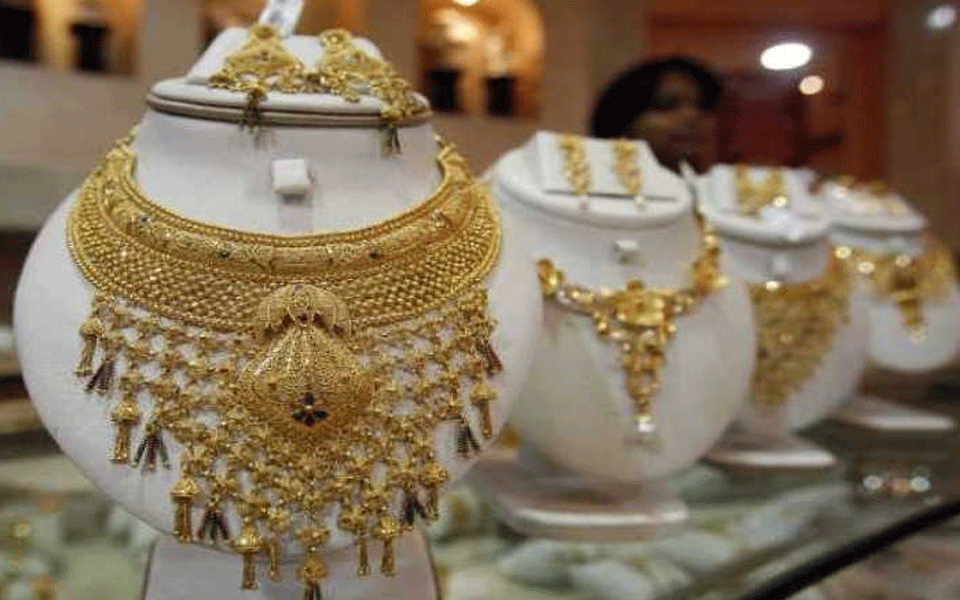
New Delhi: Gold prices surged by Rs 425 to Rs 33,215 per 10 gram in the national capital Monday due to increased buying by jewellers amid firm trend overseas, according to the All India Sarafa Association.
Silver too rose by Rs 170 to Rs 38,670 per kg on increased offtake by industrial units and coin makers.
Traders said, positive trend overseas and rise in demand from local jewellers led to upward movement in the prices of yellow metal.
In the international market, spot gold was trading higher at USD 1,298.30 an ounce, while silver moved upward to USD 15.23 an ounce in New York.
In the national capital, gold of 99.9 per cent and 99.5 per cent purity rose by Rs 425 to Rs 33,215 and Rs 33,045 per 10 gram, respectively.
On Saturday, the yellow metal had closed at Rs 32,790 per 10 gram.
However, sovereign gold held steady at Rs 26,400 per eight gram.
Silver ready advanced by Rs 170 to Rs 38,670 per kg, while weekly-based delivery gained Rs 594 to Rs 37,753 per kg.
On the other hand, silver coins held flat at Rs 80,000 for buying and Rs 81,000 for selling of 100 pieces.
Let the Truth be known. If you read VB and like VB, please be a VB Supporter and Help us deliver the Truth to one and all.
Himachal: Three killed, two injured as speeding car dashes against parked truck
Mandi (HP) (PTI): Three people were killed and two others sustained grievous injuries after a speeding car dashed against a stationary truck at Dadour near Nerchowk in Mandi district on Monday late at night, police said on Tuesday.
There were five people in the car when the tragedy struck. Three were declared dead in the hospital while two have been referred to AIIMS Bilaspur.
The deceased were identified as Anil Kumar (28), Rohit Kumar (26) and Subash Kumar (23), all residents of Mandi district, while the injured are Harish and Pankaj.
A case has been registered under relevant sections and investigations are underway, said Superintendent of Police (SP) Mandi Vinod Kumar.
He added that the bodies have been handed over to the family members of the deceased.
In a statement, Chief Minister Sukhvinder Singh Sukhu expressed grief over the loss of three lives in a road accident. He directed the district administration to ensure best possible treatment for the injured and wished them a speedy recovery.