Govt imposes stock limits on onion traders to check prices
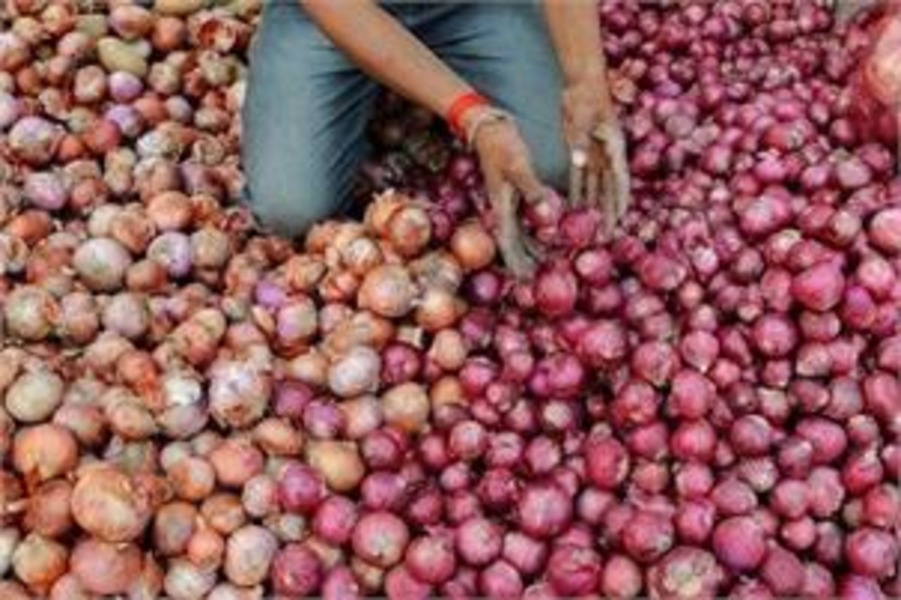
New Delhi: To boost domestic supply and provide relief to consumers from rising onion prices, the Centre on Friday imposed stock limits on both retailers and wholesales with immediate effect till December 31.
Now, retailers can only stock onion up to 2 tonnes, whereas wholesale traders are allowed to keep up to 25 tonnes. This will check hoarding and blackmarketing, it said.
Onion prices have shot up sharply to over Rs 75 per kg in the past few weeks in the wake of damage to the standing kharif crop in producing areas due to heavy rainfall as well as hoarding.
Addressing media, Consumer Affairs Secretary Leena Nandan said, "This is a decisive step. We have imposed stock limits on onion traders with an immediate effect till December 31 after concerns that traders were releasing their stored stocks slowly, creating artificial price rise situation."
She said the government had to invoke the recently passed Essential Commodities (Amendment) Act, 2020, which provides regulation of agri-commodities "only" in the times of extraordinary price rise situation.
"Under this law, normally, we would not be regulating agri-food stuff like cereals and onion. But, in times of extraordinary price rise, we can regulate if the retail price breaches the trigger levels specified in the law," she said.
In case of onion, the average all-India retail price of onion of Rs 55.60 per kg that prevailed on October 21 breached the trigger level as per the formula specified under the EC Amendment Act, she said.
The all-India average retail price of Rs 55.60 per kg was higher by 22.12 per cent compared with last year's rates of Rs 45.33 per kg and by 114.96 per cent as against average rate that prevailed in past five years. So, the retail price had actually more than doubled and, therefore, decided to impose the stock limits on the commodity, she added.
Later, Consumer Affairs Minister Piyush Goyal tweeted that the Modi government has taken third step to curb hoarding and check prices. Stock limits have been imposed on retailers and wholesale traders of onion.
The government said action under the Prevention of Blackmarketing and Maintenance of Supplies of Essential Commodities Act, 1980, would be taken to prevent any hoarding, black marketing of onions by unscrupulous elements.
Highlighting other measures taken to cool down the spiralling trend in onion prices, the secretary said the government has decided to augment domestic supplies through imports for which state-owned MMTC would soon float a tender for red onions to meet the demand supply gap.
Recently, the government relaxed fumigation and phytosanitary norms for import of onion and activated Indian consulates to facilitate trade, she said.
The secretary said the government had taken a pre-emptive step by announcing a ban on onion export on September 14 itself so as to ensure availability to domestic consumers at reasonable rates, before the expected arrival of kharif onion from next month.
"Thus, the retail price rise was moderated to some extent but recent reports of heavy rainfall in the onion-growing districts of Maharashtra, Karnataka, Andhra Pradesh and Madhya Pradesh have created concerns about damage to kharif crop," she said.
She also said the developments on the weather front have contributed to the sharp increase in onion prices.
However, to tide over the present situation, the government has stepped up offloading of onion from its buffer stock of 1 lakh tonne created in 2019-20, which is being carried out swiftly but in a calibrated manner from the second half of September, she said.
The secretary further said onion from the government's buffer stock is being sold in major mandis as well as retail suppliers such as Safal, Kendriya Bhandar, NCCF, and NAFED outlets in major cities and also via states.
Currently, Assam and Kerala governments are being supplied from the retail disposal mechanism. Andhra Pradesh, Telangana and Lakshadweep have also placed their requisition for onions, which are being dispatched, she said.
Further, onions are also being disposed of through open market sales and this will be stepped up further to bring down the price rise.
The government said kharif crop is likely to hit mandis from next month. The estimated arrival of 37 lakh tonne of kharif onion crop will improve availability, she added.
Let the Truth be known. If you read VB and like VB, please be a VB Supporter and Help us deliver the Truth to one and all.
Akash Singh says signature celebration fuels motivation, reinforces dominance

Lucknow (PTI): Pacer Akash Singh caught the eye with his unique celebration during Lucknow Super Giants' win over Chennai Super Kings, pulling out a piece of paper from his pocket after a wicket, a gesture he said was aimed at "motivating" himself and "asserting dominance" over batters.
The left-arm pacer pulled out a scrappy piece of paper after each of the three wickets he took in LSG seven-wicket win over CSK, with the message reading: "Akki on fire -- Akash knows how to take wickets in T20 cricket.
The 24-year-old, who began his IPL journey with Rajasthan Royals and was part of Chennai Super Kings’ title-winning campaign in 2023 before moving to Lucknow Super Giants, registered his best IPL figures with 3 for 26 on Friday.
"'Akki knows how to take wickets in T20 cricket', right?" Akash said when asked about the message on the piece of paper, adding that it serves as a source of motivation and helps him focus on dominating batters and delivering stronger performances for the team.
"Different things motivate different people. Some days I show the paper, some days I don't, but it reflects my mindset on that particular day. When you carry a piece of paper with something written on it, you manifest things and the most important part is when those manifestations actually materialise," he added.
Akash, who hails from Bharatpur in Rajasthan, said the strong backing from the Lucknow Super Giants support staff over the last two years had played a huge role in his growth as a cricketer.
"I've been with LSG for two years and the most important thing has been the backing from the coaches, even when I'm not in the playing XI. This year we have Bharat Arun sir, last year Zaheer sir was there...Tom Moody. The way they guide us, prepare us and keep us ready for opportunities is very important when there are 25 players in the squad," he said.
"When you are not playing, you naturally seek backing and every player wants to make the most of the opportunities he gets. The support from the captain also matters a lot and with Rishabh bhaiya backing you, the confidence grows and you are able to perform better," Akash said, referring to Rishabh Pant.
Akash said Pant had asked him to trust his strengths ahead of the clash against CSK.
"He told me that the new ball is my strength and that I can swing it both ways. So I just tried to make the best use of my skills. The wicket also had good bounce, so I focused on using the bouncer effectively,” added Akash.
On his success against CSK, Akash said his experience of playing in the IPL since 2020, including a stint with CSK, helped him understand the opposition batters better, while backing his own strengths with the ball also played a key role in his impressive spell.
"Obviously, when you play in the IPL and have shared the dressing room with some players, you understand their strengths and weaknesses. My focus was first to back my own strengths, then exploit their weaknesses and also make the best use of what the wicket was offering," Akash said.
Akash said he had sensed over the last two-three games that an opportunity could come his way after being repeatedly told to "be ready", though he admitted he was unfortunate not to get a chance earlier.
"Two days before the match, during practice, I was told to be ready," he said.
Clarifying that he had not been carrying the piece of paper in anticipation, Akash said he often notes down thoughts that could help improve his game..
"Whenever I’m alone or about to sleep, any thought that comes to my mind which can help my cricket, I write it down. The other night I got this thought and jotted it down on paper," he added.