Indian Govt Suggested Reliance as Partner in Rafale Deal, Hollande Tells French Website

New Delhi: The Indian government is the one that suggested Anil Ambani’s Reliance Defence as a service provider for the Rafale deal, former French president Francois Hollande has said in remarks made to Mediapart, a Paris-based investigative news website.
If Hollande’s statements are correct, it would sharply contradict the line taken by the Modi government over the 36-aircraft contract.
Senior government officials have maintained that the process of choosing Reliance Defence as an offset partner for the Rafale deal was a purely commercial decision that was driven by Dassault Aviation.
In a statement put out on Friday evening, the defence ministry said that the Mediarpart report was “being verified” and that “it is reiterated that neither GoI nor French Govt had any say in the commercial decision”.
Mediapart, which published its story on Friday on the Rafale controversy, asks Hollande about the arrangement between Dassault Aviation and Reliance.
Hollande was the French president when the intergovernmental agreement between France and India for 36 aircraft was announced by Modi in April 2015. While the story is behind a paywall in French, The Wire accessed, translated and is publishing the relevant parts below.
The interviewer asks Hollande: “How and by whom was the latter [Reliance] selected? (Comment et par qui ce dernier a-t-il été sélectionné?)”
The former president replies: “We didn’t have a word to say about that subject. The Indian government suggested this service provider and Dassault negotiated with Ambani. We didn’t have a choice, we picked the interlocutor (/contact person) which was selected for us. This is why, moreover, this group had no interest in granting me any special privileges (or thanks)”. [Emphasis added by The Wire].
The French version is:
Nous n’avions pas notre mot à dire à ce sujet. C’est le gouvernement indien qui a proposé ce groupe de service, et Dassault qui a négocié avec Ambani. Nous n’avons pas eu le choix, nous avons pris l’interlocuteur qui nous a été donné. C’est pourquoi, par ailleurs, ce groupe n’avait pas à me faire quelque grâce de quoi que ce soit. Je ne pouvais même pas imaginer qu’il y avait un quelconque lien avec un film de Julie Gayet .
One persistent strain of criticism in the Rafale controversy, over the last few months, has been the inclusion of Reliance Defence — which at the time of its selection as an offset partner was a fledgling company, having been incorporated just a little before the defence contract was announced by Prime Minister Narendra Modi in April 2015. Opposition parties like the Congress in particular have used this point to raise allegations of crony capitalism.
The decision to go with a smaller purchase and the selection of Anil Ambani’s Reliance, presumably by Dassault Aviation, has also sparked criticism because its inclusion came with the dropping of Hindustan Aeronautics Ltd (HAL) as a co-production partner for a larger 126-jet deal.
The Modi government has staunchly maintained that it had nothing to do with Dassault Aviation choosing Reliance. A month ago, finance minister Arun Jaitley specifically laid this out, noting that under the offset policy, any original equipment manufacturer can “select any number of Indian partners”.
“This has nothing to do with the Government of India and, therefore, any private industry having benefitted from the Government of India is a complete lie. Can Shri Gandhi and his Party deny this?” Jaitley said.
For her part, defence minister Nirmala Sitharaman has maintained that she doesn’t officially know who Dassault Aviation’s offset partner is. “I have not got to know who is Dassault’s offset partner… It is a commercial decision. There are laid down procedure to check the process of fulfilment of offset obligations. Neither I can accept, nor I can suggest, nor I can reject anybody from going with anybody,” she said last week.
Hollande’s new remarks, therefore, cast a shadow of doubt on this defence.
The Wire has asked Reliance Defence, Dassault Aviation and the French embassy in New Delhi for their comments and this story will be updated if and when a response is received.
Courtesy: thewire.in
Let the Truth be known. If you read VB and like VB, please be a VB Supporter and Help us deliver the Truth to one and all.
Rajnath to top commanders: Outmaneuver adversaries with strategic surprise
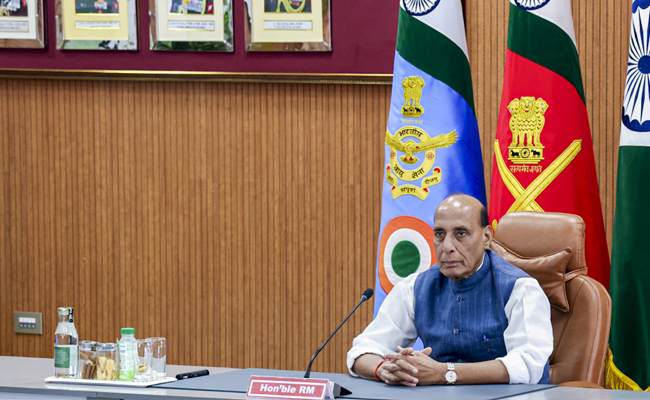
Jaipur/New Delhi (PTI): Defence Minister Rajnath Singh on Friday directed the top military commanders of the three services to integrate an "element of surprise" into modern warfare to outmaneuver India's adversaries and bolster strategic posture.
In his address at the joint commanders conference in Jaipur, Singh also described the Operation Sindoor as a testament to the "swift, precise, and joint response" of the Indian armed forces to safeguard national interests and called upon the military to remain ready to deal with any security challenges.
In their two-day deliberations, the commanders carried out a comprehensive review of the combat preparedness of the military in the wake of the evolving regional security situation.
Operation Sindoor was a demonstration of India's growing capabilities and a symbol of the nation's collective resolve and new military ethos, Singh said, a day after the first anniversary of Operation Sindoor.
He also unveiled a 'Joint Doctrine for Integrated Communication Architecture' that is aimed at strengthening doctrinal clarity, interoperability and integrated communications across the armed forces in future multidomain operations.
The joint commanders' conference, themed 'Military Capability in New Domains', brought together the top leadership of the defence ministry and the three services to deliberate on emerging security challenges and future readiness.
Comprehensive deliberations were held on future warfare, multidomain operations, technological transformation and joint capability development.
The conference witnessed extensive discussions on cognitive warfare, cyber resilience against evolving quantum and AI-enabled threats, military capability development in emerging domains, indigenous innovation and AI-enabled warfighting concepts.
It was attended by Chief of Defence Staff Gen Anil Chauhan, Chief of the Naval Staff Admiral Dinesh Kumar Tripathi, Chief of the Army Staff Gen Upendra Dwivedi, Chief of the Air Staff Air Chief Marshal AP Singh and Defence Secretary Rajesh Kumar Singh among others.
In his remarks, Singh asked the commanders to remain "future-ready" by learning from the operation as well as the current global security landscape.
He underscored the need to strengthen capabilities in artificial intelligence, autonomous systems, data analytics and secure communication networks to stay prepared in the rapidly evolving geopolitical security scenario. He emphasised that future conflicts will increasingly be shaped by hybrid threats, information dominance and operations conducted simultaneously across cyber, space, electromagnetic and cognitive domains, according to an official readout.
Highlighting the transformative impact of emerging technologies, Singh stressed on the importance of ensuring integrated national preparedness across all spectrums of conflict, it said.
Singh's remarks at the conference came a day after the first anniversary of Operation Sindoor.
The defence minister appreciated the progress achieved in enhancing jointness, integration and technological adoption across the three services, the readout noted.
Singh said that jointness constitutes a pivotal dimension within the transformative changes sweeping across the global defence sector.
"Future wars will not be won solely through weaponry, but through innovative thinking and enhanced synergy," he said.
The defence minister exhorted the commanders to cultivate the "element of surprise" to remain unpredictable to the nation's adversaries and secure a strategic edge in any given situation.
He, however, urged them to remain vigilant of the element of surprise of the enemy and always stay two steps ahead.
Singh also reiterated the Narendra Modi government's commitment to enhancing the capabilities of the defence forces through state-of-the-art weapons and platforms. He added that special focus is being laid on research in niche domains.
During the conference, he released a documentary film on Operation Sindoor.
The film reaffirms the nation's and defence forces' commitment to operational preparedness and decisive national response capabilities.
Demonstrations of advanced systems and platforms developed for intelligence fusion, operational planning and information management were also showcased during the conference reflecting growing integration of cutting-edge technologies into joint operational structures, according to the defence ministry.
The discussions will contribute significantly towards shaping India's future military transformation and integrated operational preparedness, it said.