Insurance Claim Can’t Be Denied On Ground Of Common Lifestyle Diseases
But Insurer Should Not Hide Info, Says NCDRC
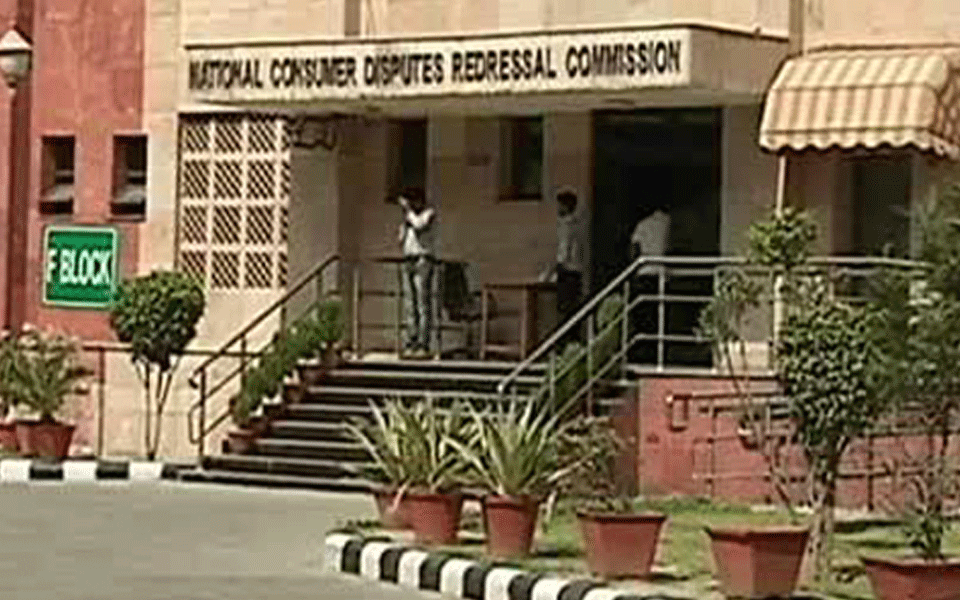
The National Consumer Disputes Redressal Commission (NCDRC) had held that insurance claim cannot be denied on the ground of common lifestyle diseases such as diabetes or hypertension but that does not give right to the insured to suppress information in respect of such diseases.
The commission also reiterated that suppression of any information relating to pre-existing disease if it has not resulted in death or has no direct relationship to cause of death, would not completely disentitle the claimant from claiming the insured amount.
NCDRC member Prem Narain said so while deciding the appeal of one Neelam Chopra, a resident of Mohali in Punjab.
Her husband had taken an LIC policy in the year 2003 and after being medically examined by a panel of doctors, he was issued the policy w.e.f. 25.12.2002 to 25.6.2026.
The husband of the complainant died on January 7, 2004 due to cardio-respiratory arrest. Her claim was rejected by LIC on the ground that the insured had suppressed material information regarding his health at the time of effecting the policy as he suffered from diabetes and LL Hansen’s disease.
When Neelam moved the District Forum, LIC was told to pay her the insurance claim amount of Rs 5 lakh along with 12 per cent interest besides Rs 25,000 as compensation for mental agony and Rs 5,000 as cost of litigation. The State Commission of Haryana allowed the appeal moved by LIC. This is when Neelam moved NCDRC. The NCDRC noted, “…the Deceased Life Assured (DLA) died on 07.01.2004 and therefore, the disease on account of which the death occurred was not prevailing on the date of filing of the proposal form as the proposal form was filled on 24.01.2003. It has also been alleged that the DLA was suffering from diabetes as mentioned in the treatment record of PGI Chandigarh. He was suffering for 3-4 years from diabetes. In the certificate of Medical Attendance, it is also mentioned that the DLA was suffering from diabetes, however, diabetes was under control. “So far as the life style diseases like diabetes and high blood pressure are concerned”, the Commission quoted from the Delhi High Court judgment in case titled Hari Om Agarwal Vs. Oriental Insurance Co. Ltd., wherein it was held that, “Insurance- Mediclaim-ReimbursementPresent Petition filed for appropriate directions to respondent to reimburse expenses incurred by him for his medical treatment, in accordance with policy of insurance- Held, there is no dispute that diabetes was a condition at time of submission of proposal, so was hypertension-Petitioner was advised to undergo ECG, which he did- Insurer accepted proposal and issued cover note- It is universally known that hypertension and diabetes can lead to a host of ailments, such as stroke, cardiac disease, renal failure, liver complications depending upon varied factors- That implies that there is probability of such ailments, equally they can arise in non-diabetics or those without hypertension. It would be apparent that giving a textual effect to Clause 4.1 of policy would in most such cases render mediclaim cover meaningless- Policy would be reduced to a contract with no content, in event of happening of contingency”.
The commission, therefore, held that it was clear that “the insurance claim cannot be denied on the ground of these lifestyle diseases that are so common. However, it does not give any right to the person insured to suppress information in respect of such diseases. The person insured may suffer consequences in terms of the reduced claims.” It also relied on Supreme Court’s decision in Sulbha Prakash Motegaonkar and Ors. Vs. Life Insurance Corporation of India to say that, “… suppression of any information relating to pre-existing disease if it has not resulted in death or has no direct relationship to cause of death, would not completely disentitle the claimant for the claim”. The commission, therefore, set aside the order of the state commission and modified the order of the district forum to the extent that LIC was told to pay only the insurance amount of Rs 5 lakh and compensation of Rs 25,000 along with litigation cost of Rs 5,000. Interest at the rate of 8 per cent would be attracted only if the LIC fails to comply with the order within 45 days.
Courtesy: www.livelaw.in
Let the Truth be known. If you read VB and like VB, please be a VB Supporter and Help us deliver the Truth to one and all.
AAP hit by exit of 7 MPs, faces test ahead of 2027 poll battles
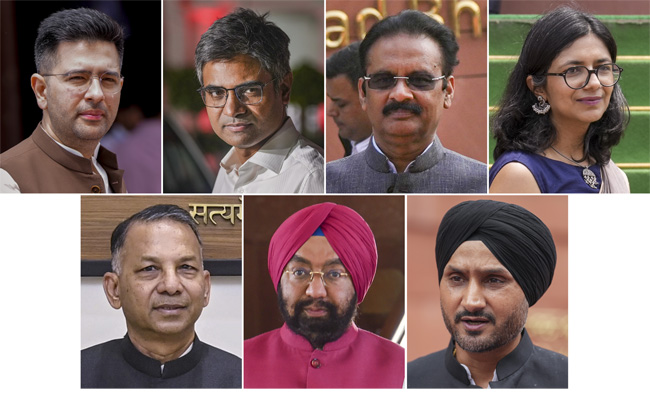
New Delhi (PTI): With Seven MPs, including prominent faces such as Raghav Chadha, Sandeep Pathak, Ashok Mittal, Harbhajan Singh and Swati Maliwal, quitting the AAP on Friday, the party has not only lost numerical strength in Parliament but its preparedness for upcoming elections has also been hampered.
The development comes against the backdrop of a turbulent phase for the Aam Aadmi Party (AAP) over the last two years, when several of its top leaders, including former Delhi chief minister Arvind Kejriwal and Manish Sisodia, were arrested in connection with the alleged excise-policy scam, leaving the party grappling with a leadership vacuum and testing its ability to function under pressure.
During that period, the party had sought to project resilience, with second-rung leaders, including Chadha, stepping in to keep both the government and organisation running.
Many among the seven MPs were seen as key pillars in shaping the AAP's outreach -- whether in policy articulation, organisational strategy, finances or public messaging -- making their collective departure more than a routine political shift and more of an organisational rupture.
Their move, meeting the two-thirds threshold under the anti-defection law, showcases both the scale and the severity of the split.
Chadha said on Friday that all seven MPs have merged with the BJP, asserting that the AAP has strayed from its principles, values and core morals. Besides Chadha, Pathak, Mittal, Singh and Maliwal, Rajinder Gupta and Vikram Sawhney have also quit the Kejriwal-led party.
For the AAP, the timing of the seven MPs' exit is particularly crucial. The party is gearing up for next year's electoral battles in Gujarat, Goa and Punjab, where it hopes to consolidate and expand its presence beyond Delhi, where it has formed the government thrice and enjoys a strong base.
AAP leaders have sought to project confidence, maintaining that the party’s grassroots connect and governance plank remain intact despite the departures.
On the ground, the party continues to hold power in Punjab and retains a presence in Delhi, along with a limited reach in Gujarat and Jammu and Kashmir.
In Parliament, however, its reduced strength in the Rajya Sabha -- down from 13 to six now -- could limit its ability to assert itself in legislative debates.
For a party that built its identity on the anti-corruption plank, a collective leadership and a steady stream of new faces rising through the ranks, the current departure revives an old pattern of prominent colleagues parting ways, including former IPS officer Kiran Bedi and poet Kumar Vishwas.
In 2015, former AAP spokesperson Shazia Ilmi quit the party and later, joined the BJP, followed by senior leader Kapil Mishra in 2017 after a bitter public fallout over allegations of corruption within the party. In 2018, founding member Ashish Khetan stepped away from active politics altogether, citing personal reasons. Each of these departures came at a time when the AAP was attempting to stabilise or expand.
With the Gujarat, Goa and Punjab polls on the horizon, the immediate challenge before the Kejriwal-led party is to steady its organisation, rebuild its leadership bench and reassure workers that the political project it launched more than 10 years ago remains intact.
For the AAP, after weathering the arrests of its top leaders and with the exit of influential parliamentarians now, the current situation may well determine whether it can sustain its expansion ambitions or will be forced to consolidate around its existing strongholds.