Johnson & Johnson’s $8.2 billion talc bankruptcy deal faces legal challenges in January trial

Johnson & Johnson’s attempt to resolve thousands of lawsuits over claims that its talc-based baby powder causes cancer now rests on a high-stakes trial set for January 2024. The case will determine whether the company’s $8.2 billion settlement plan, which J&J hopes will fast-track resolution through bankruptcy, will be approved by the court.
J&J has faced 15 years of litigation regarding allegations that its baby powder contained asbestos, causing ovarian cancer and other health issues—a claim the company denies. Despite previous failures to settle the claims through bankruptcy in New Jersey, J&J has now moved proceedings to Texas, hoping for a more favorable outcome.
While J&J announced that over 75% of claimants had voted in favor of the new deal, Andy Birchfield, an attorney representing a group of plaintiffs, has accused the company of manipulating the vote. He claims that EPIQ, the consulting firm managing the vote, allowed another attorney, Allen Smith, to improperly switch 11,434 votes from “no” to “yes.” Birchfield is demanding the votes be reversed, accusing J&J of rigging the bankruptcy process to minimize legitimate claims.
J&J’s Erik Haas, head of global litigation, defended the process, insisting the vote was conducted according to rules and reflected the claimants' desire for a quick resolution. Haas emphasized that the proposed settlement—one of the largest in mass tort history—offers fair compensation and will end years of litigation.
The controversy over the vote reflects deeper tensions between plaintiffs' attorneys. Smith, who once partnered with Birchfield on these cases, switched his clients' votes to favor the deal, citing the need to end protracted litigation. Smith, under financial pressure due to $240 million in litigation debt, argued that the revised offer provided fair compensation for clients. Birchfield, however, accused Smith of betraying former clients for financial gain and filed a lawsuit against him.
The outcome of these legal battles will shape whether EPIQ remains responsible for overseeing the bankruptcy claims process, which could yield millions in fees.
J&J is betting on the enhanced settlement and bankruptcy process to handle over 60,000 claims, arguing that it’s the only way to avoid decades of costly litigation. If approved, the bankruptcy would bind all plaintiffs, including those who opposed the deal, and establish a trust to handle future cancer claims.
However, critics warn that moving the case to Texas—considered more business-friendly—raises concerns about fairness. Judge Christopher Lopez will need to decide whether the contested votes were valid and whether the bankruptcy should proceed in Texas, especially after two previous bankruptcy attempts were blocked in New Jersey. Lopez has also halted all talc trials while the bankruptcy plan is under review.
If the bankruptcy plan succeeds, it would settle most current talc-related lawsuits and limit J&J's liability for future claims. However, an appeal is expected, potentially delaying final resolution. Larry Biegelsen, an analyst at Wells Fargo, noted that year-end resolution is possible if the court approves the deal, though the process will likely remain contested.
Let the Truth be known. If you read VB and like VB, please be a VB Supporter and Help us deliver the Truth to one and all.
Unreserved vacancies for candidates with disabilities open for all categories: SC
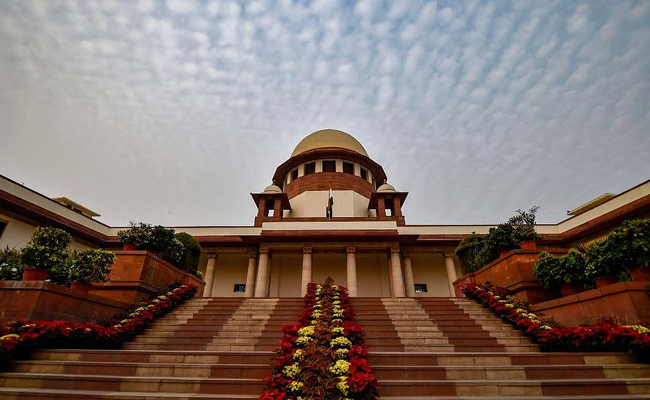
New Delhi (PTI): The Supreme Court on Tuesday said "unreserved" vacancies for Persons with Disabilities (PWD) are an open pool where merit remains the decisive factor and that eligible candidates belonging to any social or special category can be employed.
A bench of Justices Sanjay Karol and N Kotiswar Singh set aside a judgement of the Calcutta High Court, saying the "unreserved" category is not a separate "social category" but an open field for all.
It held that a more meritorious PWD candidate belonging to a reserved category like OBC, SC, or ST cannot be barred from an unreserved PWD post simply because a candidate from the "General" category is also available.
"In reservation law, it is well settled that the Unreserved/Open category does not refer to any social/communal category like SCs, STs or OBC. In other words, any post falling under the Unreserved or Open category does not pertain to any particular social category, it provides an open field or pool meant for the world at large, in the sense that it is open to all candidates, irrespective of whether one belongs to any social or special category or not," Justice Singh, who authored the verdict, said.
The court said if an unreserved or open post is meant for the special category of Persons with Disabilities, it means that the said post will be open to all candidates of all vertical social categories, whether Scheduled Castes (SCs), Scheduled Tribes (STs) or Other Backward Classes (OBC), provided such candidates are also PWD.
"Thus, all candidates, whether SC, ST or OBC, but who are Persons with Disabilities, are equally entitled to compete for the post meant for Persons with Disabilities falling under the Unreserved category, the rationale being that all those who are similarly situated must be treated equally," it said.
The case arose from a recruitment drive of the West Bengal State Electricity Transmission Company Limited (WBSETCL) for the post of Junior Engineer (Civil) Grade-II.
The notification included one post specifically earmarked for Unreserved (Persons with Disabilities -- Low Vision).
The controversy involved two candidates, an unreserved category candidate with low vision who scored 55.667 marks and an OBC candidate, also with low vision, who scored 66.667 marks.
The WBSETCL appointed the OBC candidate to the post based on his higher merit.
This was challenged by the general category candidate who said since he was a "qualified unreserved candidate", the vacancy should have gone to him and that reserved category candidates should only be considered if no unreserved PWD candidate is available.
While a single-judge bench of the high court dismissed the plea, a division bench reversed that decision, directing the employer to appoint the less-meritorious unreserved candidate.
The WBSETCL had then appealed to the Supreme Court.