Maruti Suzuki announces 2-day shutdown of Gurugram, Manesar plants
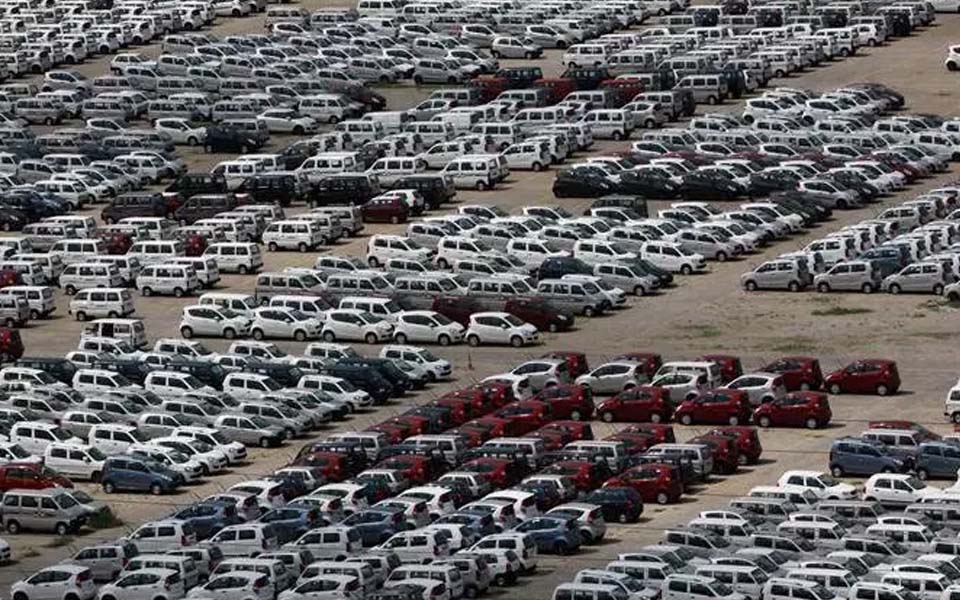
New Delhi: India's biggest carmaker Maruti Suzuki today announced no-production days at Gurugram and Manesar plants on 7th September and 9th September 2019.
In a statement to stock exchanges, Maruti Suzuki India said it has decided to shut down the passenger vehicle manufacturing operations of Gurugram and Manesar plants in Haryana for two days, on 7th and 9th September, 2019. Both days will be observed as no production days.
Maruti Suzuki shares were trading 3.5% lower at ₹5,843 apiece as compared to a 0.50% gain in benchmark index Sensex.
Many automakers in Indian have been cutting production as passenger vehicles sales are set to fall for a tenth consecutive month in August. Maruti Suzuki India had cut its production by one-third in August, making it the seventh straight month that the country's largest car maker reduced its output.
The government had in August announced a slew of measures to prop up the automobile sector but industry experts have termed them inadequate.
The auto industry has sought immediate steps from the government, including reduction in GST rates and initiation of scrappage policy, as sales continued to plummet.
Maruti Suzuki India on Sunday reported a nearly one-third decline in sales at 1,06,413 units in August. The company had sold 1,58,189 units in August last year. Domestic sales declined by 34.3 per cent at 97,061 units last month as against 1,47,700 units in August 2018. Sales of mini cars comprising Alto and WagonR stood at 10,123 units as compared to 35,895 units in the same month last year, down 71.8 per cent.
Sales of compact segment, including models such as Swift, Celerio, Ignis, Baleno and Dzire, fell 23.9 per cent at 54,274 units as against 71,364 cars in August last year.
Mid-sized sedan Ciaz sold 1,596 units as compared to 7,002 units earlier.
However, sales of utility vehicles, including Vitara Brezza, S-Cross and Ertiga, rose 3.1% at 18,522 units as compared to 17,971 in the year-ago month, MSI said.
Exports in August were also down by 10.8% at 9,352 units as against 10,489 units in the corresponding month last year, the company said.
Courtesy: www.livemint.com
Let the Truth be known. If you read VB and like VB, please be a VB Supporter and Help us deliver the Truth to one and all.
Man arrested with Rs 2.54-crore heroin in Mumbai

Mumbai (PTI): Police have arrested a man and seized over 500 grams of heroin worth Rs 2.54 crore in the illicit market from him in Mumbai, officials said on Friday.
The police's Anti-Narcotics Cell (ANC) made the drug seizure in Santacruz in the western suburbs. The operation was conducted by the Kandivali unit of the ANC on Thursday as part of a special crackdown against drug trafficking in the area, they said.
Acting on specific inputs, an ANC team conducted a raid in Santacruz (East) and intercepted a man. During a search, the team recovered 508 grams of high-grade heroin from his possession, an official said.
The seized contraband, a highly addictive, opioid drug derived from morphine, is estimated to be worth Rs 2.54 crore in the international market, he informed.
Following the seizure, a case was registered against the man under relevant sections of the Narcotic Drugs and Psychotropic Substances (NDPS) Act, 1985, and he was formally placed under arrest in the early hours of Friday.
The police are currently investigating the source of the drug and trying to identify the intended recipients of the consignment, he said.