Microsoft deepening its commitment to India's AI ecosystem, says Satya Nadella
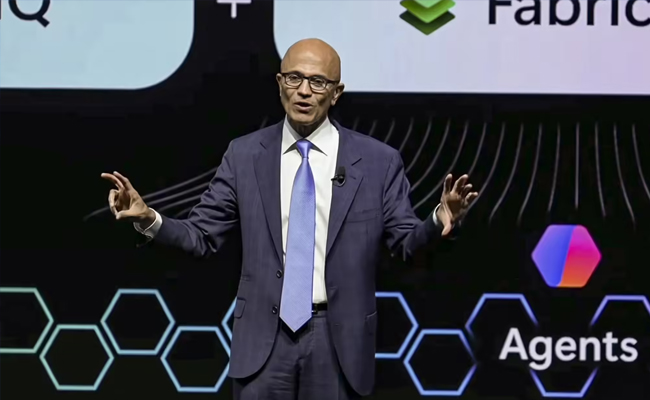
Bengaluru (PTI): Microsoft Chairman and CEO Satya Nadella on Thursday said the company is deepening its commitment to India's artificial intelligence ecosystem with massive infrastructure investments.
Microsoft is also strengthening its cloud footprint and focusing on skilling millions of Indians for an AI-driven future, he said.
Speaking at a Microsoft event here, Nadella said, "We are very excited about investing in India to make sure that we're able to bring the best in class infrastructure here, the USD 17.5 billion investment," calling it Microsoft's largest investment in Asia.
The Microsoft Chairman underlined the rapid expansion of the company's cloud footprint across the country.
"We're building on Azure as the world's computer and we have 70 plus data centre regions all over the world. In India, the footprint continues to grow. We now have central India, West India, South India, and we have a partnership with Jio as well," he said.
He further said that a new data centre region would become operational in 2026.
"We are very excited that in 2026, we will have a new DC in south central and then the most exciting part for me is that it's 100 per cent sustainable," he said.
Nadella also emphasised the importance of digital sovereignty and cybersecurity in an era of expanding AI deployment.
"We are taking sovereignty and making sure that there's a portfolio of options for sovereignty. So you have the public cloud, you have sovereign controls in public cloud..." he noted.
He warned that sovereignty cannot be viewed in isolation from security.
"Cyber security is a signals game--you can be sovereign and not have global intelligence--you'll be vulnerable in fact," he said, noting that Microsoft processes "trillions of daily signals" to secure platforms from Azure to Windows.
Nadella said he recently met Prime Minister Narendra Modi, who was very encouraging of this investment (USD 17.5 billion), in particular, to drive society, the economy and growth.
This commitment, he noted, comes on top of the USD three billion investment he had announced during his last visit.
On India's talent landscape, Nadella said the company will double down on its skilling programmes.
"We are now going to skill 20 million people across India in AI skills," he said, adding that initiatives such as the government's E-Shram programme demonstrate how AI can uplift unorganised workers.
He also highlighted India's growing influence in the global developer ecosystem.
"India is slated to become the number one community in the world with GitHub by 2030," he said, praising the "engagement and the type of projects that are coming out of this place, the contributions from India."
GitHub is a web-based platform for version control and collaboration that is primarily used by developers to store, manage, and share software code. It is built on top of Git, an open-source version control system, and provides a user-friendly graphical interface and a large suite of collaboration tools.
Nadella closed his speech by reiterating Microsoft's mission. "At the end of the day, this is all about empowering every person and every organisation in India to be able to achieve more. Let's keep building."
Let the Truth be known. If you read VB and like VB, please be a VB Supporter and Help us deliver the Truth to one and all.
Bengaluru airport introduces AI-based system to enhance safety at vehicle-aircraft intersections
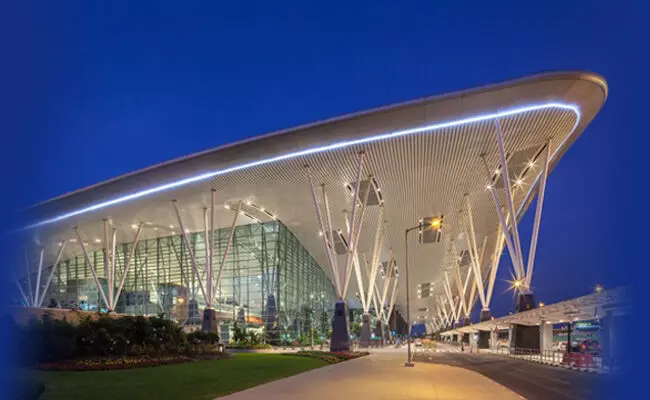
Bengaluru: Bangalore International Airport Limited (BIAL) has introduced an integrated smart airside safety system at Kempegowda International Airport to improve operational safety at key intersection zones.
According to The Hindu, the system has been designed to enhance safety at Cross Service Roads (CSRs), where aircraft and ground vehicle movements intersect.
According to BIAL, the system integrates AI-based computer vision, automation, and centralised monitoring to manage right-of-way movements and reduce the risk of human error.
“CRSs are among the most sensitive areas within airport operations, requiring precise and seamless coordination between aircraft and ground vehicles. Traditionally, right of way protection at these intersections relied on manual or semi-manual inset light activation, creating dependencies on human intervention, increasing the risk of delays and limiting operational visibility,” TH quoted BIAL as saying.
The new system uses real-time detection of vehicle movement, risk assessment, and automated signalling. AI-enabled cameras identify potential conflicts and trigger automated inset light signals to ensure aircraft priority. Normal operations resume once the area is confirmed clear.
“Based on these detections, the system triggers automated inset light activation to protect aircraft right‑of‑way and restores normal signalling once the intersection is confirmed clear. A centralised monitoring and analytics platform digitally logs all events, strengthening governance, compliance, and operational control,” BIAL said.
By embedding technology into operations, the system creates a data-driven separation layer between aircraft and ground vehicles, significantly reducing human error, especially during night and low-visibility conditions.
“Precision-led signal activation improves traffic flow, minimises unnecessary stoppage and enhances turnaround efficiency. It also establishes a scalable foundation for predictive safety analytics, enabling trend analysis, peak-hour optimisation, compliance mapping and risk forecasting to support continuous improvement and stronger airside governance,” BIAL said.