New Delhi, April 18: The top four Indian cities are today 149 per cent more congested than comparable cities in Asia and the country is losing over $22 billion a year in peak traffic hours compared to travel time during non-peak hours in those cities, an Uber-commissioned study revealed on Wednesday.
On average, commuters in Delhi, Mumbai, Bengaluru and Kolkata are taking 1.5 times longer to travel a given distance and ridesharing or shared mobility is the only solution to get rid of the traffic menace, said the study titled "Unlocking Cities: The impact of ridesharing across India" by the Boston Consulting Group (BCG).
"We continue to be at the forefront when it comes to unlocking the true potential of ridesharing for India. Through this study, we are hoping to draw the attention of administrators and urban planners on how shared cars and mobility can be part of the solution vs individual car ownership," Amit Jain, President, Uber India and South Asia, told reporters here.
According to the BCG survey, up to 89 per cent of people plan to buy a new car in the next five years.
However, over 79 per cent would refrain from buying a car if ridesharing matches car ownership for affordability and convenience, it added.
The study was launched in the presence of Uber's Global COO Barney Harford, Suresh Subudhi, Partner, BCG and Ann Lavin, Senior Director, Public Policy and Government Relations, Uber APAC.
"If car ownership trends continue, Indian cities risk coming to a complete standstill in only a few years," said Harford.
"Ridesharing can be part of the solution to traffic congestion because it uses technology to get more people into fewer cars. We can unlock our cities and their full potential, but we have to do it together," he added.
In these circumstances, ridesharing would reduce private cars by 33-68 per cent.
By reducing private cars, increasing vehicle utilisation, improving public transport adoption, and optimising infrastructure planning, ridesharing could reduce congestion by 17-31 per cent, the findings showed.
"In the coming months, we will introduce several India-first innovations that will help bring the benefits of ridesharing to many more Indians and enable us to work with the government towards a common goal: reduce private car ownership and expand access to public transit systems," Jain noted.
Overall, travel by public transport accounts for 19 per cent and 54 per cent of kms travelled in Delhi and Mumbai, respectively.
On average, 25 per cent of the private car owners surveyed in Delhi and Mumbai expressed a keen interest in becoming rideshare drivers.
"On-demand ride sharing is a practical way to reduce the number of private vehicles on the road and reduce congestion. It is important to encourage this proactively," said Suresh Subudhi, Global Sector Head -- Infrastructure and Transport, BCG.
Let the Truth be known. If you read VB and like VB, please be a VB Supporter and Help us deliver the Truth to one and all.
Allahabad HC orders probe into 'reinstatement' of teacher in UP's Barabanki
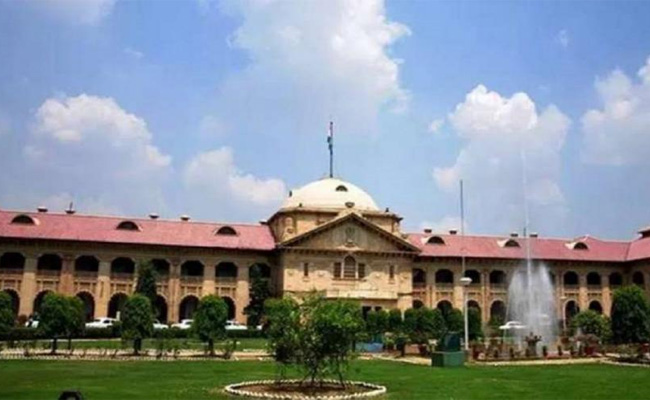
Lucknow (PTI): The Lucknow Bench of the Allahabad High Court on Friday ordered a probe by the special task force (STF) into alleged irregularities in the rejoining of a teacher at City Intermediate College in Barabanki, observing that the reinstatement appeared to be prima facie illegal.
The court also directed the recovery of the salary paid to the teacher during the disputed period.
A bench of Justice Rajeev Singh passed the order on a petition filed by the college management committee. The court expressed doubts over the roles of the District Inspector of Schools (DIOS), Barabanki, the college principal and the teacher concerned and hence, directed a detailed inquiry into the matter.
Taking note of alleged manipulation of records and misleading submissions, the court ordered the immediate transfer of the Barabanki DIOS to ensure a fair probe. It also directed the initiation of disciplinary proceedings against the then joint director of education of the Ayodhya division.
In its order, the court found that the teacher, Abhay Kumar, was initially appointed as an assistant teacher in 2018 but joined an Eklavya Model Residential School in Chhattisgarh as a lecturer in June 2024 without obtaining permission from the management. His subsequent request to retain the lien was rejected.
Despite this, he was allowed to rejoin the Barabanki College in September 2025 on the directions of the joint director of education and the DIOS, and was even paid the salary for October 2025. The court termed the rejoining "wholly illegal" and lacking any legal basis.
The bench also expressed concern over lapses in communication within the education department and directed the Uttar Pradesh chief secretary to ensure that official orders are communicated through email and WhatsApp as well, to prevent disputes.
The matter is next listed for hearing on May 28 when a compliance report is sought.