Research is only path to a better India and world, says Infosys co-founder Narayana Murthy
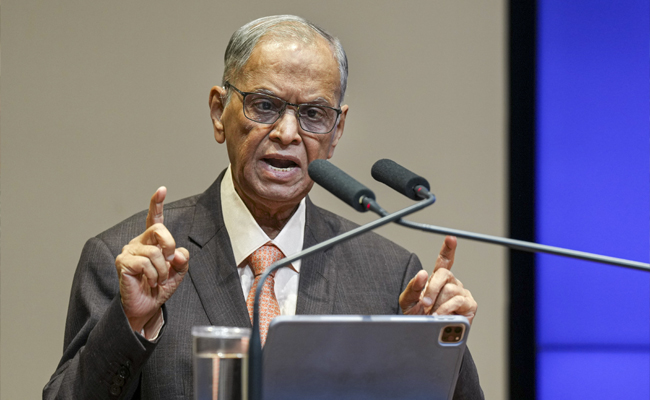
Bengaluru (PTI): IT industry veteran N R Narayana Murthy on Wednesday emphasised the need to strengthen India's national and institutional focus on research, saying it is the only path to make the country and the world a better place.
He called on India to create an aspirational, meritocratic and competitive research ecosystem that offers a rewarding environment for scientists, engineers, economists, mathematicians and humanists.
Speaking at the announcement of the Infosys Prize 2025 here, Murthy quoted Roman emperor Marcus Aurelius, and said research represents “the broadening of the mind” that leads to unravelling the mysteries of nature, seeing what others have not yet seen, and finding plausibly impossible solutions to the problems faced by humankind.
“The need of the day for our country is to strengthen our national and institutional focus on research for a better India and for a better world,” he said.
Murthy cited former US President Franklin D Roosevelt’s letter to Dr Vannevar Bush, head of the Office of Scientific Research and Development under his administration, saying it led to a monumental report titled "Science — The Endless Frontier" and to the formation of the National Science Foundation in the US.
He further said the report paved the way for America’s leadership in scientific and engineering research productivity, its space explorations, uninterrupted research funding, and the success of its universities, laboratories and corporations — making the US a superpower.
Quoting a range of thinkers from Jawaharlal Nehru to Richard Feynman, Alan Turing, Thomas Alva Edison and Jennifer Doudna, Murthy said curiosity, imagination and persistence form the bedrock of scientific discovery.
"Research in universities, laboratories, libraries and companies is born from such curiosity, imagination, Socratic questioning, daring and humility. Research effort needs audacity, daring, unbridled imagination and the ability not to be cowed down by failures,” he said.
He emphasised that research is also about not feeling defeated by failures, learning from them, avoiding mistakes in the future and improving continuously.
Murthy recalled that the much-respected economist-philosopher Dr Amartya Sen believed that development is freedom and conducted extensive research on how these two ideas are linked.
“Research in economics and social sciences guides us to understand how science and technology translate into prosperity, justice, equity, freedom and dignity. Research in the humanities reminds us that knowledge must always serve an ethical purpose.”
According to him, the voices of Franklin Roosevelt and Vannevar Bush, Jawaharlal Nehru and Richard Feynman, Alan Turing and Thomas Edison, Joseph Fourier and Manjul Bhargava, Milton Friedman and Amartya Sen and Charles Darwin and Jennifer Doudna underline a common theme — that research is humanity’s noblest collective enterprise.
“It demands courage, persistence and imagination. It bridges science and society, reason and values, and ethics and dignity,” he said.
Murthy said India must recommit itself to nurturing research ecosystems. “Such nurturing requires us to make this country an aspirational, meritocratic, competitive, welcoming, exciting, comfortable, rewarding and enjoyable place for researchers and their families — among our young scientists, engineers, economists, mathematicians and humanists," he said.
"It is our sacred duty to ensure that these role models find a highly competitive intellectual environment that reveres a hierarchy of ideas rather than a hierarchy of titles and offices."
Murthy observed that creating such an ecosystem for research is an unfailing national duty, as research is the only means to make India and the world better places.
“This is the only way we can fulfil the dreams of our founding fathers, who sacrificed their lives to create an India where the poorest child in the remotest village would have access to nutrition, healthcare, shelter, education and an opportunity to lead a fulfilling life. That responsibility of fulfilling their dreams lies on the broad, daring, imaginative and caring shoulders of the Infosys Prize laureates of 2025,” he added.
Let the Truth be known. If you read VB and like VB, please be a VB Supporter and Help us deliver the Truth to one and all.
Sujit Nair raises concerns over speculation of DMK-AIADMK understanding to block TVK
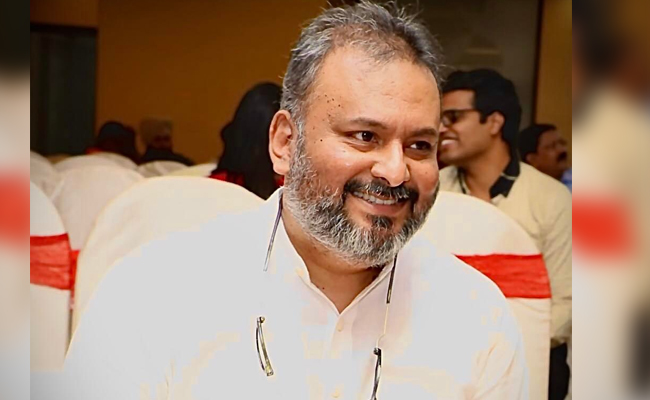
Chennai: Journalist and political commentator Sujit Nair has expressed concern over speculation that the Dravida Munnetra Kazhagam and the All India Anna Dravida Munnetra Kazhagam could explore a post-poll understanding to prevent Vijay-led Tamilaga Vettri Kazhagam from forming the government in Tamil Nadu.
In a social media post, Sujit Nair said the election verdict in Tamil Nadu reflected a clear public demand for political change and argued that the mandate should be respected irrespective of political preferences.
Referring to reports and political discussions surrounding a possible understanding between the DMK and AIADMK, he said he hoped such developments remained only speculative conversations and did not turn into reality.
Nair stated that if such an alliance were to take shape, it would raise serious questions about ideological politics in the country. He said TVK had emerged through a democratic electoral process and that the legitimacy to govern in a parliamentary democracy comes from the people’s verdict.
According to him, attempts to prevent an electoral winner from forming the government through unexpected political arrangements may be constitutionally valid, but many people could view them as politically opportunistic.
He further said that such a move could particularly affect the political image of the DMK, which has historically projected itself around ideology, social justice and opposition politics. Nair said that in ideological terms, the DMK appeared closer to TVK than to the AIADMK, and joining hands with its long-time political rival only to remain in power could weaken its broader political narrative.
He added that the same questions would apply to the AIADMK as well, as the party had spent decades positioning itself against the DMK and such an arrangement could create discomfort among its cadre and supporters.
Drawing a comparison with Maharashtra politics in 2019, Nair said he had expressed similar views when the Shiv Sena formed an alliance with the Indian National Congress and the Nationalist Congress Party after the Assembly elections.
He said post-poll alliances between long-standing political rivals often create a public perception that ideology and electoral mandates become secondary when political power equations come into play.
Nair also said such developments increase public cynicism towards politics and reinforce the belief among voters that ideology is often sidelined after elections.
He maintained that the Tamil Nadu verdict was emphatic and said respecting both the spirit and substance of the mandate was important for the credibility of democratic politics.