Rupee ends flat at 74.41 on a spike in crude oil prices, dollar buying
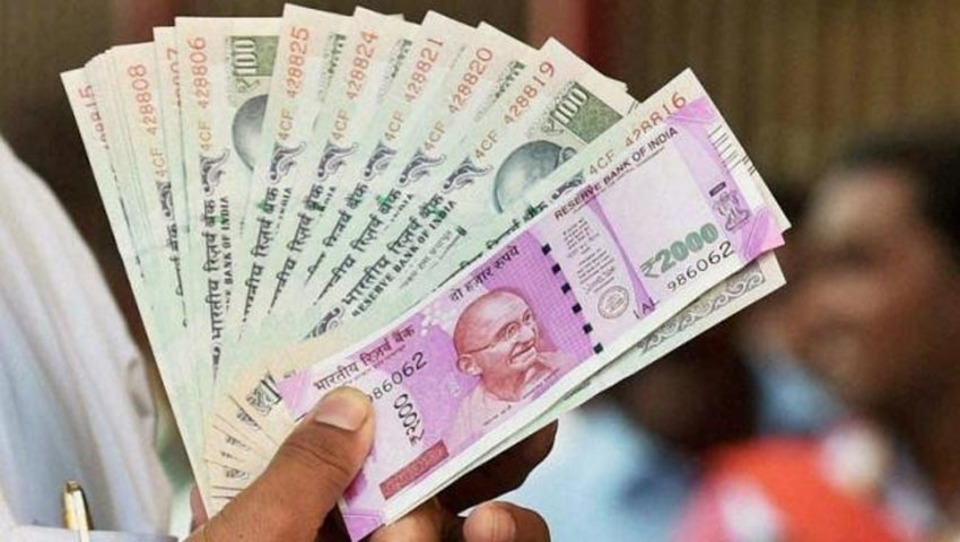
Mumbai: The rupee pared its early gains to close almost flat at 74.41 on Tuesday due to dollar buying by banks and resurging crude oil prices.
The rupee opened sharply higher at 74.34 amid heavy buying in local stock markets and raced to hit the day's high of 74.25.
The local unit, however, struggled in the latter half and gave up initial gains to finally settle at 74.41, showing a gain of just 1 paisa over the previous close.
Meanwhile, the dollar index, which gauges the greenback's strength against a basket of six currencies, fell 0.42 percent to 93.75.
On the domestic equity market front, BSE benchmark Sensex rallied 503.55 points or 1.27 percent to close at 40,261.13. The broader NSE Nifty jumped 144.35 points or 1.24 percent to 11,813.50.
Foreign institutional investors emerged as net buyers in the capital market as they purchased shares worth Rs 740.61 crore on Monday, according to provisional exchange data.
Brent crude futures, the global oil benchmark, rose 1.72 percent to USD 39.64 per barrel.
"Rupee consolidated in a narrow range for the second successive session ahead of the important US Presidential election results. The expectation is that the announcement of the result could take some time but we could get some bit of clarity by this weekend.
"Market participants are also cautious ahead of the FOMC policy statement that will be released later this week. For the week, we expect the rupee to trade with a negative bias and quote in the range of 74.20 and 75.20," Gaurang Somaiyaa, Forex & Bullion Analyst, Motilal Oswal Financial Services, said.
Alankit Limited Managing Director Ankit Agarwal said that the rupee may garner support from an upswing in domestic equities on the back of upbeat economic data from China, Europe, and the US.
It is expected that exporters may sell the greenback at attractive higher dollar/rupee levels, which may further support the rupee, dealers stated.
Traders are expected to refrain from placing large bets on the movement of Indian currency in either direction amid global unprecedented situations. The US will hold its presidential election later today, wherein Democratic nominee Joe Biden is seen taking a significant lead over incumbent President Donald Trump, Agarwal said.
Key economic data from across the world soothed frayed nerves about economic recovery at a time when Europe is struggling with the second wave of accelerating COVID-19 infections, he added.
"Rupee ended higher on back of strong inflows in the capital market mainly banking and financial sector. Also, the dollar index kept trading muted on the back of awaiting the outcome of US Elections which can decide a possible trend for the Dollar index.
"Crude prices saw a rise after a strong decline it has witnessed in recent past few days which kept the rupee rise at check. For the next couple of sessions, rupee can be in a very volatile range of 73.75 - 75.25 range," Jateen Trivedi, Senior Research Analyst (Commodity & Currency) at LKP Securities said.
Global markets approach the US election day in an upbeat mood as risk assets remained strong as the Dollar sold off against major trading currencies, Devarsh Vakil, Deputy Head Retail Research, HDFC Securities said.
"The bias for the spot USD/INR is bullish but it has risen to a level where we feel it will encounter strong resistance. Near term, the pair has resistance at 75.1 and support at 73.9," he added.
Let the Truth be known. If you read VB and like VB, please be a VB Supporter and Help us deliver the Truth to one and all.
Chhattisgarh govt enforces austerity measures, restricts foreign travel and cuts convoy vehicles
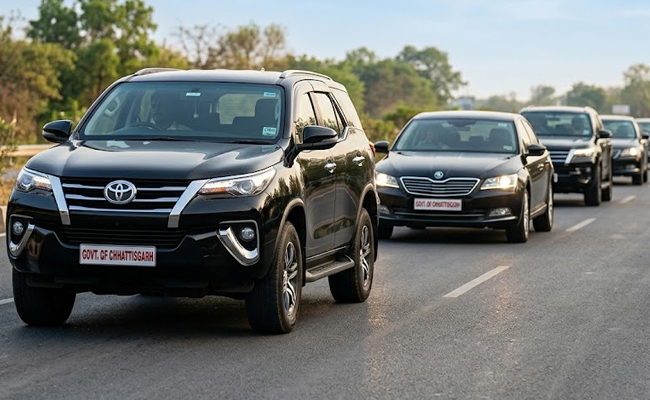
Raipur (PTI): The Chhattisgarh government on Saturday rolled out a set of austerity measures, including restricted use of convoy vehicles for the chief minister, ministers and heads of state-run bodies, besides curbs on foreign travel at government expense.
The state has decided to implement the cost-saving steps with immediate effect to ensure efficient management of financial resources and discipline in public spending, said a directive issued by Finance Secretary Rohit Yadav.
The move follows Prime Minister Narendra Modi’s appeal for austerity amid the ongoing conflict in West Asia.
The order said that only essential vehicles should be used in the convoys of the CM, ministers and office-bearers of corporations, boards and commissions, while ensuring restrained use of other government resources.
It also directed departments to take steps for a phased conversion of all official vehicles into electric vehicles in order to promote the use of EVs.
As part of fuel-saving measures, expenditure on petrol and diesel for government vehicles should be kept to a minimum, the directive said.
Vehicle pooling arrangements should also be implemented for officials of departments travelling to the same destination, it added.
The order further stated that foreign travel of government employees at state expenses will be completely prohibited except under extremely unavoidable circumstances. In such cases, prior approval of the CM will be mandatory.
To reduce administrative expenditure, departments have been instructed to hold physical meetings preferably only once a month and encourage virtual and online meetings. Regular departmental review meetings should compulsorily be conducted through video conferencing, it said.
The government also stressed the need for energy conservation in its offices, directing that all electrical equipment, including lights, fans, air-conditioners and computers, must be switched off after office hours.
The directive will remain effective till September 30 this year.
Amid the war involving the US, Israel and Iran, Modi has suggested reducing petrol and diesel consumption, using metro rail services in cities, carpooling, increased use of EVs, utilising railway services for parcel movement and working from home to conserve foreign exchange.