Rupee falls 10 paise to 90.15 against US dollar in early trade

Mumbai (PTI): The rupee depreciated 10 paise to 90.15 against the US dollar in early trade on Tuesday, as dollar demand from corporates, importers and foreign portfolio investors dented investors' sentiments.
Forex traders said investors are in a wait and watch mode and market participants are waiting for clarity from the US FED before taking decisive positions.
At the interbank foreign exchange, the rupee opened at 90.15 against the US dollar, down 10 paise from its previous close.
On Monday, the rupee settled at 90.05 against the US dollar. Market is focussed on the stance the US Federal Reserve Chief chairman Jerome Powell will deliver in the US FED meeting this week.
"Any shift in tone could quickly change the direction for global currencies," CR Forex Advisors MD Amit Pabari said.
"With the dollar turning softer—driven by rising expectations of a Fed rate cut—and the RBI actively managing liquidity and hope of a trade deal, the rupee now looks set to settle into a period of consolidation within a broad 89.20–90.30 range," Pabari added.
Meanwhile, the dollar index, which gauges the greenback's strength against a basket of six currencies, was trading 0.04 per cent lower at 99.04 Brent crude, the global oil benchmark, was trading lower by 0.19 per cent at USD 62.37 per barrel in futures trade.
"A combination of softer local equities, tepid Asia FX and pre-FED caution, higher US yields are weighing over rupee even as the dollar index holds itself near 99 levels.
"FPI equity outflows continue while uncertainty around US-India trade talks beginning on Wednesday are keeping the US dollar well bid while RBIs presence keep rupee well entrenched into a small range," said Anil Kumar Bhansali Head of Treasury and Executive Director Finrex Treasury Advisors LLP.
India and the United States will commence three-day talks on the first phase of their proposed bilateral trade agreement here from December 10.
On the domestic equity market front, the benchmark sensitive index Sensex was trading lower by 381.91 points at 84,720.78, while the Nifty was down 139.55 points at 25,821.00.
Foreign Institutional Investors sold equities worth Rs 655.59 crore on Monday, according to exchange data.
Let the Truth be known. If you read VB and like VB, please be a VB Supporter and Help us deliver the Truth to one and all.
Samson's unbeaten 87 powers CSK to eight-wicket win over DC
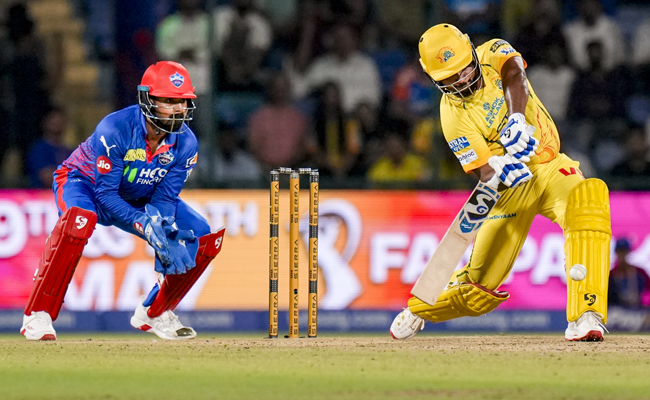
New Delhi (PTI): Sanju Samson bossed the chase with authority, anchoring a modest 156-run target with a fluent 87 not out as Chennai Super Kings outclassed Delhi Capitals by eight wickets in the IPL here on Tuesday.
Samson's knock came off just 52 balls with seven fours and six sixes, batting through the innings as CSK completed the chase in just 17.3 overs giving a huge boost to their net run-rate.
Electing to bat on a tricky surface, Delhi Capitals were restricted to 155/7.
West Indies left-arm spinner Akeal Hosein set the tone with the new ball, returning tidy figures of 1/19, including 14 dot balls.
Reduced to 69/5 in 11 overs, Delhi found some late impetus through Tristan Stubbs (38; 31 balls) and Sameer Rizvi (40 not out; 24 balls), who stitched together a crucial 65-run (off 47 balls) stand to give the innings a respectable total.
Brief Scores:
Delhi Capitals: 155 for 7 in 20 overs (Tristan Stubbs 38, Sameer Rizvi 40 not out; Noor Ahmed 2/22)
Chennai Super Kings 159 for two in 17.3 overs (Sanju Samson 87 not out, Kartik Sharma 41 not out). CSK win by eight wickets.