Rupee recoups day's losses, ends 13 paisa higher against USD
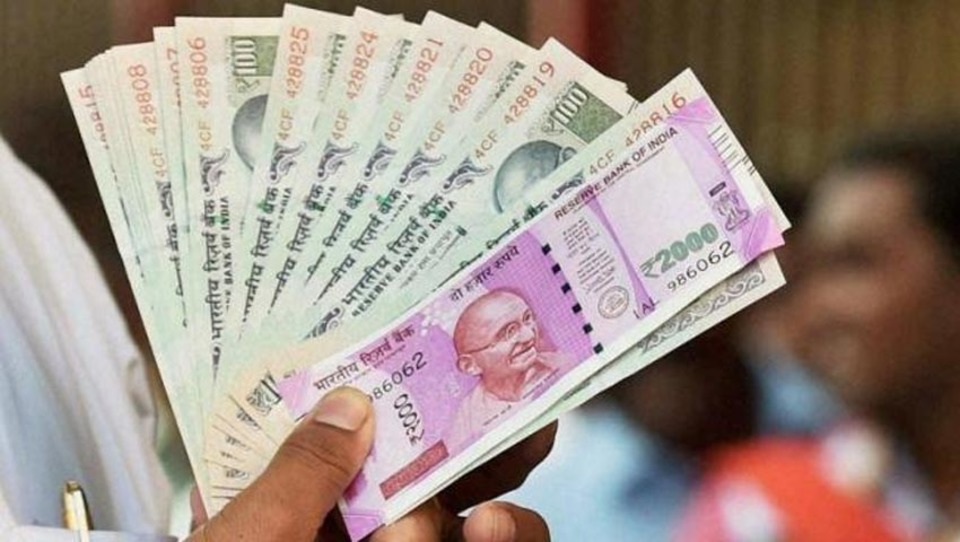
Mumbai: The rupee staged a rebound from the day's lowest level to settle 13 paise higher at 73.71 against the US dollar on Tuesday, buoyed by upbeat domestic equities and greenback selling by exporters.
At the interbank forex market, the domestic unit opened on a weak note at 73.94 against the greenback but soon staged a smart recovery.
During the session, the domestic unit witnessed an intra-day high of 73.71 and a low of 73.94 against the greenback.
It finally closed at 73.71, registering a gain of 13 paise over its previous close of 73.84 against the US currency.
The dollar index, which gauges the greenback's strength against a basket of six currencies, rose 0.07 percent to 93.11.
On the equity market front, the BSE Sensex ended 376.60 points or 0.94 percent higher at 40,522.10; and the NSE Nifty was 121.65 points or 1.03 percent up at 11,889.40.
"The Indian rupee appreciated against the US dollar on Tuesday supported by strong local shares and persistent greenback sales by exporters. Hopes of higher foreign inflows also aided the local unit," said Sriram Iyer,
Senior Research Analyst at Reliance Securities. Moreover, Asian currencies were broadly stronger against the US Dollar and lent support to the local unit, Iyer added.
Foreign institutional investors were net sellers in the capital market as they offloaded shares worth Rs 3,514.89 crore on a net basis on Tuesday, according to exchange data.
Brent crude futures, the global oil benchmark, increased 0.52 percent to USD 40.67 per barrel.
Let the Truth be known. If you read VB and like VB, please be a VB Supporter and Help us deliver the Truth to one and all.
Climate Change crisis: IMD to change parameters to declare heatwaves
Thiruvananthapuram (PTI): The IMD, along with its technical partners, will soon revise the criteria for declaring heatwave conditions in the country, as the present parameters do not suit India’s geographical conditions, according to official sources here.
Kerala, in particular, has faced difficulties in issuing heatwave warnings because of the limitations of the existing parameters.
Sources in the India Meteorological Department said the state experienced severe heat and humidity this summer and, for the first time, weather forecasts were made based on the anti-cyclone system that formed near the Karnataka–Maharashtra coast.
"We have never had an anti-cyclone system form closer to the South before, and this time we had to predict the weather based on it," a senior IMD official told PTI.
Anti-cyclonic systems are common over north-western parts of India, but this year one formed near the southern region, leading to unusually hot nights.
The anti-cyclone caused downward air movement, which pushed warm air towards the surface and prevented it from dispersing at night, the official added. As a result, Kerala recorded night temperatures 3 to 4 degrees Celsius above normal.
Because Kerala has experienced a steady temperature increase during the summer months for the last few years, changing the parameters for declaring heat waves would benefit the state, enabling the authorities to issue warnings more efficiently, the official added.
The IMD currently issues hot and humid weather warnings, although the situation warrants a heatwave warning, as the existing parameters do not allow the department to issue one.
At present, the IMD issues a heat wave warning in coastal areas when the maximum temperature reaches 37 degree Celsius or more with a temperature departure of 4.5 degree Celsius over the recorded maximum temperature.
For plains, the threshold is 40 degrees Celsius with a departure of 4.5 degrees Celsius or more from normal, while for hilly regions it is 30 degrees Celsius with a departure of 4.5 degrees Celsius or more.
Officials said the current heatwave declaration parameters also require these conditions to be recorded at two stations in the state to issue the warnings.
"In Kerala, we hardly get to record these conditions in two areas; moreover, we have severe heat stress that can easily cause a heat stroke. So we have decided to rework the heatwave declaration parameters and the changes will be implemented shortly. There will be a consultation with the Disaster Management Authority also before finalising the parameters," the official said.
Throughout Kerala, temperatures recorded this summer were three to four degrees Celsius higher than usual. The state also reported multiple cases of heatstroke despite regular warnings issued by the IMD and the state disaster management authority.
According to experts, Kerala has become a climate change hotspot, with a steady increase in atmospheric temperatures and erratic monsoons.
The IMD has also predicted a below-normal monsoon this year, as this is the first time two consecutive El Nino years are being witnessed.