Rupee recovers 10 paise from all-time low to 91.80 against US dollar in early trade
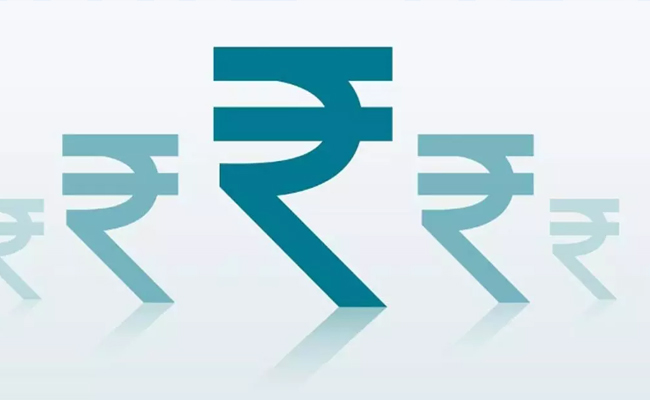
Mumbai (PTI): The rupee rebounded from its all-time low levels and gained 10 paise to trade at 91.80 against the US dollar in early deals on Tuesday, as the dollar index retreated from its elevated levels.
Forex traders said the rupee recovered marginally as traders rushed to cover broad dollar weakness.
At the interbank foreign exchange, the rupee opened at 91.80 against the greenback, up 10 paise from its previous close.
On Friday, the rupee hit a historic low of 92 per dollar and gained marginally to settle at 91.90 against the American currency.
Forex and equity markets were closed on Monday for Republic Day.
"The dollar index was down sharply to a four-month low of 96.80 amid pre-FOMC positioning as it has weakened 0.98 per cent over the past month," Anil Kumar Bhansali, Head of Treasury and Executive Director at Finrex Treasury Advisors LLP, said in a research note.
According to forex traders, the rupee remains under severe pressure from heightened global geopolitical uncertainties, weak domestic equities, persistent dollar demand, and unabated capital outflows.
The pending trade agreement with the US remains a key stabilising factor. Until the geopolitical risk eases and the trade deal materialises, the rupee is likely to remain vulnerable to external shocks, they said.
Meanwhile, US Treasury Secretary Scott Bessent has said there is a "path" to remove the 25 per cent tariffs imposed on India for buying Russian oil, noting that such purchases by Delhi from Moscow have "collapsed".
United States President Donald Trump has imposed 50 per cent tariffs on India, including 25 per cent for its purchases of Russian oil, leading to a strain in the bilateral ties between the two countries.
"Year ahead forecasts point to continued rupee weakness tied to FPIs' selling of equities and debt, weakness in Indian stock markets and RBI's oversold position. The only factor positive for the rupee is its undervaluation by about 5 per cent," Bhansali added.
Meanwhile, the dollar index, which measures the greenback's strength against a basket of six currencies, was trading 0.02 per cent lower at 97.01.
Brent crude, the global oil benchmark, was trading 1.26 per cent lower at USD 64.42 per barrel in futures trade.
On the domestic equity market front, Sensex dropped 417.68 points to 81,120.02 in early trade, while the Nifty declined 111.1 points to 24,937.55.
Foreign institutional investors offloaded equities worth Rs 4,113.38 crore on Friday, according to exchange data.
India's foreign exchange reserves jumped by USD 14.167 billion to USD 701.36 billion during the week ended January 16, the Reserve Bank said on Friday.
The overall reserves had increased by USD 392 million to USD 687.193 billion in the preceding week.
Let the Truth be known. If you read VB and like VB, please be a VB Supporter and Help us deliver the Truth to one and all.
Navy ensures security of Indian commercial ships, oil tankers: Defence Minister Rajnath Singh
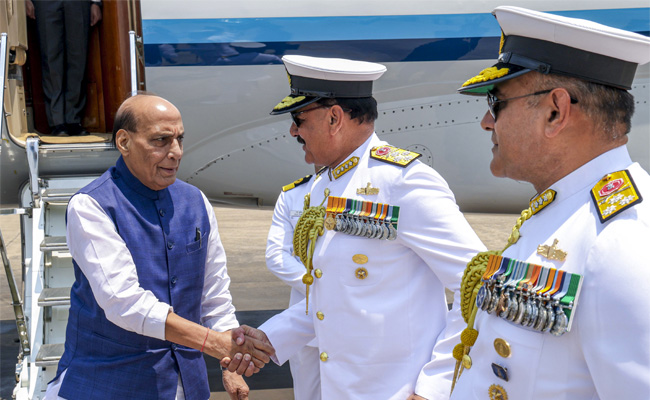
Visakhapatnam (PTI): Pointing out that 95 per cent of the country’s trade, including energy supplies, is conducted through sea, Defence Minister Rajnath Singh on Friday noted the Indian Navy's indispensable role in securing commercial shipping lanes and oil tankers against emerging maritime threats.
Speaking at the commissioning ceremony of INS Taragiri here, the Defence Minister said the Indian Navy continuously maintains its presence in the Indian Ocean--whether it is the Persian Gulf or the Malacca Strait.
Singh’s comments assume significance following the disruption of oil supplies and blockage of oil tankers in view of the prevailing situation in West Asia.
According to him, a strong and capable navy is not an option for the country, but a necessity.
“There are many sensitive points in the sea where our Navy has continuously made its active presence to ensure the smooth supply of goods. Whenever there is a situation of tension there, the Indian Navy has ensured the security of our commercial ships and oil tankers,” he said.
The Indian Navy has proven that it is not only capable of protecting the interests of the country, but if necessary, can also take every step to ensure the safety of its citizens and trade routes around the world, he added.
Citing history, he said without strengthening the naval power, no country can be considered powerful in the right sense and therefore, when Prime Minister Narendra Modi talks about Viksit Bharat by 2047, the basis of marine power becomes very important.