Rupee slumps 18 paise against US dollar to 74.36
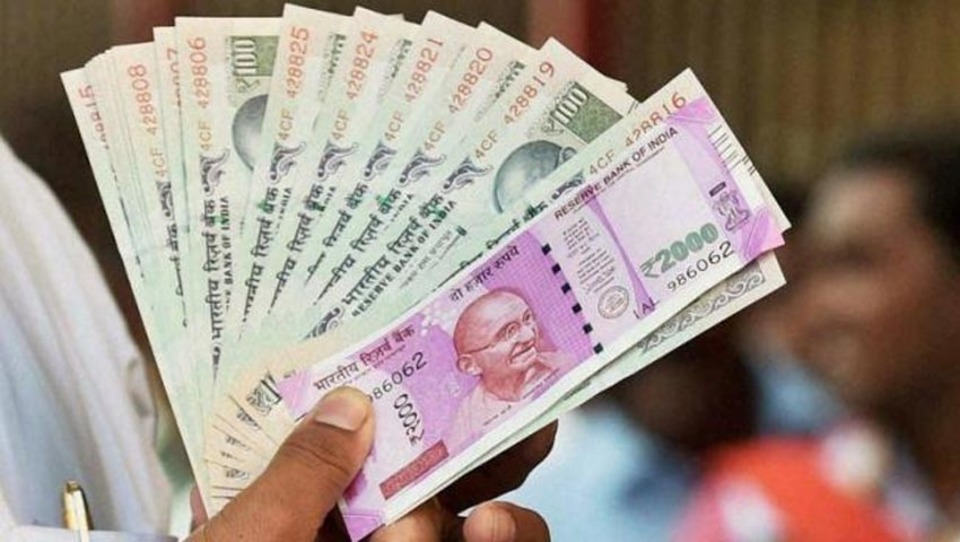
Mumbai: The rupee declined by 18 paise to close at 74.36 against the US dollar on Wednesday, tracking a strengthening American currency in the overseas market and higher crude prices.
However, a strong rally in domestic equities and unabated foreign fund inflows restricted the slide of the domestic unit, forex traders said.
At the interbank foreign exchange market, the local currency opened on a weak note at 74.24 and swung between the day's high of 74.18 and a low of 74.50 to the US dollar.
The rupee finally settled at 74.36 against the greenback, down 18 paise over its previous close.
The rupee had ended at 74.18 on Tuesday.
The dollar index, which gauges the greenback's strength against a basket of six currencies, rose 0.15 percent to 92.87.
Meanwhile, Brent crude futures, the global oil benchmark, spiked 3.26 percent to USD 45.03 per barrel.
"Indian rupee depreciated amid strong dollar and surge in crude oil prices. Further, the rupee slipped on worries over a slowdown in global economic recovery due to a resurgence in COVID-19 cases.
"Further, the market remained cautious ahead of key macro-economic data like CPI and IIP... Rupee may trade in a range of 73.80 to 74.80 in the next couple of sessions," said Saif Mukadam, Research Analyst, Sharekhan by BNP Paribas.
The BSE Sensex surged 316.02 points or 0.73 percent to close at a record 43,593.67.
Similarly, the broader NSE Nifty climbed 118.05 points or 0.93 percent to its all-time closing high of 12,749.15.
Foreign institutional investors remained net buyers in the capital market as they purchased shares worth Rs 5,627.32 crore on Tuesday, according to provisional exchange data.
"India CPI data is likely to show that Inflation remained above the Reserve Bank of India medium-term target range of 2-6 percent. India's Industrial Production data forecasted to show factory output contracted for 7 consecutive months," Mukadam added.
Devarsh Vakil, Deputy Head of Retail Research, HDFC Securities, said, "Indian rupee fell in line with other Asian currencies as dollar index rebounded and tracking the spike in crude oil prices. The rupee has been relatively weak even after strong foreign fund flows of around USD 2.3 billion in equities as RBI chose to absorb the flows rather than letting currency appreciate."
Oil futures rose after a report showed that US crude inventories fell by more than expected as prices continued to be supported by news of successful trials of a vaccine for coronavirus, he added.
Expectations of recovery have boosted Asian currencies and led to a broad-based rally in Asian shares and capped losses in the domestic unit, said Sriram Iyer, Senior Research Analyst at Reliance Securities.
"The Indian Rupee depreciated against the US Dollar on constant dollar-buying by state-run lenders, rumored to be on behalf of the central bank, to offset the impact of foreign inflows... So far the Indian equities and debt markets have already seen close USD 3 billion inflows this month and we believe that RBI could be present to mop the flows," he added.
"We expect the USD/INR (Spot) to trade higher and quote in the range of 74.05 and 74.50," said Gaurang Somaiya, Forex & Bullion Analyst, Motilal Oswal Financial Services.
Let the Truth be known. If you read VB and like VB, please be a VB Supporter and Help us deliver the Truth to one and all.
Allen, Raghuvanshi, Green power KKR to 29-run win over GT

Kolkata (PTI): Finn Allen blasted a 35-ball 93, while Angkrish Raghuvanshi hit an unbeaten 44-ball 82 as Kolkata Knight Riders kept their playoff hopes alive with a 29-run win over Gujarat Titans in the IPL match here on Saturday.
Sent in to bat, Allen went on a six-hitting spree, smashing 10 maximums and four boundaries to add 95 off 41 balls with Raghuvanshi (82).
Raghuvanshi then shared another 108 off 53 balls with Cameron Green (52 not out) to power KKR to a challenging 247 for 2.
In reply, GT could manage 218-4, riding on skipper Shubman Gill's 49-ball 85 and a 35-ball 57 from Jos Buttler. Opener Sai Sudarsan was retired hurt but returned to make a 28-ball 53 not out.
Sunil Narine (2/29) claimed two wickets and Saurabh Dubey snapped one for KKR.
For GT, Mohammed Siraj (1/50), Sai Kishore (1/38) were the wicket-takers.
Brief Score:
KKR: 247 for 2 in 20 overs (Finn Allen 93, Angkrish Raghuvanshi 82 not out, Camero Green 52 not out; Mohammed Siraj 1/50).
GT: 218 for 4 in 20 overs (Shubman Gill 85, Sunil Narine 2/29).