SBI Q2 net profit jumps 55 % to Rs 5,246 cr as bad loans decline

Mumbai: The country's largest lender State Bank of India (SBI) on Wednesday reported a 55.41 percent rise in consolidated net profit at Rs 5,245.88 crore for the second quarter ended September 30 on account of a decline in bad loans.
The bank's net profit stood at Rs 3,375.40 crore in the July-September quarter of the previous fiscal.
On a standalone basis, the bank's net profit rose nearly 52 percent to Rs 4,574 crore driven by lower provisions and higher growth in net interest income. Its net profit stood at Rs 3,012 crore in the year-ago period.
"Our assessment indicates an upward movement in economic activities. Most companies are suggesting that the activity levels are touching 70-80 percent of the pre-COVID levels. Vehicles registration, including tractors, are increasing. There are signs that the economy is recovering," the bank's chairman Dinesh Khara told reporters.
Net interest income grew 14.56 percent to Rs 28,181 crore during the quarter as against Rs 24,600 crore last year.
Domestic net interest margin for the quarter stood at 3.34 percent as compared to 3.22 percent a year ago.
The lender has received one-time restructuring applications worth Rs 6,495 crore so far and has provided Rs 650 crore for it. Of this, Rs 2,400 crore is from the retail book and the rest from the corporate book.
"Of the Rs 2,400 crore, it is predominantly MSME (micro, small and medium enterprises). Retail per se is only 2,600 people have applied for the restructuring of personal loans and home loans only 4,291 people have applied for a recast," the bank's managing director (retail and digital banking) C S Setty said.
"Together personal and home loan constitute Rs 1,300 crore and the rest is coming from about 35,000 MSMEs," Setty added.
In the corporate segment, the lender has received restructuring requests from 42 customers who account for about Rs 4,000 crore of loans.
Khara expects additional restructuring of Rs 13,000 crore up to December 2020.
"It may not be so, but it is a very liberal estimate which we have taken," he said, adding that request for restructuring would largely come from corporates and a bit from MSMEs.
The bank's gross non-performing assets (NPAs) ratio stood at 5.28 percent as against 7.19 percent a year ago. Net NPAs improved to 1.59 percent compared to 2.79 percent.
Total provision declined 21.74 percent to Rs 11,886 crore during the quarter from Rs 15,187 crore in the corresponding quarter of the previous year.
The provision coverage ratio (PCR) improved to 88.19 percent, while fresh slippages stood at Rs 2,756 crore.
"When it comes to slippages in various sectors, I would like to mention that fresh slippages are more in the agriculture sector and also in the SME sector. In SME, we have been successful in pulling back to a greater extent. Corporate slippages have come down significantly," Khara said.
The bank has estimated Rs 20,000 crore of slippages during the second half of the current fiscal.
Its collection efficiency for domestic loan book (excluding agriculture segment) stood at 97 percent at the end of Q2 FY21.
Total deposits grew 14.41 percent year-on-year, out of which current account deposits grew 8.55 percent, while saving bank deposits grew by 16.28 percent.
Credit growth stood at 6.02 percent, mainly driven by retail (personal) advances (14.55 percent).
"Retail will continue to be our major lever for growth going forward as well," Khara said.
The lender expects credit growth in FY21 to be at 8-9 percent.
Capital Adequacy Ratio (CAR) improved by 113 basis points year-on-year to 14.72 percent at the end of September 2020.
Shares of SBI on Wednesday closed 1.12 percent higher at Rs 207.05 apiece on the BSE.
Let the Truth be known. If you read VB and like VB, please be a VB Supporter and Help us deliver the Truth to one and all.
Maldivian military diver dead while searching for bodies of four Italian divers
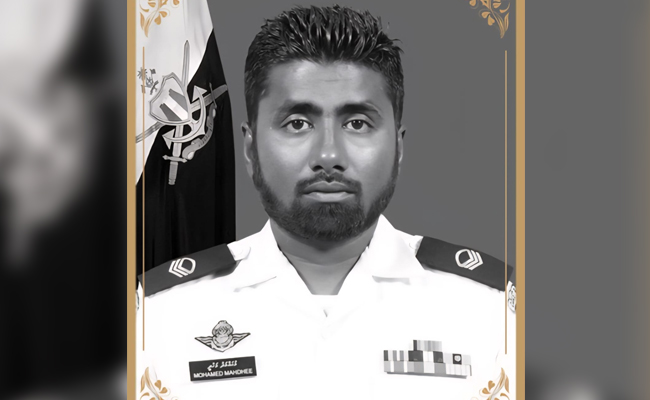
Colombo (AP): A Maldivian military diver died Saturday while searching for the bodies of four Italian divers believed to be deep inside an underwater cave.
The group of five Italian divers is believed to have died while exploring a cave at a depth of about 50 metres in Vaavu Atoll on Thursday, according to Italy's Foreign Ministry. The recreational diving limit in the Maldives is 30 metres.
Maldives Presidential Spokesman Mohammed Hussain Shareef said that Mohamed Mahudhee, a member of the Maldivian National Defence Force, died of underwater decompression sickness after being transferred to a hospital in the capital.
“The death goes to show the difficulty of the mission,” he said.
Earlier, Shareef said the searchers had prepared a plan based on their progress exploring the cave on Friday. Mahudhee was part of the group that briefed Maldives President Mohamed Muizzu on the rescue plan when he visited the search site on Friday.
Rough weather has repeatedly hampered rescue efforts.
The Italian Foreign Minister Antonio Tajani said everything possible would be done to bring the victims home. His ministry stated it was coordinating with Divers Alert Network, a specialist diving organisation, to support recovery operations and the repatriation of the bodies. The cause of the deaths remains under investigation.
The victims have been identified as Monica Montefalcone, an associate professor of ecology at the University of Genoa; her daughter, Giorgia Sommacal; marine biologist Federico Gualtieri; researcher Muriel Oddenino; and diving instructor Gianluca Benedetti, according to the Maldivian government.
Benedetti's body was recovered on Thursday.
Montefalcone and Oddenino were in the Maldives on an official scientific mission to monitor marine environments and study the effects of climate change on tropical biodiversity, the University of Genoa said in a statement Friday. However, the scuba diving activity during which the deadly accident occurred was not part of the planned research and was “undertaken privately,” it said.
The statement also said the two other victims — student Sommacal and recent graduate Gualtieri — were not involved in the scientific mission.
Cave diving is a highly technical and dangerous activity that requires specialised training, equipment and strict safety protocols. Risks increase sharply in environments where divers cannot head straight up and at depth, particularly when conditions are poor.
Experts say it's easy to become disoriented or lost inside caves, particularly as sediment clouds can sharply reduce visibility.
Diving at 50 metres also exceeds the maximum depth recommended for recreational divers by most major established scuba certifying agencies, with depths beyond 40 metres considered technical diving and requiring specialised training and equipment.
Shareef said Benedetti's body was found near the mouth of the cave and authorities believed the remaining four had entered the cave.
Two Italians, a deep-sea rescue expert and a cave diving expert, are expected to join the recovery effort, Shareef said.
Italian officials said that around 20 other Italians on the same expedition aboard the vessel “Duke of York” were safe. Italy's embassy in Colombo was providing assistance to those onboard and had contacted the Red Crescent, which offered to deploy volunteers to help provide psychological aid.
The Maldives tourism ministry said it has suspended the operating license of the “Duke of York” pending an investigation.
The Italian foreign ministry said the cave is divided into three large chambers connected by narrow passages. Recovery teams explored two of the three chambers on Friday, but the search was limited due to considerations over oxygen and decompression.
On Saturday, they will explore the third chamber, the ministry added.
Italian officials and the honourary consul are in contact with the victims' families to provide assistance.