Tesla looking at sourcing components worth about USD 1.9 bn from India: Goyal
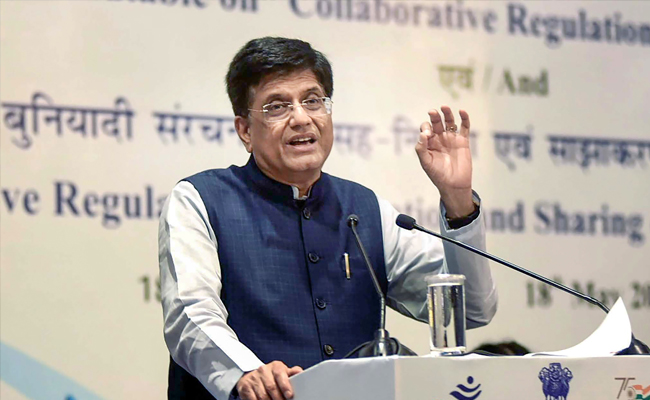
New Delhi (PTI): US-based electric vehicle maker Tesla is looking to source components worth around USD 1.9 billion from India this year against USD 1 billion last year, Commerce and Industry Minister Piyush Goyal said on Wednesday.
The minister said that going forward, demand for electric vehicles will increase and it will help in pushing the growth of the sector.
"Tesla already last year bought one billion dollars of components from I think all of you sitting here... I have the list of companies who supply to Tesla. This year their target is nearly USD 1.7 billion or USD 1.9 billion what they mentioned," he said here at an event of auto component makers.
Earlier the government had stated that it is not looking to frame a separate policy for providing incentives to Tesla, and the company can apply to avail support measures under existing schemes like PLI for auto and advanced chemistry cells
The government has rolled out the production-linked incentives (PLI) schemes (PLI) for advanced chemistry cell (ACC) battery storage with an outlay of Rs 18,100 crore and Rs 26,058 crore PLI scheme for auto, auto-components and drone industries.
The world's largest electric car producer Tesla Inc's chief Elon Musk met Prime Minister Narendra Modi in June in New York.
Musk, after meeting the Prime Minister, said he plans to visit India in 2024.
When asked whether the government is considering duty concessions on completely built-up units to attract certain sections of electric cars into India, the minister said: "Everything we have done has been done equally without any differentiation, without any preferences".
"This is the government which provides equal opportunity to everybody. So we will come out with a policy. A policy which will be in consultation with all the stakeholders - SIAM and ACMA - both will have a role in helping us draft a good policy," he added.
The government is continuously making efforts to attract newer investments and newer opportunities for the sector.
"Very clearly, we can see that going forward there will be a natural demand and an increasing demand or shift driven by an economic story by which we will see the electric auto industry grow," he said.
The electric auto industry, he said, is growing worldwide and it will see that growth in India also.
He added that the demand gap between electric vehicles and other vehicles has reduced and "narrowed quite significantly".
"My own sense is that going forward, that delta (gap) will get further squeezed and compressed," he said adding in taxis, public transport, and buses, "we already see electric vehicles becoming a very compulsive investment case".
"In this situation, we would like to see more investments and a larger production output in India of electric vehicles as soon as possible in the near future," the minister said, adding with increasing demand and production, the Indian auto component industry will not only than produce for a larger India demand, but also export.
Citing some meetings with auto industry participants, he said players have indicated that they have an interest in coming to India.
"And therefore, I am convinced that this is the future and this is something we must try to attract," Goyal said.
It will be a compulsive business case by 2030 for consumers to go in for electric vehicles and it will not be any by policy or artificial intervention.
When asked about foreign firms looking to invest in India as part of their China plus one strategy, Goyal said that global companies are coming to India because of its attractiveness.
"I totally debunk and reject the China plus one theory. That's not what is going to drive India...India of today stands on its own feet. The India of today has offerings for the rest of the world... both for investment and trade," he said.
Goyal added that India provides them good business environment, skills, managerial talent, a big market, and demand generated by 1.4 billion people.
"It's a rules-based economy..., it's a young democracy.....one of the fastest growing large economies. All of this makes it a compulsive investment destination.
"Therefore companies around the world have gone beyond the China-plus-one story, they have gone beyond the ABC philosophy of anything but China, they have gone beyond friend-shoring or near-shoring and are looking at India as a trusted partner," he added.
Let the Truth be known. If you read VB and like VB, please be a VB Supporter and Help us deliver the Truth to one and all.
AIITA welcomes Karnataka’s ban on obscene songs in school events
Bhatkal: The Karnataka unit of the All India Ideal Teachers Association (AIITA) has welcomed the Karnataka government’s decision to strictly ban school children from dancing to obscene songs during educational and cultural programmes in government, aided, and private schools across the state.
AIITA Karnataka State President M. R. Manvi congratulated the government for taking what he termed an important step to preserve the sanctity of education.
“Such decisions to safeguard the dignity of school children and uphold the values of education are the need of the hour. This rule should not be limited to government schools alone but must be strictly implemented in all private educational institutions as well,” he said.
He further urged the government to address other concerns within school programmes.
“The government should not only prohibit obscene dances in the name of school anniversaries, but also ensure that plays and dialogues that incite religious hatred are avoided. Schools should be centres of harmony, not platforms for spreading hatred,” he added.
According to a recent circular issued by the Department of School Education and Literacy, obscene dances are adversely affecting the mental health and moral values of students.
In this regard, schools have been advised to use songs that promote nationalism, positive thinking, the greatness of Kannada culture, and value-based traditions instead of inappropriate content during programmes.
The circular also emphasises that students should be dressed in decent attire.
AIITA also backed the department’s warning that disciplinary action would be taken against head teachers if such guidelines are violated. The association has further demanded that district Deputy Directors of Public Instruction strictly monitor the implementation of these rules.