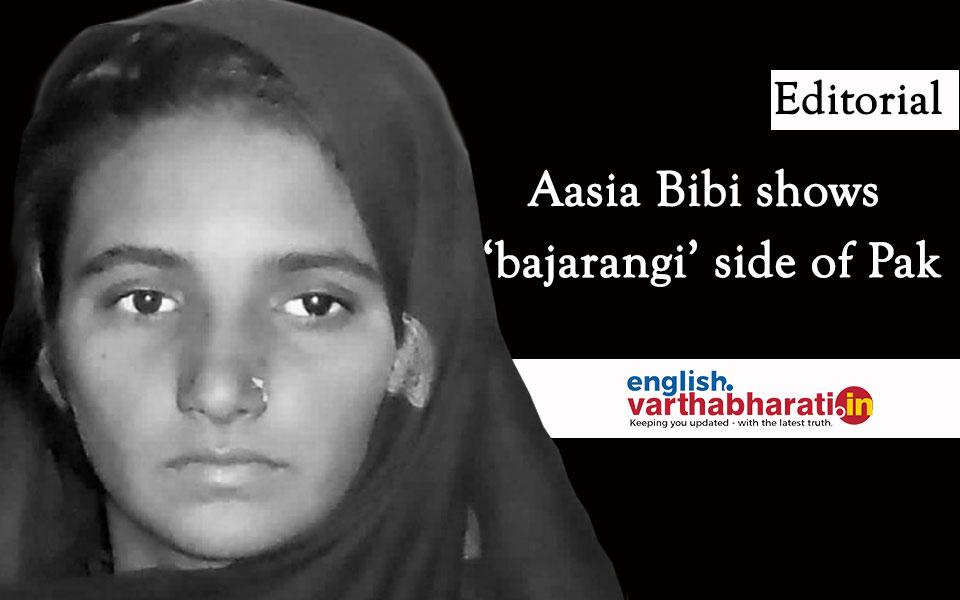
Aasia Bibi shows ‘bajarangi’ side of Pak
The global reputation of Pakistan, its government and the overall society is nothing to rave about. The opinions are not too favourable. People think Pakistan is about Taliban, bombs exploding in schools, masjid and market places, journalists and rationalists being killed, the military misrule, extremism and terrorism, drug network and many such aspects that do not associate too much with the future of its younger generation. Now, a case of Aasia Bibi, a mother of four kids has laid bare the depravity of human values in Pakistan yet again before the world and media.
Aasia Bibi, a Christian woman was working in a field in 2008. A fight erupted between her and her coworkers. She spoke in anger and apparently this had words that allegedly desecrated Islam. A case was registered against her and the local court pronounced verdict that she should be sent to gallows as per the law of blasphemy. Lahore court upheld the sentence.
But the Supreme Court of Pakistan took cognizance of this, and cancelled the death sentence. It even pronounced her not guilty and released her.
With this, people could heave a sigh of relief that the judiciary system was still working in Pakistan. But the developments after this sentence and Aasia Bibi being freed, have brought the world’s focus on Pakistan. And these are not really bright developments either. This has been a massive set back for PM Imran Khan who wanted to show to the world that Pakistan works on democracy and nothing less. Total civility of Pakistan is in crisis now as the world can see.
Some groups took to violent protest on the streets of Pakistan after the Supreme Court released Aasia Bibi. Some extremist scholars said Supreme Court judge must be sent to gallows for pronouncing such a verdict. Aasia has been kept protected in a secret place following this, amidst heavy security. The lawyer who fought her case has escaped to Netherlands, owing to fear for life. Just about a few days ago, a retired judge was killed in broad daylight on the streets of Lahore for having pronounced a judgment that went against the grain of Pak’s collective psyche.
Old leaders and political parties are trying to complicate the situation as much as possible to avoid Imran Khan from being a statesman and a PM who would not be forced to pay heed to mob mentality or religion-dominant political scenario of Pakistan.
Some western blind faith organisations, especially missionaries have tried to project the tussle as the one that exists between Christians and Muslims in the country. Blasphemy is an old tool used by anarchists in Pakistan since ages. This is not an issue between majority and minorities at all. The law of blasphemy can be applied to anyone who criticizes any officially recognized faiths such as hindu, Buddhist, islam or any other religion that has the sanction of the government. As per the 2014 statistics, about 1,300 cases have come before Pakistan court on blasphemy grounds. In all these cases the accused are muslims. The subgroups of Islam have used this law to settle scores with each other often, and without fail. Though the law of blasphemy is getting stringent with every passing year, courts have taken a liberal view on such cases.
Hence in most cases, the accused are let off without the charges getting proved. They are penalized or given a light sentence or short term jail. Cases that officially end in death sentence being commuted for this are very miniscule.
As it happens in India, the freedom of expression is being threatened by blind faith followers on the streets, than the government or judiciary. The proof of this is about 60 people were lynched by blind faith mobs in the last 18 years, over them being penalized or jailed. The extremist organisations encourage people to take to such violence over Islam as a faith.
In the general scenario, extremist organizations are not accepted by general public. None of them can go to people, seek votes and come to power in Pakistan in democratic manner. They are not even capable of solving any concurrent issues of Pakistan. Yet, they want to be in power and enjoy all the benefits that come with it. They can flare communal tensions and enrage people to get their agenda fulfilled. If they really have any respect for Quran and Prophet Muhammad, they would have been fighting to elevate Pakistan from the sorry state that it is now, stuck in time and ignorance. Though the country has less population than India, it still lags behind in social and economic progress.
About 40% of the people are under extreme poverty. About half crore child labourers have dark future there. Pakistan’s rate of literacy collapsed from 60% to 58% in the last few years while other nations have surged ahead. The rate of unemployment is at a dangerous 8%.
With facts being this miserable, youths are being misled in the name of religion and lakhs of reward is announced to kill some people who speak rationally. Hence, the literates and organisations of that country are against the very interest of the nation’s bright future. Pakistan does not need external enemies to ruin itself.
The current situation of Pakistan hold some invaluable lessons for India. A country that falls into the trap of faith and religion has no future. It is bound to enter into a phase of doom. There are groups that disobey the court when it comes to faith. Our priestly class say pretty much the same thing regarding many cases, including the recent Babri Masjid-Ram Janmabhoomi controversy.
Just as Pakistan is our neighbor, their menaces and ills have also surrounded us. Hence, instead of preaching tolerance to others, let’s also not forget we may end up on the same road if we forget where we are headed.
Let the Truth be known. If you read VB and like VB, please be a VB Supporter and Help us deliver the Truth to one and all.
“Goli maro…” slogan raised as ABVP-linked group disrupts play at University of Hyderabad

Hyderabad: A group allegedly linked to the Akhil Bharatiya Vidyarthi Parishad (ABVP) disrupted a theatre performance at the University of Hyderabad on Sunday evening. The group is also accused of vandalising property and assaulting students.
Slogans such as “Desh ke gaddaron ko, goli maro…” were raised during the incident, according to eyewitnesses.
According to the Observer Post, the disruption happened as Mahesh Elkunchwar's play Holi was being staged at the Department of Theatre Arts' GB Hall. The group reportedly objected to certain portions of the play, claiming that some phrases hurt religious sentiments.
According to accounts from those present, the situation escalated when individuals forced their way into the venue after damaging fixtures and breaking glass panels outside the auditorium. Students attempting to intervene were reportedly assaulted, and a guest faculty member was allegedly threatened.
Several students sustained injuries and were provided initial treatment at the campus health centre before being shifted to a nearby hospital.
Police later arrived at the scene, brought the situation under control, and escorted those inside the hall to safety. Witnesses said tensions remained high, with some members of the group continuing to raise slogans during the evacuation.