Bank of Baroda is ill; Vijaya bank gets the shot

Karnataka is not a land of traders. But the state has made significant contributions to banking and cooperative sectors. Many banks took birth and progressed well based on their efforts, sincerity and integrity. State Bank of Mysore, Corporation Bank, Syndicate Bank, Canara Bank, Vijaya Bank and the cooperative banks that were set up and supported by the farmers themselves. All of them changed the direction and socio economic condition of our state.
After Indira Gandhi nationalised the banks, even the poorest of poor farmer could access the banking services. But under Modi’s administration, everything is turning topsy-turvy. Now we hear the news that banks would be privatised. At the same time, there are plans to sacrifice banks to save big corporates. State Bank of Mysore that was started by Nalwadi Krishnaraja Wadiyar and Sir M Visvesvaraya has already been closed under the pretext of merging.
Central government is all set to erase the symbol of pride of people of Karnataka coastal area, the Vijaya Bank.
Vijaya Bank is a mark of great dignity for the Bunt community for since they started it and ensured the bank would thrive and stay in sound profit even till date. The bank was started by Attavar Balakrishna Shetty in 1931, and the network was expanded to other parts of the country by Sundararajan Shetty.
Vijaya Bank is one of the most significant contributions Bunt community has made to the country. Today, all communities have been reaping the benefits of this. Central government is all set to wipe off this mark of pride and dignity of Bunt community today.
As a matter of fact, the government does not have a sound reason to shut Vijaya Bank itself. Because the state-owned Vijaya Bank is posting decent profits even now. Ironically enough, Vijaya Bank has to lose its identity to breathe life into the dying Bank of Baroda of Gujarat.
Bank of Baroda, of Gujarat and Maharashtra's Dena Bank are in massive loss owing to massive defaulting by major corporate companies since many years now. So to save these two loss bearing banks, the central government has decided to sacrifice Vijaya Bank by merging with those.
The total loss posted by public sector banks when the financial year ended on March 31, 2018 was at Rs 87,370 cr. Punjab National Bank which has been battered by a slew of scandals and bad loans that have gone unpaid, is on the top of the list of loss making banks. Only Indian Bank and Vijaya Bank were among profit making banks in the list of 21 healthy national banks in the financial year 2017-18.
Vijaya Bank posted a profit of Rs 727 cr, which is a great accomplishment. On the other hand, Bank of Baroda has posted a massive loss of in the trimester Jan-March 2017-18 to the tune of Rs 3102.34 cr. This shows the dark underbelly of Gujarat model of development by revealing how the traders of Gujarat undid their financial institutions including fleecing the Bank of Baroda.
In a report, Bank of Baroda has revealed the reserve funds owing to bad loans in 2016-17 was Rs 2425.07 cr and this jumped to a whopping Rs 7052.53 cr in 2017-18. Dena Bank is in the same boat. In second trimester of 2018 financial year around September, the total loss was Rs 416.70 cr. This amount is exactly the double of what the bank suffered the previous corresponding year as admitted by Dena Bank.
In the last financial year corresponding time, Dena Bank recorded a loss of Rs 185.02cr. Now for the wrong decisions made by these banks Vijaya Bank has to pay through the great sacrifice of self.
Government is mentioning this is a strategy of merging the strong bank with a weak one. Even if we understand that, why should Vijaya Bank lose its identity in the melee? Vijaya Bank is the stronger one in the equation of Dena and Bank of Baroda.
Hence they both could lose identity and Vijaya Bank's name should be retained forever. But here, things have turned upside down. Vijaya Bank will be shut forever. Bank of Baroda will retain its existence by taking the sacrifice of Vijaya Bank. This shows how strong the lobby of Gujaratis is working on the centre.
Economically, State Bank of Mysore and Vijaya Bank were most significant contributions of the state and now the centre is all set to erase them. In the coming days, south indian financial institutions would be sacrificed one after another to make good for the loss making banks in the northern part of the country. Even now, north Indians have occupied all vantage positions in banks across banks in southern part of the country. It has become almost impossible for people to transact in banks if they do not have the knowledge of Hindi. After Vijaya Bank merges with Bank of Baroda it will so straight into the hands of Gujaratis.
Why should we surrender the assets that we grew with the hard work of people of this land, into the hands of Gujarati Baniyas? This is a question people of this land should ask the centre, irrespective of whether they are coastal Kannadigas or belong to other parts of the state. The banks that are thriving right now may be used to provide impetus to dying banks in North India, owing to their own mistakes.
Let the Dena Bank and Bank of Baroda be merged with Vijaya Bank's instead of vice versa. Let the name of Vijaya Bank be retained for good. South Indian banks should never allow their ownership to the north Indian banks. To raise our voice against this is not just the obligation of Bunts who are losing Vijaya Bank now, but of every person in the state which has contributed a lot to economic health of the nation.
Let the Truth be known. If you read VB and like VB, please be a VB Supporter and Help us deliver the Truth to one and all.
Deputy CM Shivakumar announces property ownership drive in Bengaluru
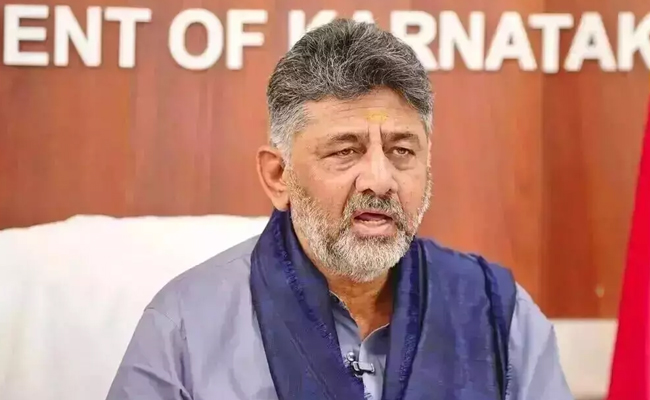
Bengaluru (PTI): Karnataka Deputy Chief Minister D K Shivakumar announced a major property ownership drive here aimed at correcting and regularising property records, saying the government had already rectified 23 lakh Khatas and enabled citizens to download their documents online.
Shivakumar, who also holds the Bengaluru Development portfolio, said the state government had begun converting B-Khatas into A-Khatas and would organise special Khata camps every Saturday across corporation limits from May 16 to help citizens secure their property documents.
A Khata is a legal document in Bengaluru certifying that a property complies with all local by-laws, regulations and has paid property taxes to the civic body.
“We have already corrected 23 lakh khatas and provided an opportunity for people to download them,” he said.
Shivakumar explained that the major campaign has been undertaken in Bengaluru to streamline property documentation.
The Deputy Chief Minister said between five and 10 centres would be set up in every corporation area as part of the “Khata Andolana” programme and urged citizens to participate in large numbers.
“I appeal to people to safeguard their property documents. We have created an opportunity for all citizens,” he said.
Calling it a "people-centric" initiative, Shivakumar said the government was working to ensure citizens received proper ownership documentation for their properties.
Shivakumar further claimed that the initiative had drawn national attention and said the Union government had recognised Karnataka with an award for the programme.
“Your Khata is your right. Obtain your Khata and protect yourself from fraud,” he said, while urging people to take advantage of the scheme.