Madhya Pradesh: Bhopal tragedy should be made election manifesto
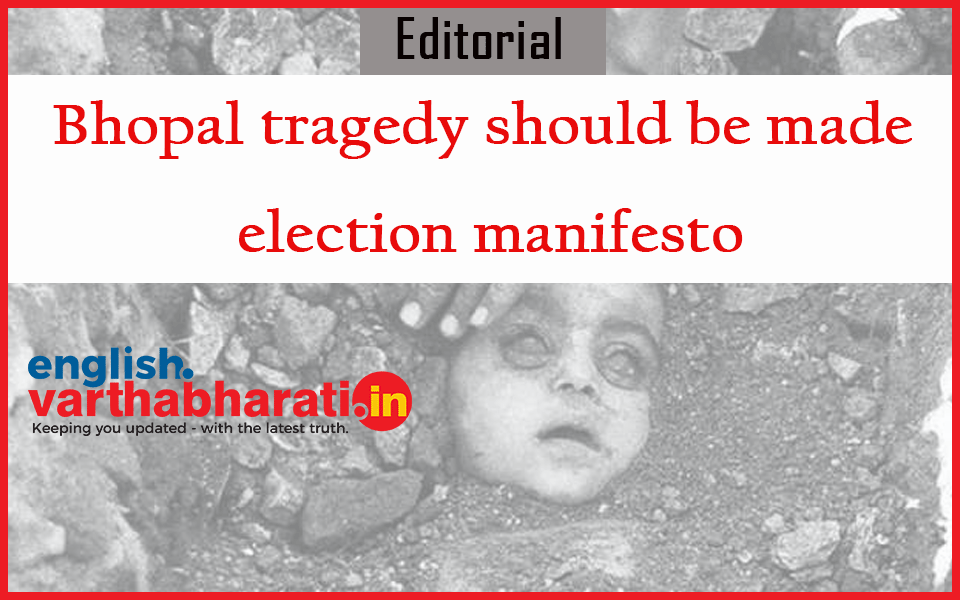
Nuclear war is not the only way the world would end. India has realised damage of that scale can be caused by other things too through the 1984 Bhopal tragedy.
Earthquake in tsunami Kendrick havoc, the damage can be intensified by man made disasters as well. dangerous looking right around the corner in every country that has a nuclear reactor in its premises. Hiroshima and Nagasaki disaster result of massive war related cruelty. Batman who should be held responsible for tragedies like that of Bhopal? it has been 34 years since the gas tragedy took place claiming thousands of life and a few generations of children being born with disabilities result of inhaling the poisonous gas by the mothers. People are still bearing the brunt of this tragedy and are paying through their future for this. Yet no culprit has been arrested or no one has been held responsible for this inhuman incident.
When the incident took place in 1984 about 10,000 people were killed as a result. Mother dance of death has not stop ever since. People still die as a result of that gas leakage.
Everyday at least five people feel the impact of that incident till date. Methyl isocyanate gas the delete on the night of 2nd and 3rd December in 1984 claimed lives of 10,047 people in one go when it leaked from the premises of a factory that manufacture pesticides.
As per the statistics 5,47,000 people were affected by this leakage. This data has been put together by the Madhya Pradesh government. As per their sources, more than 15,000 people have paid through their lives subsequent to that.
In the last 34 years since the incident many elections have come and gone. streets of Bhopal a resonating with election rallies and people are expecting a new government to come into power by December this year. Unfortunately no party has ever made this an election manifesto so far. The BJP is trying to win this election by feeding communal poison to people. but no party, including BJP, has ever dared to discuss the issues of those affected by the gas tragedy so far.
What is interesting is, Bhopal gas tragedy rehabilitation and relief Minister Anil Sarang himself was affected by the incident. That has not been able to add much quality to the lives of survivors.
On one hand there is a pain of Bhopal gas tragedy culprits going scot free; and on the other, the survivors are living a life of punishment. They are forced to fight two battles.
on one hand the health complications are very high and on the other they are still fighting for a relief amount from the government.
After the election dates were announced, the victims of Bhopal gas tragedy met and decided to support a candidate would help them get Rs 5 lakh as relief money. Bhopal group for information and action, Bhopal gas peedit nirashrit pensionbhogi sangharsh morcha and Bhopal gas peedit mahila stationary karmachari sangh are working to provide relief and rehabilitation for the victims of gas tragedy.
According to them, if the candidates can make this a part of their official election manifesto, this would be their commitment and a legal recourse is possible of they do not heed to their words.
A criminal callousness has been exhibited in killing that one of the biggest man-made human tragedies of the world.
Victims have not been provided with medical aid legal or financial assistance in fighting the battle.
None of the projects that would dispose off the poisonous chemicals that are polluting the groundwater resources took off really.
None of the politicians are interested in helping the victims.
According to them the Bhopal Gas tragedy victims do not play any significant role in winning the elections.
Even politicians understand winning elections is going to be very difficult if the contest with lofty social commitments. Hence they have taken to elections with emotional issues.
As the date of election is approaching, hoardings and banners have come up in areas where gas tragedy victims live such as Kazi camp, DIG overbridge, JP Nagar, Shahjahanabad and Jahangirabad etc.
The victims have come together to create a formidable political force. This is a promising development. What remains to be seen is how seriously would the political parties take this issue. Because, for politicians, Bhopal tragedy is a bygone incident. They do not deem it important to refer to it again after over 30 years of its occurrence.
There are seven constituencies in Bhopal. High number of victims live in Narela and North Bhopal areas. About 80-90% people have been directly affected by the tragedy.
There are considerable number of families and survivors and their families in Bhopal central and Huzoor areas. They are suffering from the aftermath of the incident.
About 40% inhabitants here are the survivors of the tragedy and their number is massive enough to have an impact on the outcome of the elections.
Berasia constituency is considered as extension of the rural area of Bhopal. Many residents of this place are those who migrated from Govindapura other parts of Bhopal. At least this time around, Bhopal tragedy should become a topic of discussion and manifesto to ensure the victims are done justice.
There are hundreds of Bhopal's all over the country and they may render some tragedy or the other some day. If we don't learn our lessons from Bhopal tragedy, we may be forced to pay a big price for our ignorance later. Hence, while serving some justice to the Bhopal victims, the govt should also look at ways of avoiding such disasters.
Let the Truth be known. If you read VB and like VB, please be a VB Supporter and Help us deliver the Truth to one and all.
Vijay''s TVK wins an impressive 108 seats in TN polls
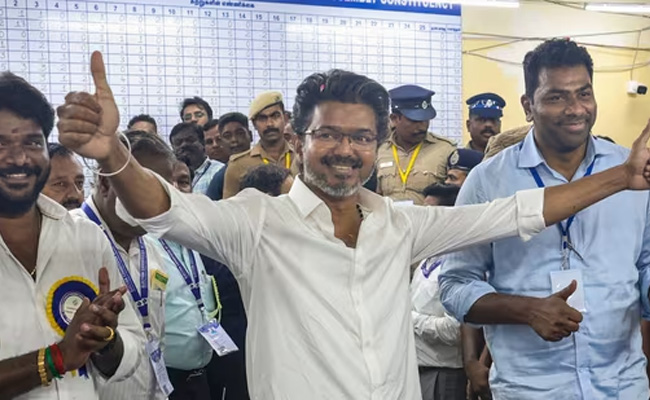
Chennai (PTI): Vijay-led TVK secured an impressive 108 seats trouncing the incumbent DMK led by M K Stalin which finished with only 59 seats in the Tamil Nadu Assembly elections held on April 23, as per the final tally of the ECI on Tuesday.
The opposition AIADMK won 47 seats while its allies the PMK obtained 4 and the BJP and AMMK clinched one seat each respectively in the election, according to the data available on the Election commission of India's website.
The DMK's allies - the Congress managed to win 5 seats, the IUML, CPI, CPI (M), and VCK: 2 each and DMDK secured one seat, among a total of 234 Assembly constituencies in the state.
The votes were taken up for counting on May 4 and the final tally was announced on Tuesday.
Actor-politician Vijay's Tamilaga Vettri Kazhagam on Monday created a record of sorts in the electoral history of Tamil Nadu and emerged as the single largest party by delivering a shock defeat to DMK and its president Stalin in his Kolathur constituency, while the AIADMK was pushed to a distant third spot.
Vijay won from both Perambur and Tiruchirappalli East constituencies.
The TVK has clocked nearly 35 per cent (34.92) vote share in its debut polls.
This will be the first time in Tamil Nadu that a party will assume power a little over two years after its founding in February 2024.