BOYCOTTING CHINESE GOODS: HOW PRAGMATIC IS IT?
A war hysteria is gripping the country after violent clashes between the Indian and Chinese soldiers on the Ladakh border left 20 Indian soldiers dead. Without understanding the gravity of the situation, a few media organizations are giving unnecessary advice to the government, almost encouraging the government to wage a war without showing even a modicum of concern for those who lost their lives in the recent clashes.
It is easy to issue a clarion call for a war from television studios. Soldiers who have served in the snowy terrain and waged a daily battle against the difficult climatic conditions have now returned home in coffins. It is difficult to imagine the extent of death and suffering that would ensue if India wages a war against a strong country such as China. Our ‘TV soldiers’ should stop for a moment and imagine the trail of damage and destruction a war would leave behind, going by the violence in a small-scale clash that resulted in so many deaths. These armchair soldiers should offer advice to the government only after considering the martyrs in the recent clashes as their own.
It would be wise to bear in mind that the ramifications of the war is not limited to the loss of lives of Indian soldiers but is bound to impact other aspects as well. Thousands of people of Chinese and Nepal origin are employed in India and attempts are being made to spread hatred against them. These people, who have no political affiliation with the Chinese government’s politics, have come to our country in search of livelihood. The hatred that we spew on them will result in infliction of cruelty on ourselves. Similar to how people from Nepal and China seek livelihood here, Indians have also built their lives in Nepal and China. The head of Patanjali, Balakrishna, is from Nepal and the roots of Patanjali can be traced to Nepal. Also, thousands of Indians have settled in China with hundreds of Indian students studying and living in China. If we express our intolerance towards the Chinese, Indians in China would be at the receiving end of such intolerance by the Chinese.
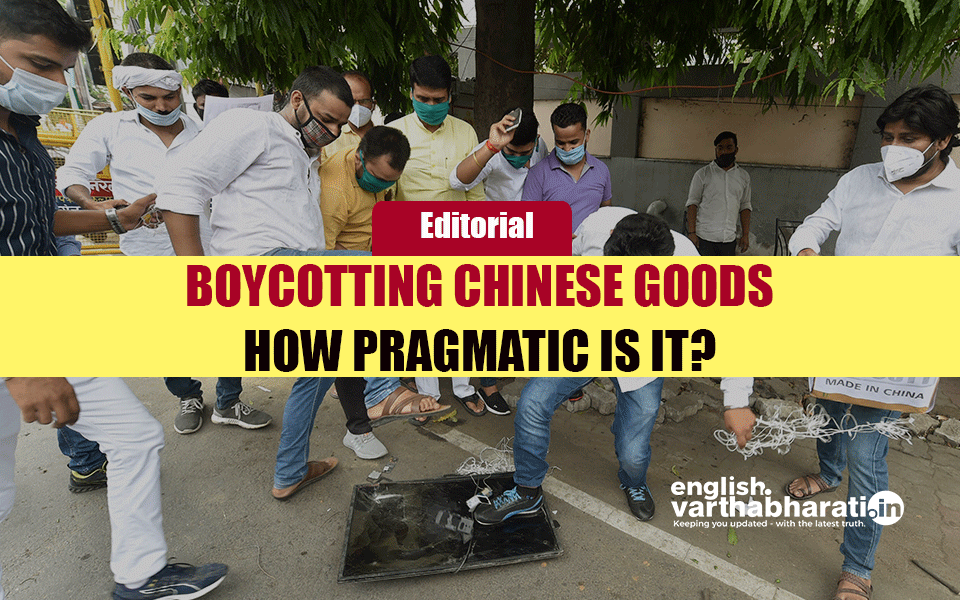
As we have seen in the past in such disputes with China, there is a public outcry to ban Chinese goods and the All India Traders’ Union has already submitted a memorandum to the government in this regard. BJP leaders have even asked the government to reduce imports from China. Union minister Ramdas Atavale has, in fact, asked the government to ban Chinese food. But this is not the first time that such a demand has been made. Whenever China has entered into a dispute with India, right-wing organizations have launched protests asking for such a ban. The Sangh Parivar has always been intolerant towards China owing to ideological differences.
When the Narendra Modi-led government took office, it was expected that at the behest of the RSS restrictions against China would be increased, Chinese goods would be boycotted, and emphasis would be laid on the production of goods locally. Instead, surprisingly, the Modi government opened the doors of the country to the world. From small and petty businesses to defence deals, everything was opened up.
At the same time, several profit-making local industries have been shut under the Modi regime. The credit for the total decimation of Hindustan Aeronautics Ltd (HAL) must also go to the Modi government with the controversial Rafeal deal contributing to the downfall of this public sector giant. Besides, several profit-making PSUs were handed over to the private sector on a platter. The slogan, ‘Make in India’, remained just that. While demonetization destroyed several small and medium-sized industries, the lockdown imposed due to the coronavirus was the second attack on the swadeshi dreams. It’s almost a crude joke that India that is in tatters economically should talk about ‘Atma Nirbhartha.’ At least, the Modi government should have kept China out of India’s economy in the last six years. Instead of doing that, the Modi government handed over several deals to the Chinese including, ironically, the contract of constructing the Rs 3,000 crore Vallabhbhai Patel Unity statue that was given to a Chinese company.
The writing on the wall is clear: The politics of emotions is different and is limited to electoral politics and border-related issues become relevant only in such situations. Industrialists and traders have no borders and treat every country the same. For the same reason, several BJP leaders are investing in major industries in Pakistan. Several BJP leaders are in the forefront of beef exports. The construction of the multi-crore Delhi-Meerut underpass project has been contracted out to a Chinese company. All these show that big industrialists neither have any religion nor are confined to any country.
Damaging a television set or destroying ten mobile sets do not mean that Chinese products can be rejected. Without changing its economic policy in its entirety, India cannot reject Chinese goods. Besides, China is not dependent on India alone and depends on India only for three per cent of its exports. India, on the other hand, relies heavily on Chinese imports as Indian industries accrue several benefits, including transportation costs, more than exports. According to an estimate, while our exports to China is to the tune of 16.7 billion dollars, our imports are to the extent of a whopping 70.3 billion dollars. Chinese companies have invested in several Indian startups including PayTM. Before rejecting any foreign items, we must focus on strengthening our foundations and encourage local manufacturing and production.
We need to ask ourselves about the alternatives that are before us if we reject foreign goods, especially Chinese goods. Atavale, who protested against Corona with the ‘Go Corona Go’ slogan, is now issuing ‘Go China Go’ statements! How can we attach any importance to the statements of Atavale who failed to understand ‘social distancing’ imposed against his own community?
The policies of the Modi government have made it impossible to completely ban Chinese goods. At the same time, the country does not have the financial might to purchase goods at a higher price from other countries. It is impossible to resolve the Ladakh border issue by merely banning Chinese goods. At the most, it could only lead to war mongering.
In the present situation, it is the responsibility of political parties and the media to show restraint and not precipitate the situation further. The all-party meeting convened on Friday should hold an honest discussion on the issue. It is easy for the opposition parties to ask the government to respond to China ‘in their own language’ through the use of force, knowing full well that the actual situation is not so simple. Instead of using the border dispute to embarrass the government, the opposition parties should guide the government appropriately. At the same time, the Modi government should not hesitate to accept the suggestions of seasoned politicians of the opposition parties.
Let the Truth be known. If you read VB and like VB, please be a VB Supporter and Help us deliver the Truth to one and all.
Allahabad HC orders probe into 'reinstatement' of teacher in UP's Barabanki
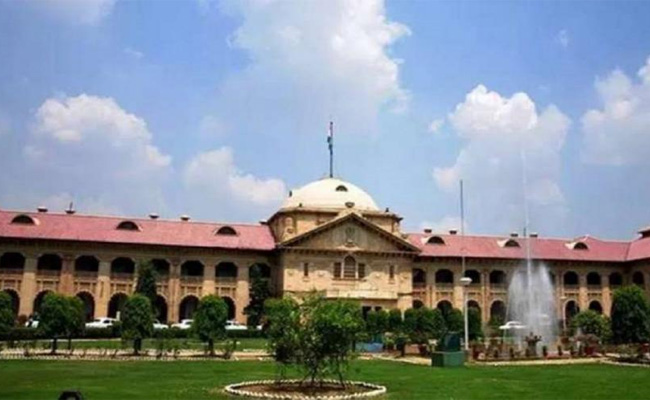
Lucknow (PTI): The Lucknow Bench of the Allahabad High Court on Friday ordered a probe by the special task force (STF) into alleged irregularities in the rejoining of a teacher at City Intermediate College in Barabanki, observing that the reinstatement appeared to be prima facie illegal.
The court also directed the recovery of the salary paid to the teacher during the disputed period.
A bench of Justice Rajeev Singh passed the order on a petition filed by the college management committee. The court expressed doubts over the roles of the District Inspector of Schools (DIOS), Barabanki, the college principal and the teacher concerned and hence, directed a detailed inquiry into the matter.
Taking note of alleged manipulation of records and misleading submissions, the court ordered the immediate transfer of the Barabanki DIOS to ensure a fair probe. It also directed the initiation of disciplinary proceedings against the then joint director of education of the Ayodhya division.
In its order, the court found that the teacher, Abhay Kumar, was initially appointed as an assistant teacher in 2018 but joined an Eklavya Model Residential School in Chhattisgarh as a lecturer in June 2024 without obtaining permission from the management. His subsequent request to retain the lien was rejected.
Despite this, he was allowed to rejoin the Barabanki College in September 2025 on the directions of the joint director of education and the DIOS, and was even paid the salary for October 2025. The court termed the rejoining "wholly illegal" and lacking any legal basis.
The bench also expressed concern over lapses in communication within the education department and directed the Uttar Pradesh chief secretary to ensure that official orders are communicated through email and WhatsApp as well, to prevent disputes.
The matter is next listed for hearing on May 28 when a compliance report is sought.