Challenges Before the New Chief Minister
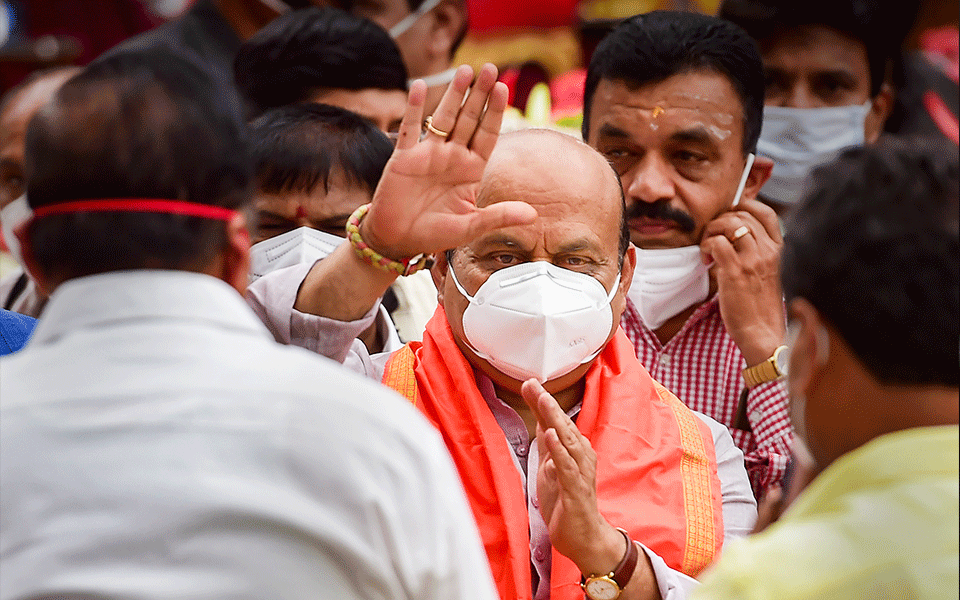
By selecting Basavaraj Bommai as the new Karnataka Chief Minister, the BJP Central leaders have taken a smart decision. The Sangh Parivar-backed group within the BJP which planned to snatch power from the Lingayats in the State has beaten a retreat at least for the time being. At the same time, however, it has succeeded only partially in its first attempt. Having realized the strength of the outgoing Chief Minister B S Yediyurappa and the Lingayat lobby which backed him to the hilt, the Sangh-Parivar group had to make amends to its original plan. The developments in Karnataka are thus seen as the BJP’s central leadership giving in to Yediyurappa by choosing one of his close confidantes for the hot seat. The RSS and the Central leadership will now keep a close watch on the new dispensation and will keep experimenting their agenda and push it ahead wherever possible during the two years before the next Assembly elections.
Compared to the known faces in BJP, the selection of Basavaraj Bommai is an excellent choice both for the state and for the BJP. The Central leadership’s selection was unexpected for the Hindutva hardliners in the BJP. By choosing Bommai, who has a history of working with Siddaramaiah, who is not identified prominently with the RSS and most importantly, is a confidante of Yediyurappa, the BJP leaders saved the state from the rule of a Hindutva hardliner. His choice must have come as a surprise to Bommai himself. His father S.R.Bommai became the Chief Minister in similar unexpected circumstances in 1988 and was in the post only for eight months. Power that comes unexpectedly can be lost as unexpectedly. If Basavaraja Bommai has internalized this lesson from his father’s experience, he will know how to moderate his own expectations from the post, given the current situation in the BJP.
Given the track record of the institutionalized corruption during Yediyurappa’s rule, it will be futile to expect the state’s administration to be back on the rails with a mere change of Chief Minister. If the Centre continues its step-motherly treatment of the state in providing funds, the new Chief Minister will also become helpless. When Yediyurappa was the Chief Minister, the Centre did not release the full share of GST to the state and repeatedly turned down the state’s request for adequate compensation during droughts and floods. The Central leadership did not back Yediyurappa politically either. He was not allowed to expand his cabinet for months after he was sworn in as Chief Minister in 2019. If only his cabinet colleagues had cooperated with him fully, Yediyurappa would have been able to give a much better administration. As he was making futile trips to Delhi to convince the Centre to release more funds, the State’s contingent of 25 MPs from his party did not come to his help. Instead they sided with the Centre and issued open statements that the State had adequate funds. That was at a time when Yediyurappa was staring at an empty treasury. The new Chief Minister can do any good to the state only if all these change in the coming days.
It is foolish to assume that the selection of Basavaraj Bommai will end dissidence in the BJP. Those who were personally dissatisfied with Yeddiyurappa might have found solace with his replacement but the source of their grouse was not addressed. Senior leader Jagadish Shettar has stated already that he will not join the new cabinet. Another senior leader Eshwarappa has demanded the post of the deputy Chief Minister. A group of seers from his Kuruba caste have voiced this demand on his behalf. Other prominent leaders such as Yatnal and Umesh Katti are sharpening their knives. Legislators in the pro-Yediyurappa group are obviously hurt. The new cabinet will have to accommodate the opposition turncoats whose support is crucial for the government to survive. In addition to all this, the silence of RSS leaders can also be analyzed in different ways. The new Chief Minister has said that he will take Yediyurappa’s guidance for administration. However, if Yediyurappa starts interfering in the administration, it will give rise to fresh problems. Similarly, if Bommai keeps Yediyurappa and his son at a distance, the father and son duo will start groupism within the party and may even lead a breakaway faction. Yediyurappa’s son has allegedly amassed such wealth during the two years of his father’s rule.
Most importantly, RSS which has not been able to implement its game plan fully can continue to sponsor groupism within the party to push for the kind of change that it wants to see in the government. It will obviously want to back leaders such as Prahlad Joshi, B L Santhosh, or Tejaswi Surya as Chief Ministers as they are the main torch bearers of its ideology.
If Bommai is able to provide good administration despite such challenges lined up before him, it would truly be his achievement. It is the duty of the Central leaders and RSS leaders therefore to cooperate with Bommai to provide good administration to the state that is reeling under Coronavirus, lockdown, and floods. Karnataka does not have the strength or the patience to witness yet another change in Chief Ministers before the next elections due in early 2022.
Let the Truth be known. If you read VB and like VB, please be a VB Supporter and Help us deliver the Truth to one and all.
Lt Gen NS Raja Subramani to be India's next Chief of Defence Staff
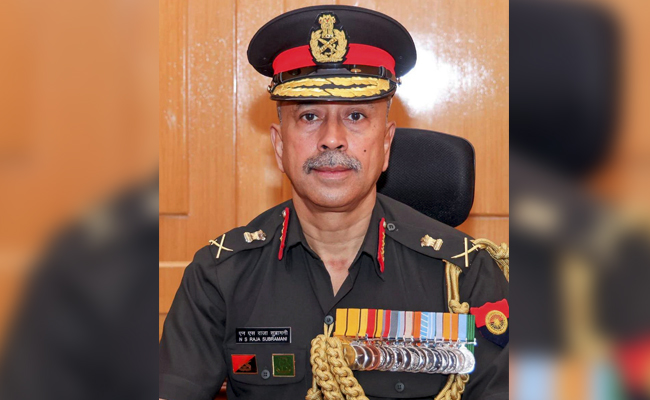
New Delhi (PTI): Lt Gen NS Raja Subramani will be India's new Chief of Defence Staff (CDS) and his key task is set to be to implement the ambitious theaterisation plan that seeks to ensure tri-services synergy.
He will succeed Gen Anil Chauhan whose tenure will come to an end on May 30.
Gen Chauhan, a former Eastern Army Commander, took charge as the country's senior-most military commander in September 2022, over nine months after the first CDS, General Bipin Rawat, died in a helicopter crash in Tamil Nadu.
The government has appointed Lt Gen NS Raja Subramani (Retd) as the Chief of Defence Staff, who will also function as the secretary of the Department of Military Affairs, the defence ministry said on Saturday.
Lt Gen Subramani is currently serving as the military adviser to the National Security Council Secretariat.
Prior to that, he was the Vice Chief of the Army Staff from July 1, 2024 to July 31, 2025, and was General Officer Commanding-in-Chief of the Central Command from March 2023 till June 2024.
As Chief of Defence Staff, Lt Gen Subramani's primary task will be to implement the theaterisation model to bring in tri-services synergy by rolling out integrated military commands.
The officer is a graduate of the National Defence Academy and the Indian Military Academy. He was commissioned into the eighth battalion of the Garhwal Rifles on December 14, 1985.
Lt Gen Subramani is an alumnus of Joint Services Command Staff College, Bracknell (UK), and the National Defence College, New Delhi. He holds a Master of Arts degree from King's College London and an MPhil in defence studies from Madras University.
In his illustrious career spanning over 40 years, Lt Gen Subramani has served across a wide spectrum of conflict and terrain profiles and tenanted a host of Command, Staff and Instructional appointments.
He commanded the 16 Garhwal Rifles in Counter-Insurgency operations in Assam as part of Operation Rhino, the 168 Infantry Brigade in Jammu and Kashmir, and the 17 Mountain Division in the Central Sector, all during a challenging operational environment.
He also has the distinction of commanding two Corps, including the Indian Army's premier strike Corps on the Western Front.