Compulsory pass to be scrapped; kids in quandary

Students committing suicide is even more gory than the farmers ending their lives in this country. There would be some report or the other about some student ending his or her life somewhere in the state starting from March to June every year. This happens like series of events. Education today is another version of child labour. While young children work to earn money in factories and other places, other children work to bring marks for their parents’ satisfaction.
Those who score less marks come under assumption that their entire life is over. They face criticism by their parents, humiliation by the society and insults by many others. All this destroys their confidence and will power. Those kids who are yet to face life, surrender to death. Just to ensure children remain safe and protected from this phase, kids from seventh and eighth standard were kept away from this difficult test. This was inevitable for many reasons. Primary and high school education is just a phase to identify the talent present in children.
To deny an opportunity for the students to go further in studies by limiting the education to scoring marks, is to trample a bud before it blooms. This was one of the major factors for the increasing number of school drop outs in the past. Education experts feel children learn better and with great interest when they do not experience the pressure of having to score marks. A child can grow up to be anything. A painter, a singer or a writer, just about anything. All this is a part of the education, say the experts. Just because a student cannot excel in a topic, he or she cannot be declared dumb or unfit for further education. They may have immense opportunities to achieve something in a field of their choice or interest. To stop him from going further, may actually rob all the opportunities the child has to do well elsewhere. Unfortunately, the new year has begun on a negative note for children of the nation. The right to education act 2009 had mentioned students should not be failed from class one to eighth under any circumstances and a suggestion to amend this bill to remove the ‘compulsory pass’ clause was passed in the parliament on January 3.
This decision by the parliament is somewhat a failure of the government which would be borne by the hapless students. Dilapidated buildings for schools, toilets that are absent, lack of school playing grounds, insufficiently educated teachers lacking empathy, the school administration that listens to government officials more than the headmaster, uniform syllabus that does not encourage learning and exam methods and systems that test the perseverance of young children, finally take a toll on them. Instead of fixing this, the government seems to think compulsory pass is leading to collapse of education standards among children.
Central government has said this amendment is supported by the states that have the interest if children’s education in mind. States were asked about their stance on this topic in 2015. Some states had said they would like to retain compulsory pass and even gave reasons as to why they’d prefer that since they had the interest of children’s future in mind. Some other states had given suggestions that had completely ignored the challenges of present.
Some states wanted to do away with the compulsory pass, while some remained neutral. To penalize kids and force them to learn is a violation of their rights, instead of modifying pedagogy and methods of teaching. The change has to happen in teaching methods, and not in scrapping compulsory pass. Education is not passing on information or helping them score marks. It is something that allows their personality to bloom and waters the talents they may have within them. This is the responsibility of government, teachers and educational institutions. Since the stakeholders have failed in imparting their duties, they have decided to scrap compulsory pass and penalize students for no fault of theirs. Making students sit in the same class for years never yields good results. This has been shown by experiments worldwide. This has more negative effects than positive. Yet, the government is instituting that the problem with skills has arisen due to compulsory pass bill in primary classes.
Children will get into a fix with this decision of the government. While kids are already taking drastic steps as ending lives unable to withstand the PUC and SSLC exam performance pressures, this may affect 7th std kids too in the future. Changes don’t assure improvement. The government should spare a thought about how this can help better future of children too. Government has to retreat from the proposed amendment for compulsory pass order.
Let the Truth be known. If you read VB and like VB, please be a VB Supporter and Help us deliver the Truth to one and all.
Women BJP MLAs protest against opposition in UP assembly premises
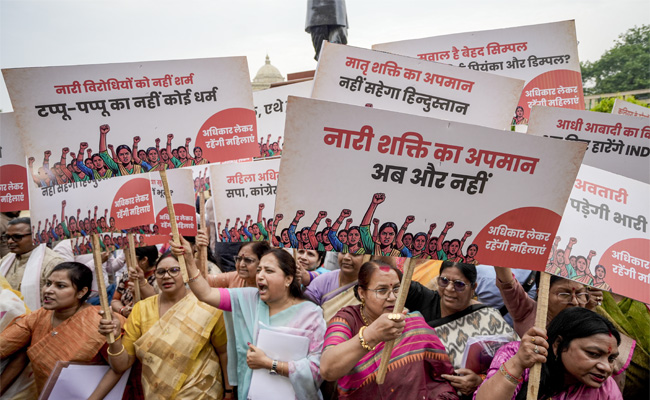
Lucknow (PTI): Women BJP MLAs held a protest in the Vidhan Bhawan complex before the one-day special session of Uttar Pradesh assembly, slamming the opposition for defeating the passage of a bill, which would have led to implementation of the Women's Reservation Law, in the Lok Sabha.
This followed another demonstration by Samajwadi Party MLAs, who alleged that the BJP was misleading public in the name of women's reservation.
The women BJP legislators assembled in front of Chaudhary Charan Singh's statue in the assembly premises, holding banners inscribed with the slogan "Insult to Matrushakti (women's power), India will not tolerate it". The protesting members entered the main hall of Vidhan Bhawan carrying the banners.
Participating in the protest, the state Minister for Women Welfare and Child Development, Baby Rani Maurya, told reporters that all opposition parties, including the Samajwadi Party and the Congress, had opposed the women's reservation, a stance for which they would have to pay a heavy political price.
"On this issue, all of us women stand united. We will ensure that we secure our reservation," she said.
BJP MLA Ketki Singh remarked that their protest represents the collective outrage of millions of women across the state.
Singh asserted that the opposition has betrayed women by creating hurdles in the path of women's reservation. The current demonstration is merely the beginning, and very soon, women from every street, intersection and household will join the protest movement, she said.
Minister Vijaylakshmi Gautam said, "We strongly condemn the despicable act committed by the Samajwadi Party and the Congress in an attempt to hold back 'half the population' (women). Their action was directed against the very bill that Prime Minister Narendra Modi had introduced to empower and strengthen Nari Shakti (women's power), and which he strived to pass expeditiously."
Uttar Pradesh assembly is holding a one-day special session on Thursday. During the session, the government is set to move a censure motion against the opposition parties over their failure to pass the Constitution Amendment Bill, which would have led to implementation of the Women's Reservation Act, in the Lok Sabha.