Congress included, opposition parties need to unite

The results of five state assembly elections has given a new lease of hope to opposition parties, simultaneously descending a pall of gloom on BJP over its dismal performance. Had these states been won by BJP, the hope of Operation Lotus would have received some boost in Karnataka too.
Yeddyurappa would have started some ground work with a fond hope of being reinstated as the CM again. The mine mafia was all set to throw money around to ensure this would happen. But since these states gave their verdict in the opposite direction, the pipe dream of BJP leaders is now forced to remain. So these results have given the opposition parties a new hope to build something on.
A good unity and possibility of a coalition among them is all very inevitable now. Earlier, Communist leader such as Harkishan Singh Surjeet would take the lead in ensuring there is a good understanding between parties in such situations. There were leaders such as Jyoti Basu. But none of them exist now. Left parties aren’t playing a major role in the country’s politics. Hence, to bring the opposition parties together, Andhra CM Chandrababu Naidu has set the ball in motion.
After the BJP assumed power in the centre, constitutional aided administration has been severely compromised upon. Premier institutions like CBI, RBI and the other autonomous institutions have also been meddled with, by the government.
At times like this, secular federations, organisations and parties have to come together to achieve a single objective and offer pro-people programmes to achieve some core goals. No single party can ever hope to tame the tentacles of this octopus called corporate sector that has encouraged the majority communalism along with funding the BJP.
But there are naturally many issues with such a coalition coming together. In the undivided Andhra, Telugu Desam and TRS do not have a conducive understanding with each other. Congress is the main opposition for the ruling left parties in Bengal and CPM in Kerala. They both are willing to come together against a common enemy. If the opposition parties come together putting behind their differences, they can defeat the communal BJP and its allies in no time.
But then if Modi succeeds in clinching the power second time over, the efforts to create an RSS-specific Hindu Rashtra will intensify with no holds barred. If this is to be stopped, the opposition parties have to come together. This should not be a convenient arrangement but an honest one. Former PM Deve Gowda has to take the lead in this. CPIM secretary Sitaram Yechury must allow such a possibility to take shape. Mayawati’s BSP is also thinking on those lines.
Now their Rajasthan and Madhya Pradesh units have already declared their support to Congress to form the government. Stalin of DMK, Chandrababu Naidu and TSR also have a very significant role to play. BJP may have lost in five states, but it will not keep quiet in Lok Sabha elections. The coming together of opposition parties is inevitable if the country is not to be submitted to fascists.
Congress needs to change its approach. It is going back to a lethargic approach soon as it has delivered a victory. It forgets the danger communal forces pose to the society and makes space for only opportunists. Former CM Siddaramaiah has said this is not the time to celebrate victory but to stand firmly against communal forces and fight them back. Congress has to strengthen its base of activists and party workers at cadre levels. They have to be informed about the secular credentials of the party. It should not stick to the dual stance it is exhibiting in the case of women’s entry into Sabarimala in Kerala where Congress seems to have joined hands with BJP to keep women out against the SC rule. This is opportunistic politics. Congress must think about a united opposition front at times of challenge like this.
Let the Truth be known. If you read VB and like VB, please be a VB Supporter and Help us deliver the Truth to one and all.
Representative of Iran's Supreme Leader in India calls current situation 'no war, no peace'
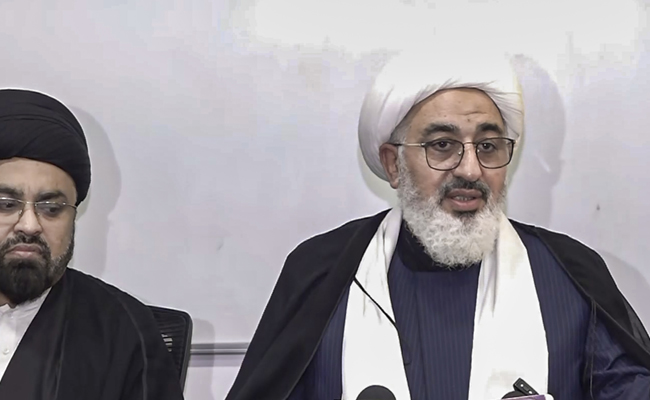
Bengaluru (PTI): Representative of Iran's Supreme Leader in India, Abdul Majeed Hakeem Ilahi on Saturday characterised the ongoing tensions between his country and the Israel-US alliance as a state of “no war, no peace”.
Calling for an immediate halt to the conflict, he said the global stability hinges on those who initiated the war.
He questioned why countries affected by the war and suffering from the energy crisis are not pressuring the US and Israel to stop the aggression.
Addressing a press conference here, Ilahi said Iran did not want the conflict, but was compelled to respond amid continued attacks, even as negotiations were expected to continue.
"Iran didn't want this war, but Iran was forced by the war and several times Iran tried to avoid this war... I don't know what is the condition of these people and these countries (US-Israel)... they want to impose on other countries what they want, and who gave them this authority?" he questioned.
Recalling the negotiations Iran held in Oman, he said talks later moved to Geneva and made progress before being disrupted by sudden attacks.
Ilahi claimed that airstrikes and missile attacks led to the deaths of Iran’s supreme leader Ayatollah Ali Khamenei, ministers, commanders and civilians.
"They killed a lot of civilians… They attacked a primary school, and they killed 175 innocent girls," he said, claiming over 4,000 deaths, more than 40,000 injuries, and widespread damage to houses, hospitals, universities and public infrastructure.
Despite these losses, he said Iran resisted calls for “unconditional surrender” and stood firm and defended itself.
"They wanted unconditional surrender. Which no one—no one can accept it. Iran said, 'Okay, we are ready to be sacrificed,' but we are not ready to submit ourselves," he added.
He argued that they (US-Israel) proposed the current ceasefire only after realising that they could not achieve any of their objectives after 40 days of conflict.
The envoy further claimed that the ceasefire is not an actual ceasefire, but a “no war, no peace” situation.
Explaining the current situation in Iran, he said conditions remain stable and people are going about their daily lives.
"They are working ....(leading) their ordinary life. They are working—they're going farming and they do everything....and they aren't scared of anything. And they are ready to defend themselves," he added.
Addressing the crisis in the Strait of Hormuz, he said the situation was stable before February 28 and all countries benefited from it.
"(For) 10,000 years, the Strait of Hormuz was open...and Iran daily yearly spent a lot for providing security in the Strait of Hormuz... so no one even complained anything about the Strait of Hormuz. Everyone was free...and even our enemies their warship was passing through the Strait of Hormuz," he said.
However, he linked the current maritime instability to the actions of the US and Israel.
"So Iran cannot do anything. Those people who initiated, created and started this war, they have to stop it. And everything will go back to normal," he said.
Criticising the mentality of the "great powerful country", Ilahi said, "they think they have the right to do whatever they want. It should change."
He sought to know why the countries affected by the conflict are not exerting pressure on the US and the "Zionist" regime to halt the war.
"Why are they not asking them? This crisis and problem by which a lot of countries are affected was created by them. A lot of factories are closed and even working days in some countries reduced... A lot of restaurants are closed," he said.
Seeking fairness and justice, Ilahi said instead of asking Iran, all those nations should ask those who initiated this war to stop it, by telling them, "we are suffering."
To a query on international mediation, Ilahi, referring to the US, asked, "Is it acceptable and reasonable that one country orders all countries -- you should not deal with this country, You should not purchase from this country. You should not have business with this country. You should not buy from this country."
Ilahi also highlighted Iran's long-standing ties with India and said, "It is a great country and we respect India and Indians."
"We have 5,000 years relationship and friendship. We are connected to India by education, by philosophy, by culture, by civilisation and by the economy," he said.
According to him, the bilateral cooperation remains strong, citing diplomatic engagement.
"At the moment also, our relationship, collaboration, cooperation with India is very good," he said, adding Iran allowing Indian ships to pass through Strait of Hormuz reflects the ties.
"Iran allowed Indian ships to pass through the Strait of Hormuz. Why? A lot of countries couldn't get this permission?... The relationship between Iran and India is very good," he added.
He expressed confidence that in future too, the ties between Iran and India will be strong.