Demonetisation: Second emergency witnessed by India
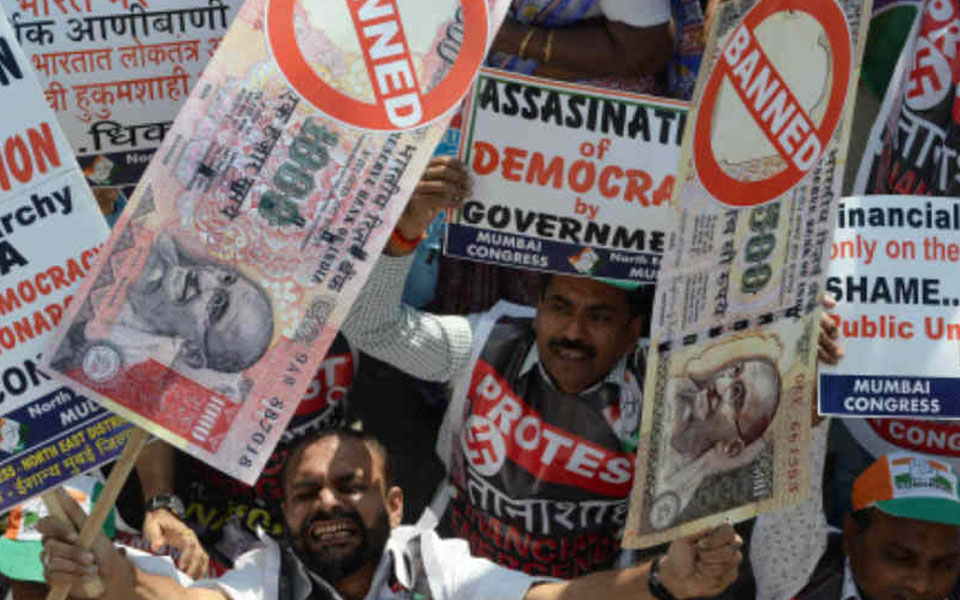
If you’d ask the government about what it found by digging a whole lot of mountains, you’d find no answer. Because the government has completely failed in its mission to bring back black money from abroad, or even check its existence within the country. A common man with basic street smartness knows the safe havens of black money are religious institutions, the offering boxes at big temples and secret treasuries of swamijis etc.
Apart from those places, black money is safe in politicians’ homes. But our PM Narendra Modi looked for this black money in the torn pockets of middle and lower middle class that lives on hand-to-mouth existence. He forced people to queue up before ATMs to put in, and withdraw their own hard earned money. He caused immense damage to the economy of India. The collapse of rupee continued without even slightest resistance. After all this, Reserve Bank of India has officially declared no black money was unearthed in demonetization. Does this not mean the government itself has now admitted that there is no black money in the country? What is the point in having inconveniencing people to such a large scale?
The government had given many reasons to defend demonetization. They said earlier that terrorism would be controlled greatly with this step and stone pelting incidents in Kashmir would also be checked. Most important reason was that counterfeit currency will choke to death, even as the value of rupee would increase in international market against the dollar. But then, when the reality struck, it was different from all this. None of the country’s problems were solved, instead they doubled up and turned more complex.
In the financial year that ended in March 2018, the number of counterfeit currency in denominations of Rs 50 and Rs 100 was the highest in the last three years. About 6,453 fake notes were found in 2015-16. This number jumped to 9,222 notes in 2016-17. And in 2017-18, this number became 23,447!
As for the Rs 100 currency, about 2,21,447 fake notes were found in 2015-16. After demonetization, that number shot up to 2,339,182 fake notes were found. This is a significant rise in the number.
Initially it was assumed that the new Rs 2000 currency introduced after demonetisation was of high quality that cannot be counterfeited because of intricate security features. However, according to the RBI annual report, only 638 fake notes of this denomination were found in 2016-17, and this number saw an increase in 17,969 (valued at Rs 36 cr) in 2017-18. Compared to last year, the amount of fake currency found was reduced by 31.4%. The main reason for this is understood to be reduced circulation of Rs 500 and Rs 1000 currencies in 2016. But after new Rs 500 was introduced, the fake currency racket surged again with 199 notes being found in 2016-17, and 9892 notes being found to be fake in 2017-18.
On the other hand, though banks got 100% cash back into the banking system, all that couldn’t be termed genuine. Through demonetization, all those people who had stacked black money, government gave them an opportunity to turn it into white. Every black money hoarder used this chance to turn his money into legal one. The media has often spoken about politicians being involved in this. Even Amit Shah’s name figures in this list. Either Income Tax department or any other investigative agency has not bothered to pick up the trail of money that came into the banking system to watch for fraudulent transactions. There are also allegations that note ban was known to a few corporate companies, organisations and political outfits beforehand and they had already made arrangements to escape the damage, and turn their money into white.
Now the government is speaking about digitalization of money transactions. The economic crisis faced owing to demonetization has put the RBI in a tricky situation. The printing of new notes has been a financial burden on RBI. The primary motive of unearthing black money wasn’t even achieved remotely. This has put the RBI in a tight spot. To cover up for this blunder, the government is speaking about digitalization of money.
This whole concept is comical to say the least since this nation lakhs of villages who don’t even have basic infrastructure in place, let alone achieving digitalization through technology. Small and medium traders have suffered massive loss. The mega malls and super bazaars are reaping the benefit of this. Right after currency ban, the decision of the government to introduce an act on prevention of cruelty to animals dealt a heavy blow to the people living in rural areas. Fake Gau Rakshaks used this to their total benefit. The cost of transporting cattle increased manifold. They were forced to take care of cattle that had ceased to give them returns, turned into an economic burden.
All these developments were the second emergency the country witnessed. The government needs to apologise for imposing such travails on the people of the nation.
Let the Truth be known. If you read VB and like VB, please be a VB Supporter and Help us deliver the Truth to one and all.
Real Madrid fines Valverde and Tchouaméni half a million euros each for altercation

Barcelona (AP): Real Madrid slapped players Federico Valverde and Aurélien Tchouaméni with half-a-million-euro ($588,000) fines on Friday for their altercation during practice.
The massive fines came a day after the midfielders tussled when the team trained. Valverde said in a post on social media on Thursday that no punches were thrown. But Valverde knocked his head on a table and he suffered a small cut that required a brief hospital visit.
On social media, Valverde initially called it a “meaningless fight” with a teammate and said “everything has been blown out of proportion."
His employers, however, considered it a significant enough breach of team discipline to nail both Valverde and Tchouaméni with fines that bite even the bank account of a top soccer player. The half-a-million euro penalties reflect the reputational damage the club was enduring in a chaotic end to a disappointing season.
In a statement, the 15-time European champion said its disciplinary action was concluded after both players expressed to the club “their complete remorse for what happened and apologized to one another.”
Madrid added they also apologized to their teammates, the coaching staff and club supporters, as well as showing their willingness to accept whatever disciplinary action the club deemed “opportune.”
Tchouaméni was back training with Madrid on Friday, two days before they play at Barcelona in a clasico. Madrid has to win otherwise Barcelona will be crowned La Liga champion.
After being notified of the fine, he posted a public apology to the club and its fans on social media.
“What happened this week in training is unacceptable,” Tchouaméni wrote. "I say this while thinking about the example we are expected to set for young people, whether in football or at school.
“Above all, I am sorry for the image we projected of the club.”
Valverde was not at practice due to the head knock.
Both players are set to play in the World Cup next month, with Tchouaméni playing for France and Valverde for Uruguay.
Chaotic end to a poor season
===================
The run-in between the players, who for seasons have played side by side in Madrid's midfield, came after they argued this week in previous training sessions. But tempers boiled over on Thursday. Spanish media was rife with reports that the players previously disagreed over the club's decision to let coach Xabi Alonso go after just months on the job.
It was not the only altercation involving Madrid players during training this week. Álvaro Carreras confirmed he was in a “minor” incident with a teammate. Spanish media said he and fellow defender Antonio Rüdiger got into a scuffle.
Álvaro Arbeloa, the coach who was promoted from Madrid's reserve team when Alonso was fired in January, will face tough questions on what went wrong inside the changing room when he gives a press conference on Saturday ahead of the clasico at Camp Nou.
Madrid is facing a second consecutive campaign without a major trophy amid rumors in the Spanish media that club president Florentino Pérez is considering bringing back Jose Mourinho to straighten out his underperforming team.