Do not insult the constitution

In the recent past, some esteemed Judges had cautioned against the subverting of constitution and the powers granted by the constitution. They had felt ever since BJP came to power in the centre, democracy was under threat. Extra constitutional powers were constantly attempting to destabilize the democracy and democratic institutions. Today, assembly elections in Karnataka are a big example of this subversion in progress. It is no secret that the raids conducted in the run up to the elections using IT and other agencies were done for political reasons. Even after all this, BJP didn’t get a full majority, but had to be satisfied with 104 seats, at least nine seats short of the majority. Now the governor Vajubhai Vala has invited B S Yeddyurappa, the Karnataka leader of this party to form the government. This has obviously created anxiety among activists who fight to retain the spirit of democracy. Opinions that governor’s decision to allow one party to form the government and then take time or be given time to prove majority on the floor will give rise to ‘horse trading’ are not too far from the truth either. HD Kumaraswamy of JD(S) has already said his party members are being offered Rs 100 crore to defect and join the BJP.
One interpretation is that BJP legislative party leader BS Yeddyurappa is being invited to form the government against the people’s mandate since the party did not get absolute majority. This morning he may even take oath to the office of the Chief Minister of Karnataka. If this happens, it would create a very bad precedence. The governor may claim he invited the single largest party to form the government with 104 members. If this was the case, why was it not followed in the case of Goa which has 40 seats where Congress was in majority with 17 members over the BJP and its allies? When this matter was taken to the Supreme Court, even the court upheld the decision of the governor. The same case repeated in Manipur where Cong emerged as the single largest party. BJP with just two members was allowed to form the government with allies. Meghalaya too favoured Congress with 21 seats, but the party was denied the opportunity to form the government. BJP and allies formed the government there too. Union minister Jaitley said this was a constitutionally appropriate measure. Same thing repeated in Nagaland too where Cong emerged as the biggest party but was denied the opportunity to form the government. But one needs to know why the same rule cannot be applied in Karnataka too? JD(S) and Congress together have submitted a list of MLAs in their support to the governor, to stake claim to form a government. Governor needs to give them an opportunity to show solidarity at least. But then this is not being done.
Elected governments have to be formed under the very rules laid down by the constitution. But the happenings after the conclusion of assembly elections in Karnataka are quite appalling. The person who occupies the chair of a prime minister says he would not allow the JD(S) and Congress to form the government. This amounts to directly influencing the governor who has invited the party without majority to form the government. All these aspects do not hold up the spirit of democracy. The governor is not concerned about how the leader of this party would even prove majority on the floor later. Because there are not too many independent MLAs in Karnataka at the moment except for one and that number is not sufficient to achieve majority.
Now horse trading will have to be done between JD(S) and Congress MLAs. This move by the governor will give rise to all probabilities of this happening. Amit Shah is in Karnataka to achieve this very goal. Though no party has got absolute majority, nearly 64% of the voters have favoured secular parties. BJP could secure only 36.2% votes among the ones polled. Now when secular forces have come together to form the government, the governor should allow this to happen acting in the spirit of democracy. But the governor Vajubhai Vala comes from the Sangh Parivar background and was a minister in PM Narendra Modi’s government. But whatever be his history, he has to be impartial when he sits in the office of the governor. There are many examples on how a governor should take decisions in political situations like this. In 1998 when a similar situation had arisen, President K R Narayanan had allowed time to Atal Behari Vajpayee’s government to prove majority on the floor. Then the BJP had accepted this. Even now, the same parameter must be followed, Kumaraswamy and his allies should be allowed to form the government. Else, he would be committing a major blunder on this matter and would be failing the constitution as well as democracy.
Let the Truth be known. If you read VB and like VB, please be a VB Supporter and Help us deliver the Truth to one and all.
Axar shifts focus to next IPL after KKR all but end DC's campaign
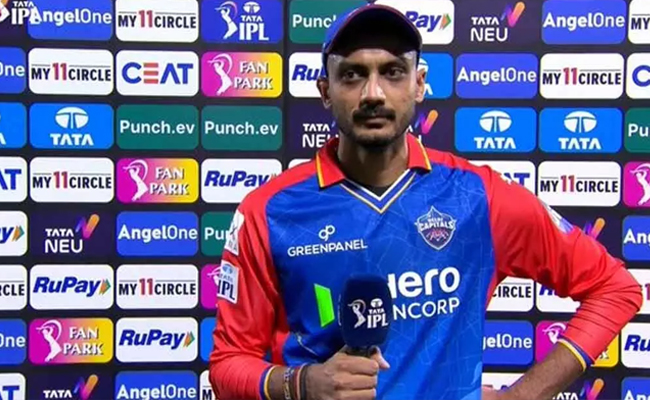
New Delhi (PTI): A beleaguered Axar Patel admitted that both his team's batters and bowlers let the side down after Delhi Capitals suffered a humiliating eight-wicket defeat to Kolkata Knight Riders, virtually ending their IPL 2026 playoff hopes, while indicating the team had already begun looking ahead to the next season.
DC endured a miserable outing at home, managing only 142/8, which Kolkata Knight Riders chased down in just 14.2 overs, powered by a blistering unbeaten 100 from Finn Allen and his destructive stand with Cameron Green (33 not out) as the visitors tore apart the bowling attack.
With just eight points from 11 matches, DC are eighth on the table, while KKR revived their playoff hopes with a resurgent run, moving to seventh with nine points from 10 outings, though their road to the knockouts still remains difficult.
"For now, we'll go back and think about the mistakes we made. After that, obviously there's still a long journey ahead and next year will come too. So we'll think about what plans we can make for next year and what approach we should take," said Axar after the match.
"Based on that, we can also look at the players sitting on the bench and decide who can be given opportunities and what changes we can make," he added, hinting at a possible major overhaul next season.
With 200-plus totals becoming the norm this season, 142 was always going to be inadequate, and Axar admitted the score was well below par while also pointing out at poor judgement shown by the spinners while defending the modest total.
"I think the runs were definitely below par and at the same time the spinners made quite a few mistakes. Looking at the way the pitch behaved, I feel the spinners did make errors.
"At the same time, we lost five wickets in two-three overs, and I think that's where the momentum slipped away from us. That's probably something we need to think about because the same thing happened against CSK...we started well, and then suddenly wickets kept falling," he added.
He admitted the solutions to the issues could be found but players need to show the right mindset and character.
"See, you can't solve it in a complicated way. So, I think it's more about applying the right mindset. Even if you lose one or two wickets, you can still spend time at the crease and play through it. I think that's what needs to be applied, when wickets are falling in clusters, you need to absorb the pressure for an over or two," opined Axar.
KKR skipper Ajinkya Rahane was pleased to see a struggling Finn Allen finally rediscover his touch with the bat.
"I'm really happy for Finn Allen. He was struggling first four or five games, working really hard, but the way he batted tonight was fantastic. But I want to praise our bowlers again.
"We did well because of them. And they've been doing it so well consistently, especially those middle overs and the death overs. Our spinners, Sunil Narine, Varun (Chakravarthy) and Anukul Roy, have been fantastic," he said.
"Fielding-wise, yes, we are working really hard. Our fielding coach has been really strict with us. And that's what has been helping us. The result which you've been seeing about the catches and the ground fielding, credit goes to our fielding coach as well," he added.