Era of liberal Hindutva politics ends
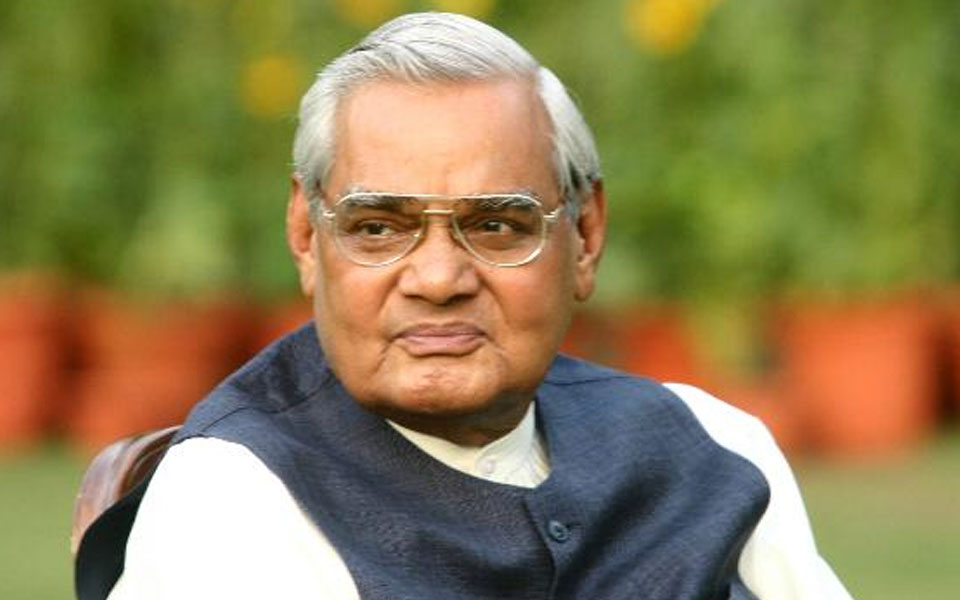
As if to indicate the path of extremism the current Hindutva politics is taking, from that of liberal nationalism, veteran politician and statesman, RSS ideologue former PM Atal Bihari Vajapayee breathed his last on Thursday. It had been more than a decade since Vajpayee moved away from active politics and public life. As a mark of liberal politics he stood for, Vajpayee spent almost his last few years in the ICU. But the most troubling fact is, all the contemporaries that had joined hands with him during his heydays, weren’t facing any better time in the party either.
BJP has put most of its senior members in compulsory ICU. The others have been sent to old age homes within the party. Advani, Murli Manohar Joshi, Jaswant Singh and all others are currently irrelevant in the party. Modi, Amit Shah, Adityanath and the others are setting the order for everything within BJP. With the death of Vajpayee, BJP has proclaimed an era has really come to an end, that of veteran politicians and statesmen.
Vajpayee maintained a certain distance from the RSS even if he coexisted in the same ideology almost. While the country was up in flames hearing the speeches such as Advani and Uma Bharathi, Vajpayee's soft words gave a much needed solace. When the country was faced with a question of finding a political alternative, it did not choose Jan Sangh or BJP. Instead, the country chose Janata Parivar as its third front. BJP used the opportunity when Janata Parivar failed to work constructively to build the nation. Indian people chose Vajpayee-led BJP as an alternative to Congress. This was some kind of a political game that RSS played. On one hand Advani was impressing Indians with his Ram Rath Yatra. Wherever he went, there would be bloodbath. At the same time, RSS knew the secularism and democratic values were still strong in the country.
On one hand, they were trying to drive Hindutva to the grassroots level, while projecting Vajpayee to the front and get the attention of upper class people. Though L K Advani brought more seats for BJP with his indirect involvement in violence, Vajpayee was made the PM candidate since RSS preferred that way. Seculars voted for Vajpayee, and not for BJP; or so they believed. If not for him, even other secular forces wouldn’t have joined hands with the BJP.
The NDA came into being with Vajpayee in the forefront. He was the pretext for power hungry politicians to come together. His name consumed even fiery politicians such as George Fernandes. Some people call Vajpayee as a secular politician. But he never had any difference of opinion with RSS stance and Hindutva politics. He only opposed the ways in which this goal was to be achieved. His path was that of liberalism. And this caused a major rift between Sangh Parivar and Vajpayee.
His poetic talks, his statesman-like attitude and the language of heart that he spoke, he was everybody’s prime minister. He even succeeded as the PM. He spoke very aptly, fitting enough for the occasion. He had mastered that art. He tried to follow ‘Raj Dharma’ as a PM, to the best of his abilities. But most times, it remained a futile attempt. He tried with all his honesty to build bridges between Pakistan and Bangladesh. BJP came to power with Pak and Bangladesh as taking points.
Hence, his Vajpayee's attempts could hardly bear fruits. He succeeded only partially. But the Sangh Parivar continued to reduce everything he tried to do, to mere dust. He had to work both as Sangh Parivar activist and as a PM of the country. The country lost hold over diplomatic relations and external relations with other countries during Vajpayee's time. India identified itself with America after distancing itself from Non Aligned policy. It lost the trust of third world countries.
India battled maximum number of terrorist attacks during his time as PM. This caused him great embarrassment. Kargil loss imposed a war on India and the country suffered a lot because of that. Another black spot was the hijack of Indian Airlines flight. Terrorists attacked the parliament during his tenure as PM. More than anything else, he contradictory stand during the Gujarat massacre. On one hand, he almost defended it and on another, he prodded Modi to follow Raj Dharma. When Advani came forward to resign owing to Gujarat genocide, it is said that Vajpayee stopped him. Today, this decision is causing the country very dear. The nation is paying a heavy price for the mistake Advani committed.
Let the Truth be known. If you read VB and like VB, please be a VB Supporter and Help us deliver the Truth to one and all.
PM arrives at Brigade Parade Grounds for swearing-in ceremony of BJP's first govt in Bengal
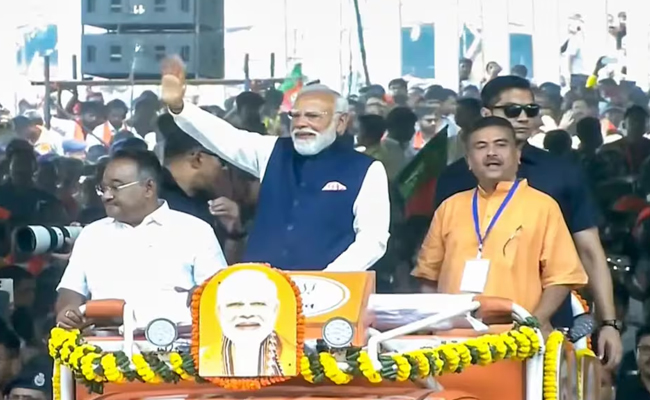
Kolkata (PTI): Prime Minister Narendra Modi arrived at the Brigade Parade Grounds here on Saturday to attend the swearing-in ceremony of the BJP's first government in West Bengal.
Accompanied by state BJP president Samik Bhattacharya and CM-elect Suvendu Adhikari, Modi was accorded a rousing welcome.
Amid the 'Jay Shri Ram' slogan, Modi entered the venue on an open vehicle and was seen waving at the crowd.
The Prime Minister landed at Netaji Subhas Chandra Bose International Airport here a little before 10 am and took a helicopter to reach the Race Course ground before proceeding by road to the venue.
Thousands of BJP supporters gathered at the Brigade Parade Grounds since early morning to witness the oath-taking ceremony.
The BJP secured 207 seats in the 294-member Assembly, ending the Trinamool Congress' 15-year rule in the state.