Excess food needs to reach the hungry
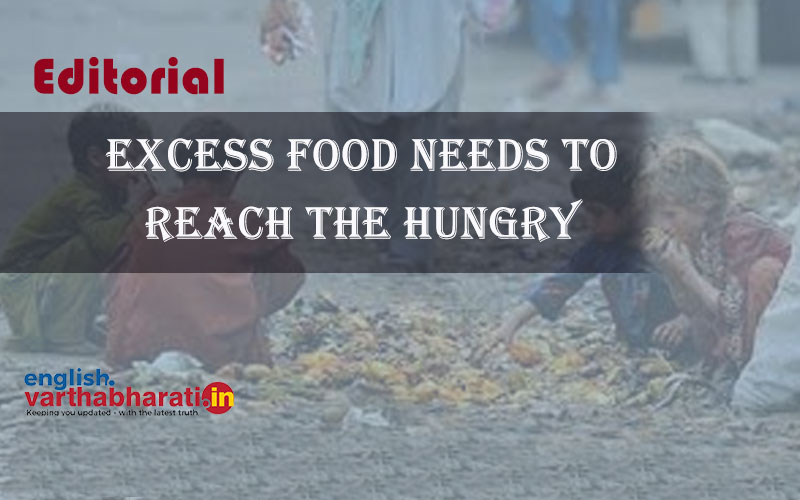
Hunger is the basic urge granted by nature to humankind. But humans have turned it into some sort of disease generating process. As a result of insatiable hunger, lakhs of people are dying all over the world.
A lot of people are struggling with malnourishment and underdevelopment aided illnesses, hanging between life and death. The earth, which is the most enriched creation of god, is filled with impoverishment despite the rich resources it has.
None of the poverty or hunger was created by god. Man’s greed has to do with every shortage of resources we face today. And humans alone are accountable to find solutions for that. India isn’t lagging behind in creating hunger and perpetuating it further. As per reports, more than 14.9% population of the country is malnourished.
Which means, more than half of malnourished people are in our country. And most of them don’t even know if they would get the next meal or not. Reports reveal more than 20 crore people go to bed hungry. Many accounts of hunger deaths have been reported in 2018. This bitter truth is always masked with sweet lies or hollow promises. Global Hunger Index 2018 pus India in 103rd place among the 119 countries that made to the list.
But the true picture, apart from the beautiful fakes projected by the media, is very different from the ones we are served.
This is the proof to the fact that when it comes to common people, not everything is in order. Why is India, that enjoys nature’s bounty, facing such a difficult situation when it comes to hunger? Experts have already opined that unfair distribution of resources is the main reason for the prevailing hunger in India, and not excess population as commonly assumed.
China which took the step of controlling population in order to reduce poverty, is also facing this mammoth task of having to tend to the aged, who are increasing in number with every passing day. Now that country has completely withdrawn from one child policy. We need to honestly think about harnessing population, assuming that being the most priced resource to aid progress.
We also need to accept the fact that we have failed in controlling poverty. In order to celebrate our short success, we cannot allow the poor to die unattended. Though we may not be able to solve the issue of poverty in complete sense, we can certainly work towards protecting the poor.
We may not be able to build palaces for the homeless, but we can certainly provide them a safe place to stay or a roof on their heads. We may not be able increase the standard of their life, but we can most certainly solve some of their problems.
We may not be able to provide them multi-course meals, but we can ensure they don’t go to bed hungry. We are not facing food scarcity. As per the reports, India produces enough to feed her people, but the failure lies in distribution of this food.Our resources are getting divided unequally and unjustifiably.
We are also wasting a lot of food. On one hand, we have people dying of hunger, and on the other, huge quantity of food is reaching the waste basket. As per an estimate, more than one third of the food produced is being wasted annually. Inefficient packing and supply methods contribute to 40% fruits and vegetables getting wasted before they reach the consumers. More than 30% grains turn unfit for consumption.
Prevailing methods of processing and supply chains contribute to wastage of paddy and other food grains. Fully ripen fruits are discarded with the anticipation that they’d rot even before they reach the destination. Vegetables and food items meet the same fate.
All these rejected items turn into a big part of ‘wastage’ which can be taken to the poor and hungry. Our marriages, occasions where we serve food, events, restaurants, lodges, hotels and homes waste a lot of food. Marriages see a lot of food wastage with varieties of items being served to those who discard mercilessly because they are not hungry, but are only tasting the food there. As a result, a lot of food lands in the waste bin.
One of the best chefs in the world, Massimo Bottura of Italian origin, has come up with a new idea. He has created a collective called Food for Soul. This organization ensures the food that is excess, is taken to the poor and hungry instead of landing in waste bins. This way he is saving food as well as the people.
A ‘food bank’ can serve well for our people who reach the brink of life owing to hunger and malnourishment. If that is done, India will save its face and the country can do better than watch people die of hunger.
Let the Truth be known. If you read VB and like VB, please be a VB Supporter and Help us deliver the Truth to one and all.
Rickelton's ton in vain as SRH beat MI by 6 wickets

Mumbai (PTI): Ryan Rickelton's whirlwind unbeaten ton was overshadowed by Heinrich Klaasen's unbeaten 65 as Sunrisers Hyderabad defeated Mumbai Indians by six wickets in an IPL match here on Wednesday.
Chasing an imposing 244-run target, Travis Head (76 off 30) and Abhishek Sharma (45 off 24) shared 129 runs for the opening wicket to set the platform for SRH.
Klaasen (65 not out off 30 balls) then displayed his all-round hitting abilities to guide SRH home with the help of Nitish Kumar Reddy (21) and Salil Arora (30 not out off 10) in 18.4 overs.
Earlier, Rickelton's knock powered MI to 243 for five.
MI rode on a 93-run stand between Rickelton (123 not out off 55 balls) and Will Jacks (46 off 22) in 7.1 overs for the opening stand to power the side.
MI skipper Hardik Pandya scored a valuable 31 off 15 balls before being dismissed.
Praful Hinge (2/54), Eshan Malinga (1/29), Sakib Hasan (1/39) and Nitish Kumar Reddy (1/31) were the wicket-takers for SRH.
Brief Scores:
Mumbai Indian: 243 for 5 in 20 overs (Ryan Rickelton 123 not out; Praful Hinge 2/54).
Sunrisers Hyderabad: 249 for 4 in 18.4 overs (Travis Head 76, Heinrich Klaasen 65 not out; AM Ghazanfar 2/51).