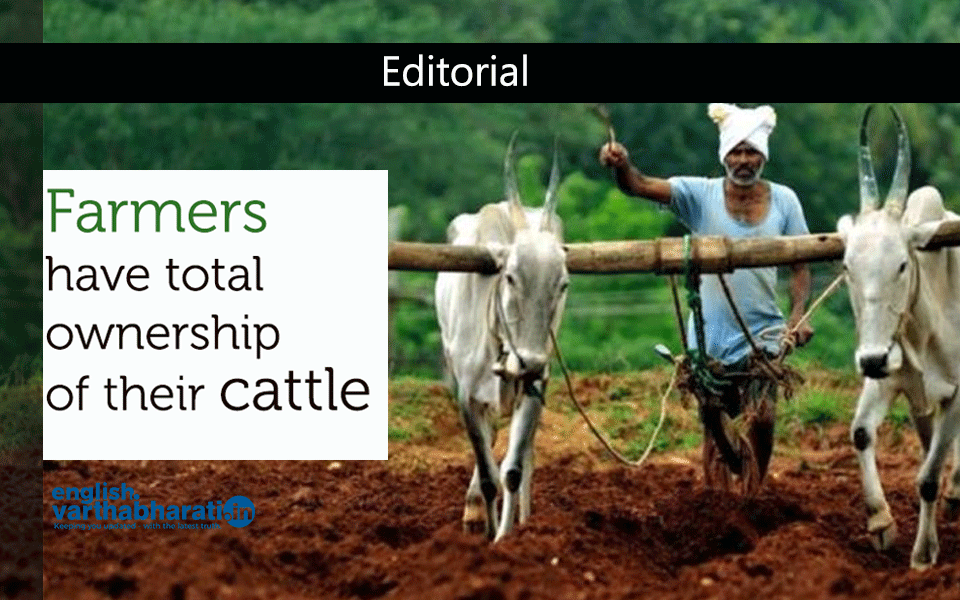
Farmers have total ownership of their cattle
The current tragedy of this country is those who are not domain experts have begun to give expert opinions on every issue. Those who do not even have primary knowledge of science speak about science, politicians talk about economics and street rowdies speak about dharma and culture with clubs in their hands.
RBI is the best example of how politicians with no economic knowledge have messed with the country’s systems and damaged it to a large extent. Supreme Court gives out contradicting verdicts because anti-constitutional elements decide who should disseminate justice.
Saffron-flaunting men like Yogi who do not have any experience in farming or cattle rearing, are deciding on who the cattle should be sold to, and how one would take care of them. As a result of this, dairy farming has collapsed in the rural areas and schools are turning into cow shelters.
The result of priestly class’s conspiracy to take dairy farming into their own hands by turning it into a dharmic task than an economic option, is showing on the country’s psyche. The Yogi government has been creating baseless schemes to protect the cows such as cow ambulance, cow shelters in schools, cow protection forces manned by goondas, etc.
Cattle rearing is on a downhill in Uttar Pradesh owing to the government taking away the rights of farmers who cared for these cattle. They are getting transported to slaughter houses on the sly. The cattle that are found on the streets are being tethered at schools and hospitals.
Uttar Pradesh government is basically concerned about cattle on the street instead of caring for people and their welfare. All agrarian aspects are linked to one another. Since cattle rearing and agriculture went hand in hand owing to dependency on tilling, the animals were domesticized.
The cattle waste was the best fertilizer for the land. The dung, the urine everything enriched the nutrients in the land. The returns from this could help farmers balance their maintenance costs. Now with cultivable land being less, cattle have less utility for such purposes any more since most of the agricultural activity happens based on machines and automobiles.
Just the way as the farmers were part of agriculture, even the beef consumers contributed their bit to complete the food chain and keep the economy going. The cattle that have outlived their time and utility are being given up for beef consumers.
This serves two purposes. One would be the expenses part would come down where the cattle was to be cared for even when there are no definite returns, and the second was an economical benefit that involved selling them. This money would be used to buy new cattle, and the business would grow further expanding the scope of farming.
More than this, those who worship cows are not too keen on rearing them or taking care of them. The farmers who rear cattle worship them annually as part of their paying respect to the animals that help their lives.
Cattle, to farmers, are like currency. If there are two extra cattle, the money one gets by selling them would be used for a marriage or house maintenance or anything else that would serve the purpose for the moment. This is a constant economic activity. Dairy farming is turning upside down with priestly class claiming this activity is more of a devotion than of economic one.
The farmers who were at the forefront had to move back, owing to the goondas of Sangh Parivar who took the centre stage. The Gau Rakshaks now decide who the cattle would be sold to, even beyond its owner. The act brought about by the government against selling the cattle is more like second round of demonetization.
Ironically, no one has to take care of these cattle that had gone beyond utility. They would have turned into food and provided nourishment to the society. This would have ensured nutrition to the poor.
Owing to this government policy, the poor are deprived of nutritious food. And the farmers lost the income they’d get by selling the aged cattle. All these expenses are now on the government now. The money that could have been spent for people, schools and public health and other supporting systems had to be used for creating facilities for the cattle and failed even in that.
Many cattle died owing to bad maintenance in Gaushalas which turned profitable to others, but not to the poor farmer who took care of the cattle. Dairy farming thus suffered a huge blow.
The government needs to wake up now at least and encourage beef consumption and provide impetus to dairy farming. Cattle should be declared the property of farmers who rear them, in clear and loud messaging. The money that’s being spent on Gaushala should be used for improvement of schools and hospitals. This way, both the farmers and cattle would be spared.
Let the Truth be known. If you read VB and like VB, please be a VB Supporter and Help us deliver the Truth to one and all.
AIITA welcomes Karnataka’s ban on obscene songs in school events

Bhatkal: The Karnataka unit of the All India Ideal Teachers Association (AIITA) has welcomed the Karnataka government’s decision to strictly ban school children from dancing to obscene songs during educational and cultural programmes in government, aided, and private schools across the state.
AIITA Karnataka State President M. R. Manvi congratulated the government for taking what he termed an important step to preserve the sanctity of education.
“Such decisions to safeguard the dignity of school children and uphold the values of education are the need of the hour. This rule should not be limited to government schools alone but must be strictly implemented in all private educational institutions as well,” he said.
He further urged the government to address other concerns within school programmes.
“The government should not only prohibit obscene dances in the name of school anniversaries, but also ensure that plays and dialogues that incite religious hatred are avoided. Schools should be centres of harmony, not platforms for spreading hatred,” he added.
According to a recent circular issued by the Department of School Education and Literacy, obscene dances are adversely affecting the mental health and moral values of students.
In this regard, schools have been advised to use songs that promote nationalism, positive thinking, the greatness of Kannada culture, and value-based traditions instead of inappropriate content during programmes.
The circular also emphasises that students should be dressed in decent attire.
AIITA also backed the department’s warning that disciplinary action would be taken against head teachers if such guidelines are violated. The association has further demanded that district Deputy Directors of Public Instruction strictly monitor the implementation of these rules.