From Golden Age to Varna Age
VB Editorial | August 16, 2025 |
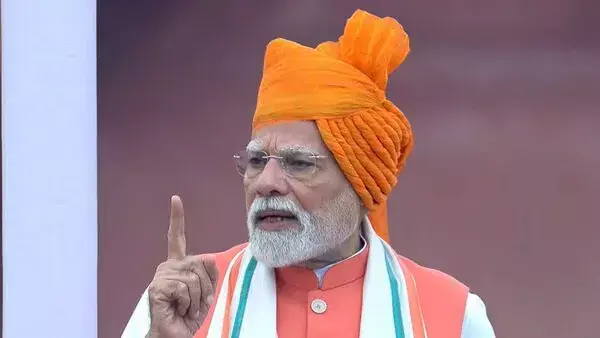
From the Red Fort this Independence Day, Prime Minister Narendra Modi once again spoke of his “resolve for a prosperous, self-reliant India.” It was his 12th consecutive speech from the same stage, a record surpassing Indira Gandhi. Yet, what stood out was not the record itself but the hollowness of repetition. The Prime Minister himself admitted that speeches cannot build a nation — and yet, a decade later, the difference between his first address in 2014 and his words in 2025 is hard to find.
Ten years ago, the country placed its faith in Modi’s promises. The hope was that India’s fortunes would change. But what is the reality? Economically, India has slipped. GST has shackled businesses, and now reforms in GST are being portrayed as a gift, not an apology. Operation Sindhoor is being advertised as a security success even as the Pahalgam attack exposed glaring failures. NITI Aayog’s own chief has said the current 6.5% growth rate cannot make India a developed nation.
Meanwhile, hunger, unemployment, and atrocities against Dalits are rising. The Global Hunger Index shows India slipping further. Violence in the name of religion is becoming common. Mobs lynch innocent people in the name of cows. On the 79th Independence Day, many states attempted to impose bans on meat. The irony is staggering: India is one of the world’s largest beef exporters, yet its poor are denied nutritious food. Farmers cannot sell cattle they rear, while their livelihoods are destroyed. Violence continues in Manipur. Militancy festers in Kashmir.
Even democracy is under question. Reports of electoral fraud are emerging across states. In Bihar, voter roll manipulation by the Election Commission has been widely exposed. The Supreme Court itself has raised concern. Yet, the Prime Minister remained silent on all of this in his Red Fort address.
Instead, he chose to celebrate the Rashtriya Swayamsevak Sangh (RSS), calling it “the largest non-governmental organisation engaged in nation-building.” This single declaration reveals much. For the RSS, there is no history of fighting for farmers, Dalits, workers, or women. Its seniors did not join the freedom struggle. Savarkar, fearing Kala Pani, wrote mercy petitions to the British and lived on their pension. When Netaji called on the youth to join his army, Savarkar advised them against it.
M.S. Golwalkar, the ideological architect of the RSS, upheld the caste system and rejected the Constitution. For decades, RSS offices did not hoist the national flag. When young nationalists hoisted it at the Nagpur headquarters in 2001, they were dragged into court cases for 12 years. Nathuram Godse, Gandhi’s assassin, drew inspiration from RSS ideology. Sardar Patel himself banned the RSS for conspiring against the nation. Its name has come up in cases from Malegaon to present-day extremist violence. Abroad too, demands for action against its affiliates continue.
The government that has crushed countless NGOs working for the environment, farmers, Adivasis, and Dalits now expresses pride in the RSS. What future does this signal? An India shaped by RSS ideology means an India shaped by Manusmriti — where caste hierarchy, Brahminical dominance, and untouchability would once again define society.
This is the exact opposite of what Ambedkar envisioned. He dreamed of a golden age built on equality. Instead, the government is pushing India towards a Varna Age rooted in inequality. To ignore the RSS’s finances and its unconstitutional activities, while glorifying it from the Red Fort, is not just an error of judgment — it is a dangerous shift in the nation’s direction.
That is why this year’s Independence Day speech has left many Indians anxious. From the dream of equality, India seems to be slipping into an age of division. From the Golden Age to the Varna Age — this is the worry staring the nation in the face.
Let the Truth be known. If you read VB and like VB, please be a VB Supporter and Help us deliver the Truth to one and all.
Real Madrid fines Valverde and Tchouaméni half a million euros each for altercation

Barcelona (AP): Real Madrid slapped players Federico Valverde and Aurélien Tchouaméni with half-a-million-euro ($588,000) fines on Friday for their altercation during practice.
The massive fines came a day after the midfielders tussled when the team trained. Valverde said in a post on social media on Thursday that no punches were thrown. But Valverde knocked his head on a table and he suffered a small cut that required a brief hospital visit.
On social media, Valverde initially called it a “meaningless fight” with a teammate and said “everything has been blown out of proportion."
His employers, however, considered it a significant enough breach of team discipline to nail both Valverde and Tchouaméni with fines that bite even the bank account of a top soccer player. The half-a-million euro penalties reflect the reputational damage the club was enduring in a chaotic end to a disappointing season.
In a statement, the 15-time European champion said its disciplinary action was concluded after both players expressed to the club “their complete remorse for what happened and apologized to one another.”
Madrid added they also apologized to their teammates, the coaching staff and club supporters, as well as showing their willingness to accept whatever disciplinary action the club deemed “opportune.”
Tchouaméni was back training with Madrid on Friday, two days before they play at Barcelona in a clasico. Madrid has to win otherwise Barcelona will be crowned La Liga champion.
After being notified of the fine, he posted a public apology to the club and its fans on social media.
“What happened this week in training is unacceptable,” Tchouaméni wrote. "I say this while thinking about the example we are expected to set for young people, whether in football or at school.
“Above all, I am sorry for the image we projected of the club.”
Valverde was not at practice due to the head knock.
Both players are set to play in the World Cup next month, with Tchouaméni playing for France and Valverde for Uruguay.
Chaotic end to a poor season
===================
The run-in between the players, who for seasons have played side by side in Madrid's midfield, came after they argued this week in previous training sessions. But tempers boiled over on Thursday. Spanish media was rife with reports that the players previously disagreed over the club's decision to let coach Xabi Alonso go after just months on the job.
It was not the only altercation involving Madrid players during training this week. Álvaro Carreras confirmed he was in a “minor” incident with a teammate. Spanish media said he and fellow defender Antonio Rüdiger got into a scuffle.
Álvaro Arbeloa, the coach who was promoted from Madrid's reserve team when Alonso was fired in January, will face tough questions on what went wrong inside the changing room when he gives a press conference on Saturday ahead of the clasico at Camp Nou.
Madrid is facing a second consecutive campaign without a major trophy amid rumors in the Spanish media that club president Florentino Pérez is considering bringing back Jose Mourinho to straighten out his underperforming team.