Gaushala instead of schools; cleanliness without pourakarmikas!
Various sections of media are covering PM Modi’s swachata or cleanliness programmes with great aplomb. On the other hand, the government is spending crores together on setting up gaushalas for cows. And at this time, two reports have been published that could mock the schemes listed above. One being, five people have died after getting into the sewer manhole in Chhattisgarh. Another news is that a there are no schools in 13,511 villages in the country. And Uttar Pradesh stands on top of the list of states without schools in the country. This information kind of mocks the whole interest Yogi Adityanath is showing in setting up cow shelters since the time he took over as CM.
Swacchata Andolan is not something new to this country. We have created castes to clean streets and drains in our country. And a particular community has been putting its life and future, at stake for the sake of cleanliness in the society. Mahatma Gandhi had stopped visiting these places after he was shocked at the level of unhygienic standards in temples and pilgrimages. He held a flag of freedom in one hand and broom in another. He saw that the toilets were reeking of filth in the first Congress meet and he began cleaning them up. He called upon everyone to take up tasks to ensure hygiene is maintained, by way of reaching out to broom, and this is an honourable thing.
He reiterated that this task isn’t a lowly job. He spoke the same way about Bhangis also. But unfortunately that turned into a controversy. Gandhiji had actually said that with the intention of conveying that their job or the need for hygiene is extremely noble one. Today, Narendra Modi is speaking of cleanliness just like Mahatma Gandhi. He is standing before the cameras for the sake of ‘cleanliness’. Though it has been three years since he launched the scheme, he is unable to explain the success of other works during his tenure. He has not been able to find out reasons for that either. All that cess collected for Swacchata Andolan, where is it going? Thousands of crores have been set aside to clean Ganga. The water is still not drinkable from that river. Has any Pourakarmika been able to see any improvement in his life in the last four years? All these issues will lead to disappointment.
Swacchata Aandolan can be a success only when the lives of Pourakarmikas improve, so as to enable them to do better work. None else other than politicians or officers who can make this scheme a success. Pourakarmikas have been cleaning the roads of this country since ages. They are the ones that are real and inseparable partners of swacchata andolana in our nation. While they are in this noble task, the government or the authorities have been refusing to pay them a decent wage for their work. The situation of Pourakarmikas having to demand their wage through a strike or a dharna is the hard reality of this country. The contract workers that work on cleaning streets of drains do not even get least safety gears such as gloves or proper dresses. They need to be supplied, at least once a month, with a new set of safety materials to safeguard themselves. Their health is to be cared for. If a swacchata andolan is taken up without all this, we’d have dead bodies floating every now and then in the drains. This is the reality of Modi’s andolan right now.
After Yogi Adityanath came to power in Uttar Pradesh, more than Rs 80 crore has been spent on setting up Cow Shelters or Gau Shalas in the state, and the money continues to flow for this purpose. But the same state is on top of the list of highest number of villages without schools. The government is spending money on Gau Shalas when it should be spent on schools. The inevitability to set up Gau Shalas has also arisen out of that state’s wrong decisions as well.
So far farmers could decide whatever they wanted to do about their cattle. But ever since Yogi became CM, the farmers lost the right of deciding whether they could sell the cattle after their utility or keep them. Even a cattle past its utility could bring money to a farmer. But after the policy banning its sale was imposed, the farmers were forced to leave the useless cattle on the streets. Today the government is spending many crores on cattle but that has no use for dairy farming or to common people. This whole issue of Gau Shala is more of an emotional thing than with any utility at the end. The government has no money to supply oxygen cylinders to hospitals. Such schemes as Gaushala set the country back by ages. Leaders like Yogi and Modi are the biggest challenges who refuse the stakeholders a share of their role in the success march of the country.
Let the Truth be known. If you read VB and like VB, please be a VB Supporter and Help us deliver the Truth to one and all.
KMES Institutions shine in SSLC result, continue four-decade legacy of education in rural Karkala
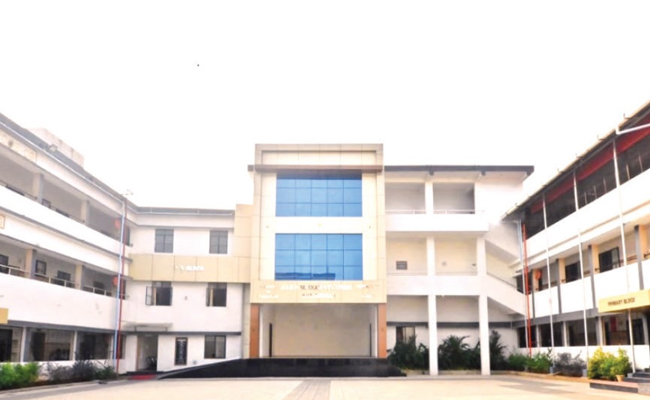
Karkala: KMES Institutions of Education at Kukkundooru in Karkala taluk has recorded outstanding results in the 2025-26 SSLC and PUC examinations, continuing a four-decade educational journey that began with just 22 kindergarten students and no building of its own.
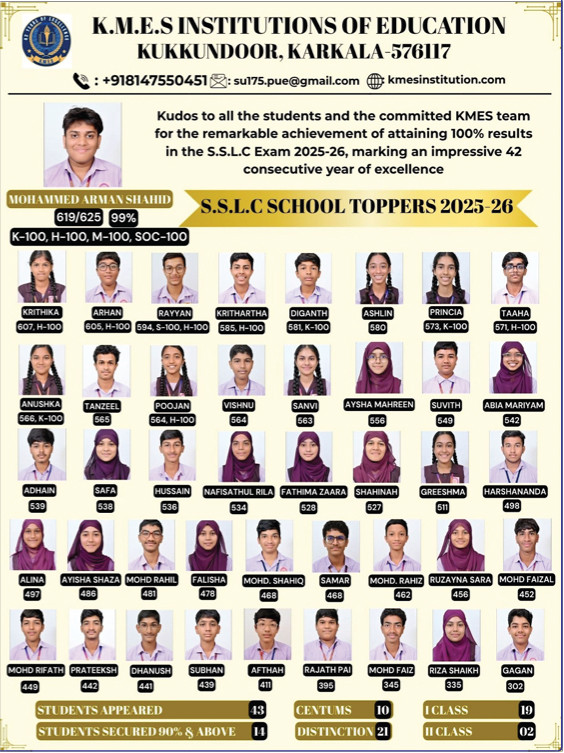
The institution secured a 100 per cent result in the SSLC examinations, with all 43 students passing the examination this year.
Muhammad Arman Shahid emerged as the school topper by scoring 619 marks out of 625, securing 99 per cent and also ranking sixth at the state level. He scored full marks in Kannada, Hindi, Mathematics and Social Science.
Krithika V. Nayak secured the second position in the school with 607 marks and 97.12 per cent, while Arhan stood third with 605 marks and 96.8 per cent.
Out of the 43 students, 21 passed with distinction, 19 secured first class, two students obtained second class and one student passed in third class. Fourteen students scored above 90 per cent.
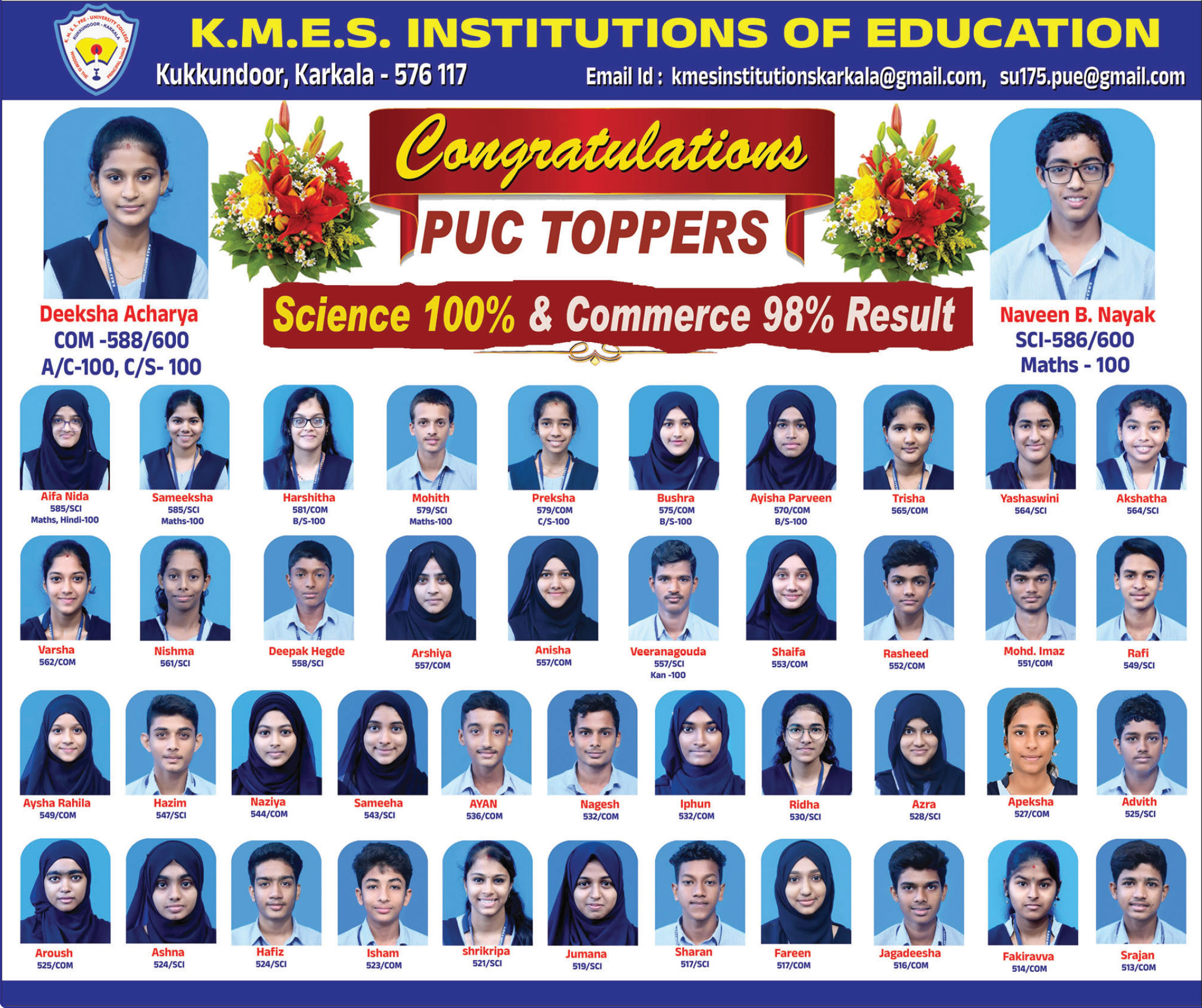
The institution also performed strongly in the PUC examinations. The Science stream recorded a 100 per cent result, with all 44 students passing, while Commerce secured a 98 per cent pass percentage.
Twelve students scored full marks in different subjects, including Mathematics.
In Commerce, Deeksha Acharya topped the college with 588 marks, while Harshitha H. Kini secured the second position with 581 marks.
In Science, Naveen B. Nayak emerged as topper with 586 marks, followed closely by Sameeksha Moily and Aifa Nidha, who both secured 585 marks.
Speaking about the achievement, High School head teacher Shrimati Patkar said the institution has always focused on supporting academically weak students through affordable education and free special classes.
“Our ambition is to provide quality education even to students who struggle in studies. The fees are very low, and free coaching classes are conducted. I have worked here for 28 years and have always found the atmosphere supportive of education,” she said.
Primary School head teacher Lolita Zeena D’Silva appreciated the dedication of the teaching staff and said the school encourages students not only to achieve high marks but also to become role models.
PU College Principal Balakrishna Rao said the institution focuses on value-based education and overall personality development.
“The aim is to help students succeed not only academically but also in cultural activities, sports and leadership. We encourage qualities such as patience, tolerance and discipline,” he said.
Rao also credited the institution’s growth to the support of founders K.S. Mohammed Masood and K.S. Nissar Ahmed, along with President K.S. Imtiaz Ahmed.
Speaking on the occasion, Imtiaz Ahmed said the institution was built on the dream of making quality education accessible to financially backward families in rural areas.
He said the guidance and encouragement of his elder brothers, Mohammed Masood and Nissar Ahmed, along with the contribution of teachers, students and parents, helped transform the institution into a model educational centre.
The KMES Institutions trace their roots back to 1984, when they were founded by senior social activists Haji P.M. Khan, K.S. Nazeer Ahmed and Haji A.S. Rashid Haider.
The institution initially functioned from the Government Urdu School premises as it did not have a building of its own. Classes began with only 22 students in lower kindergarten and two teachers.
Later, under the leadership of K.S. Mohammed Masood and with continuous financial and moral support from non-resident businessman K.S. Nissar Ahmed, the institution gradually expanded.
In 1993, the school shifted to its own building and began conducting classes from LKG to Class 5.
As student admissions increased, Nissar Ahmed personally funded the construction of three additional classrooms to address infrastructure shortages.
The institution’s new school building was completed in 1997, while the PU College building was constructed in 2001.
From humble beginnings in a borrowed building to producing state-level rank holders and consistent academic results, the KMES Institutions have grown into one of the prominent educational centres in the Karkala region.