Immutable shall fall; dynamic shall survive

The politics of statue that's happening in India isn't limited to this country alone, but has spread to some other nations as well. The proof of this lies in the fact that the incidents around Mahatma Gandhi's statue in Ghana are getting complex with every passing day. Giving in to pressure by a few professors, the statue of M K Gandhi was ripped out from the University campus. This is almost the same politics that's getting a lot of attention in India as well.
The whole country knows why Patel statue was erected in Gujarat. BJP wants to fight the memories of Nehru with Patel as a combat strategy. Their idea that they can erase the memories and contribution of Nehru by way of erecting a statue of another leader itself is a very narrow thinking. Patel is a leader within India. But Nehru grew up to be an international leader. His non-alignment movement gave rise to third front in the world. Having slipped up big time in ushering development, the BJP is trying to dissuade people by building statues of Patel, Shivaji, Lord Ram and others.
Even in destroying the statue of Gandhi in Ghana there are populist and appeasement politics. The statue was removed to please a section of people in Ghana telling them that Gandhi was a racist and racism supporting individual. As per the general public of Ghana, Gandhi's stances on issues are not any different from those who are imperialistic racists. Just the way as there are people who like him and dislike him in our country, the same kind of people exist elsewhere too. While one finds that RSS hates Gandhi, there are Ambedkarites who dislike him vehemently too. Because Gandhi had supported casteism and defended something as inhuman as carrying human waste. At the same time, one cannot reject the values of truth, non-violence and simplicity that he reintroduced to the country through his life. Gandhi statue was opposed in the past too in Africa. In 2015, Gandhi statue was smeared with white paint in South Africa, and this has continued till recently by way of aborting the bid to erect Gandhi statue in Malawi.
The political leaders of Ghana succumbed to people's demand and tore off the statue of Gandhi in Ghana. But there is a sensitive issue here. This statue was erected as a mark of good diplomatic relations between the dual countries. This was to commemorate the three nation tour that the president of India undertook in 2016. The statue was just a metaphor for two nations to express their good diplomatic relationship. India and South Africa often take the softer route to express their diplomatic relations. When situation gets out of control, the same statues turn into pawns of diplomatic rigmarole and solutions at the hands of people. The same thing has now transpired in Ghana. With Gandhi statue being razed to the ground, it also made way to a complicated dimension being added to the relationship between the two countries.
If people of that nation feel Gandhi indeed was a racist, they have all the rights to bring down his statue. But then when forging diplomatic relations, the impact of erecting any statue, on the people of the country has to be taken into consideration by the nations involved. A statue is not merely a token between two diplomats and the nations they represent; but an indicator of how the impact would roll out should things go on an undesirable plane anytime later. Statues are not pertinent for any bilateral relations. There are more ways of achieving this goal than erecting statues. When people choose immobile metaphors like statues, the future naturally will have more challenges than the past.
Another example for this would be of the statue of Manu before the Rajasthan High Court. The Dalits and Shudras of this country have been fighting against the ideology and prejudices proposed by Manu that have been dominating the discourse since ages. Freedom for this country was not just about chasing out the British but also to disregard the Manu ideologies wholly so as to achieve some dignity. Constitution took the place of Manu's ideologies. Unfortunately, right infront of the High Court in Rajasthan, his statue has been erected. The dalits and shudras have been expressing their displeasure regarding this since quite some time now. When the high of Hindutva sobers down, the statue may even be gone. If a Dalit headed government ever comes to power in Rajasthan, they may pull this statue down just to please their own people. This statue is a challenge to those who trust the Constitution.
To solidify the thoughts of leaders in the form of statues is a bad precedence. A hero today may be a villain tomorrow. Then a statue does not take long to be torn down. We can take the example of Lenin statue that was torn down in Tripura in the recent times. We can even guess the statues that would be destroyed if a left government assumes power in Tripura again. The lifeless statues can never create a feeling of solidarity. They can be detrimental to unity sometimes. Hence any government should stop using resources to erect statues. That money should be spent on creating public facilities to be used by general public. The words of sharanas that the immobile shall fall and the dynamic shall survive, should be remembered at this stage.
Let the Truth be known. If you read VB and like VB, please be a VB Supporter and Help us deliver the Truth to one and all.
Miscreants decamp with 70 kg silver articles from jewellery shop in Bengaluru
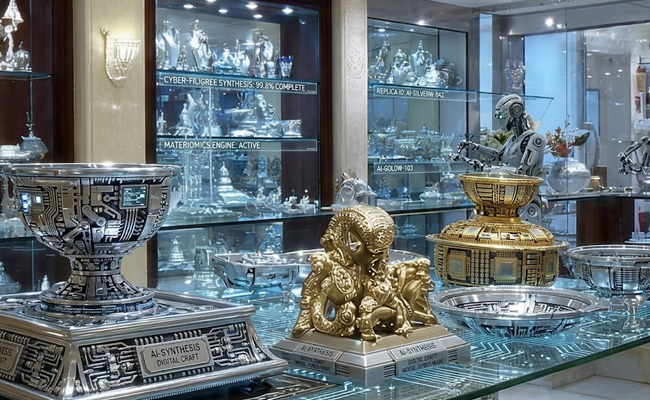
Bengaluru (PTI): Unidentified miscreants allegedly broke into a jewellery shop here and decamped with approximately 70 kg of silver articles worth crores of rupees, police said on Friday.
The incident was reported at a jewellery shop near 8th Mile, Havanur, on April 28, they said.
According to police, the accused are suspected to have entered the premises from the rear after breaking open the lock and drilling a hole through the wall of the shop.
The incident came to light at around 7 am on April 28 when shop staff opened the premises and discovered signs of forced entry and extensive damage to the rear section of the building, following which they alerted police authorities.
Preliminary estimates indicate that around 70 kg of silver articles, worth crores, were stolen. Most of the silver items displayed in the cupboards were taken, while valuables kept in the locker remained intact, a senior police officer said.
Police said CCTV cameras inside the shop were not functioning. Efforts are underway to identify the suspects using footage from cameras installed in the vicinity.
The miscreants also allegedly took away the Digital Video Recorder (of CCTV) of an adjacent shop, the officer added.
Investigators are also examining the tools and techniques used to gain access to the shop, suspecting the involvement of a professional gang with prior knowledge of the store layout.
A case has been registered at Bagalagunte Police Station, and further investigation is underway to identify and apprehend the accused, police said.