Is Yeddyurappa alone responsible for the mess?
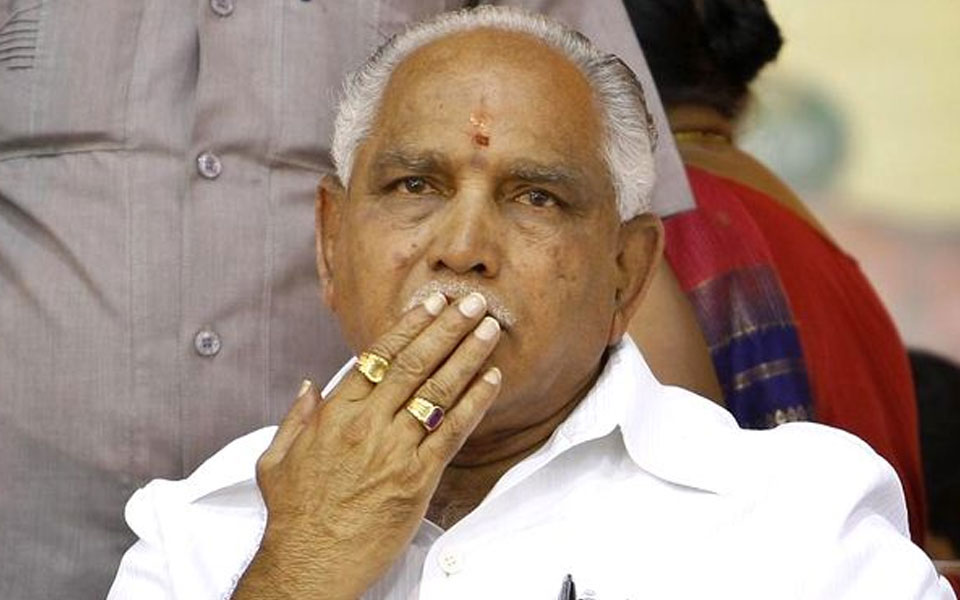
Looks like the attempts to keep Operation Kamala alive in Karnataka has boomeranged on BJP. An audio recording of Yeddyurappa trying to negotiate with an MLA’s son has exposed the ‘undercover’ dealings of Yeddyurappa.
Initially Yeddyurappa had denied that this was his voice and he was even supported by his partymen who had reiterated his claims. But now Yeddyurappa himself has admitted to the fact that the voice in the tape is his. So, with that, one thing has become clear. That the government isn’t unstable because of internal factors, but because some external factors like the BJP are trying hard to make it thus.
To attempt to buy over MLAs elected through a democratic process by offering them money is equivalent to hacking the EVMs. This is like compromising on democratic institutions. BJP has admitted to have committed this offence. Who should pay for this? BJP has to make that decision within their own party.
Jibes have already started on Yeddyurappa even within the party soon after he admitted to the voice in the audio tape being his. But we need to understand one aspect. We should not be weighing Yeddyurappa who led the Operation Kamala and the Yeddyurappa who admitted to his voice.
In the recent days, people are blatantly refusing their role in anything despite the allegations being genuine. Yeddyurappa could have done the same thing too. He has opened a chain of stores of various allegations. This additional allegation couldn’t have been so heavy. He could have shifted the blame to his opponents and led a peaceful life as a leader. He has to be appreciated for his admission. He should not be unduly critiqued for having admitted to Operation Kamala.
Now coming to the larger issue, this is not his fault alone. There are bigger names behind Operation Kamala and targeting Yeddyurappa would mean they go scot free.
“Success has many fathers, failure is an orphan” is a popular English adage.
If the BJP had been successful in operation Kamala and formed the government, the credit of this would be usurped by Modi and Shah.
Media had often projected Operation Kamala as some sort of an accomplishment. Anchors would cry hoarse over what time the new government would be formed and the new CM would take oath. They were equally excited about Operation Kamala for their part.
Now with Yeddyurappa’s admission, everyone has gone into a tizzy. Hence he is being projected as a criminal. They are not sad that Operation Kamala failed, but they are angry that BSY admitted to his role.
BJP wants all the possible seats in Lok Sabha elections in Karnataka and other states too. The Modi-Shah duo are strategizing each and every move to ensure maximum seats are clinched for the party.
Hence Shah has closely directed this Operation Kamala. Their whole agenda is to at least try and create some sort of mistrust among people about the current coalition government, even if they cannot form a government.
Yeddyurappa can never enter into this business without the instruction of the higher authorities in the party. Because the funds to support these claims have to come from higher levels. Hence BJP has used Yeddyurappa in some sense. The leaders have made him a prey.
Now he has turned into a challenge to them. There have been attempts to unseat him from the leadership position of BJP in Karnataka. But since Lingayats have been supporting the BJP, Yeddyurappa has been retained inevitably.
If BJP throws him out, the Lingayat support base may be lost. RSS is in a fix over Lingayats demanding separate religion tag because Yeddyurappa is a mass leader of Lingayats.
Destabilising him would mean Lingayats would move away from the party. Hence some of the BJP leaders are pushing him to do things that blacken his image.
Now with his admission, he has become even a weaker leader. That this admission came on the day when Modi was in the state, has caused even more problems to BJP because it has harmed even their poll preparation.
Did he foresee the conspiracies that he admitted to his mistake? Or is his admission a preface to new politics? Only time hold the answer.
Let the Truth be known. If you read VB and like VB, please be a VB Supporter and Help us deliver the Truth to one and all.
Man arrested with Rs 2.54-crore heroin in Mumbai

Mumbai (PTI): Police have arrested a man and seized over 500 grams of heroin worth Rs 2.54 crore in the illicit market from him in Mumbai, officials said on Friday.
The police's Anti-Narcotics Cell (ANC) made the drug seizure in Santacruz in the western suburbs. The operation was conducted by the Kandivali unit of the ANC on Thursday as part of a special crackdown against drug trafficking in the area, they said.
Acting on specific inputs, an ANC team conducted a raid in Santacruz (East) and intercepted a man. During a search, the team recovered 508 grams of high-grade heroin from his possession, an official said.
The seized contraband, a highly addictive, opioid drug derived from morphine, is estimated to be worth Rs 2.54 crore in the international market, he informed.
Following the seizure, a case was registered against the man under relevant sections of the Narcotic Drugs and Psychotropic Substances (NDPS) Act, 1985, and he was formally placed under arrest in the early hours of Friday.
The police are currently investigating the source of the drug and trying to identify the intended recipients of the consignment, he said.