Loss of face for central goverment

There has been a constant attack on constitutional organisations ever since Modi’s BJP government assumed power at the centre. Autonomous institutions have been meddled with constantly, pushing envelope to use them to settle vendettas and equations with the political opponents. One of the major examples of this lies in the fact that CBI chief Alok Kumar Verma was sent on compulsory leave in the recent times. Verma had moved courts questioning the decision of the goverment on the leave issue. Supreme Court took up the matter for hearing and has given a dressing down to the government, stating the leave stands cancelled and Verma should return to office. But he has been barred from taking any policy related issues, till the CVC investigation is complete.
Central government was never humiliated like this. Alok Kumar Verma’s tenure would end on January 31. He was sent on compulsory leave, forcibly in October. This is a classic case of government interference over everything else. Supreme Court expressed dissatisfaction over such highhandedness on part of the government.
Right from the beginning, the autonomy of CBI has always been under a scanner because it’s autonomy seems more like tokenism than genuine. All the political parties that have been in power have been using CBI in some way or the other to settle scores with their political opponents. But the midnight operation and sending Verma on leave was a direct attack launched on the CBI. Supreme Court has reinstated Verma, clearly ignoring the reasoning provided by the government that the action was initiated based on the Central Vigilence Committee Commissioner’s report.
PM, Chief Justice of Supreme Court and leaders of opposition will sit together to decide about the future of CBI chief. The decision by the Supreme Court will have its impact on CBI even after Verma’s retirement by the end of the month. The governemnt cannot really take a unilateral adhoc decision regarding the next appointee as CBI director. The argument made by Fali S Nariman, representing Verma is that the director has two year service tenure and the decision made by the govetnment is ntohing but interference.
Central government had appointed Verma as CBI chief in 2017. Then he was sent on leave all of a sudden. Is there any truth in the allegations made by the opposition that Verma was going into the files and details of the Rafael deal made by the central government which caused him to be shunted out? Why was Asthana, who is considered a Modi aide, appointed as the director of CBI in the same month?
After Asthana’s appoinment, CBI turned into a warzone of internal bickerings. The central goverment is solely responsible for this. This brought out the fights into open space and ruined the confidence it enjoyed among people, thanks to Modi government. When Verma had travelled aborad, Asthana had attended a meeting on promotions for staff called by the CVC. Verma was livid when he heard that Asthana attended the meeting on his behalf, stating he had not designated anyone as acting chief. This brought out the differences of opinion among both seniors in CBI and both then lodged complaints citing corrpuption charges. The centre then woke up and sent both of them on leave and appointed Nageswara Rao as the acting chief. The centra government did not check with highpower committee for any suggestions. Advocate Prashanth Bhushan and others had submitted a plea to CBI seeking inquiry into Rafeal deal, that seems to be surrounding Modi at the moment. Based on this complaint, Verma had colletced a few details for further investination. Hence one version says this caused Modi goverment to train their guns on Verma and send him on leave. This is not totally far from the truth either. Central goverment got into a quick sand trying to protect Modi. This is a warning bell for the future goverments as well.
Let the Truth be known. If you read VB and like VB, please be a VB Supporter and Help us deliver the Truth to one and all.
Rickelton's ton in vain as SRH beat MI by 6 wickets
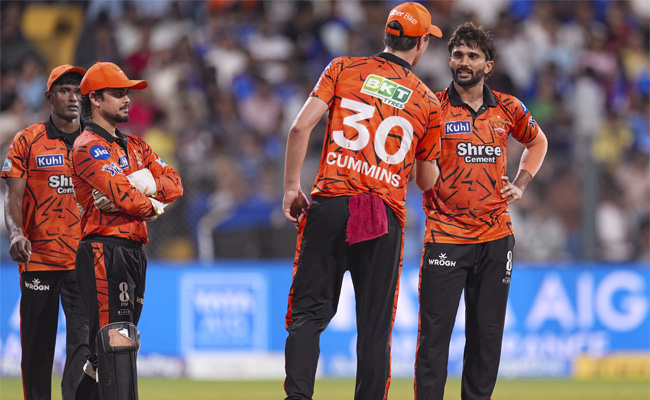
Mumbai (PTI): Ryan Rickelton's whirlwind unbeaten ton was overshadowed by Heinrich Klaasen's unbeaten 65 as Sunrisers Hyderabad defeated Mumbai Indians by six wickets in an IPL match here on Wednesday.
Chasing an imposing 244-run target, Travis Head (76 off 30) and Abhishek Sharma (45 off 24) shared 129 runs for the opening wicket to set the platform for SRH.
Klaasen (65 not out off 30 balls) then displayed his all-round hitting abilities to guide SRH home with the help of Nitish Kumar Reddy (21) and Salil Arora (30 not out off 10) in 18.4 overs.
Earlier, Rickelton's knock powered MI to 243 for five.
MI rode on a 93-run stand between Rickelton (123 not out off 55 balls) and Will Jacks (46 off 22) in 7.1 overs for the opening stand to power the side.
MI skipper Hardik Pandya scored a valuable 31 off 15 balls before being dismissed.
Praful Hinge (2/54), Eshan Malinga (1/29), Sakib Hasan (1/39) and Nitish Kumar Reddy (1/31) were the wicket-takers for SRH.
Brief Scores:
Mumbai Indian: 243 for 5 in 20 overs (Ryan Rickelton 123 not out; Praful Hinge 2/54).
Sunrisers Hyderabad: 249 for 4 in 18.4 overs (Travis Head 76, Heinrich Klaasen 65 not out; AM Ghazanfar 2/51).