Mallika Ghanti surrounded with controversies
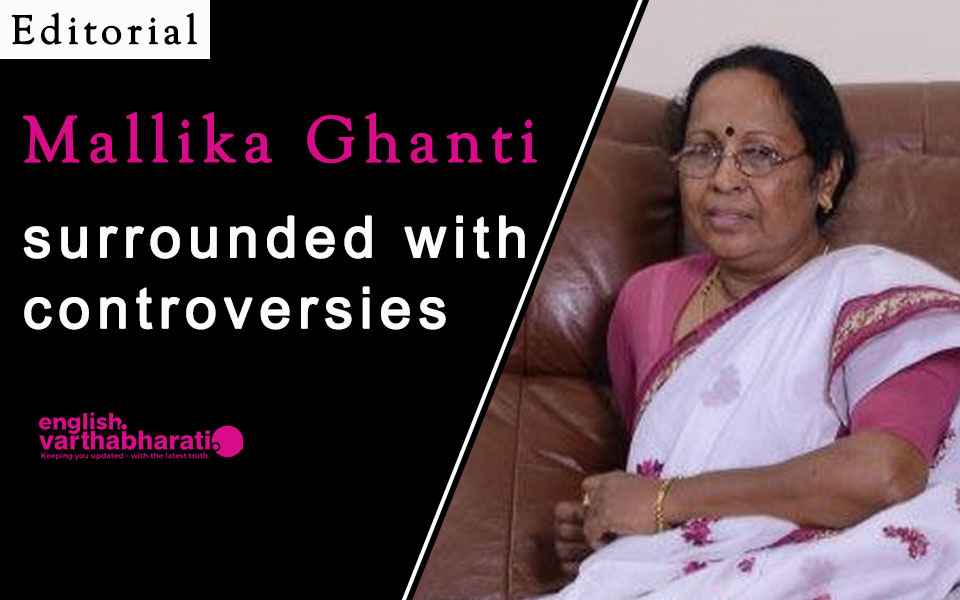
Hampi Kannada University has its own place of pride in the history of Karnataka. Many renowned thinkers have enhanced the value of this institution. The role of this University in bolstering the cause of Kannada can never be ignored.
But in the recent times, the university is in news for reasons other than constructive ones pertaining to literature, language etc.
It is rather a sad thing that the VC of this University, renowned thinker Mallika Ghanti is in the centre of such storms that are exactly not positive to the image of the University.
If a teacher loses track, his students lose the path and gradually this will lead to deterioration of the society at a higher level.
At the same time, the impact of a deteriorating University on the state and language is simply immeasurable in terms of damage done to various aspects of the state. With this being the reason, we will have to take developments in the university with more seriousness than ever. The fact that a controversial guest being invited to the literary event organised by Hampi University caused a great furore in various circles of the state.
One cannot even imagine Hampi University without Prof M M Kalburgi. His contribution to Kannada literature and research is beyond mere comprehension. When such a person was killed, a senior journalist write a rather distasteful tribute to him.
The first allegation on Ghanti is that she invited such a journalist to Hampi University as guest. There are many right leaning writers, thinkers and researchers. They all have excellent rapport with Hampi University. They have also been invited as guests for various events. But no one ever criticised Ghanti for that.
The public wanted to know what was that pertinent reason for Ghanti to invite a person who write disgusting tributes to those thinkers and writers who were murdered. Many for and against arguments were also presented. After the university students protested against this, Ghanti went and cancelled the whole event.
Another equally inappropriate decision by Ghanti was quietly ignored on the same occasion. Hampi University has been giving Nadoja award in the name of Adikavi Pampa since a long time. This award was inspired by the “Desikottam award” that is given in Shanti Niketan established by Rabindranath Tagore.
Nadoja title has been conferred on many stalwarts such as Kuvempu, Nijalingappa, Gangubai Hangal, Kambar and others. This time Nadoja was conferred on an incomprehensible haste to literary organiser Manu Baligar. He may well be deserving of this title. But there are accusations that Mallika Ghanti has violated a few norms while nominating persons for this award.
Sometimes such allegations may deride the value of the award as well. And this may cause embarrassment to even those who received it. Hence Ghanti owes it to people that these allegations be answered to. According to Kannada Universities Act 1991, the president of Kannada Sahitya Parishat is the member of governing board of the University. In this case, it is Manu Baligar.
In the 25 year history of Kannada University, no senate or Syndicate member has been conferred with this award. So the credibility of this selection is under scrutiny now. According to retired lecturers of the University, there have been gross flouting of norms in selecting a candidate for this award.
Normally the practice is that the governor will set up a committee of three members consisting former VC of the University, another professor from any other university, and another member as indicated by the Syndicate members. But this time around, syndicate did not suggest any names for its part.
Another aspect is before placing the name of Manu Baligar for discussion and approval by Senate and Syndicate, Mallika Ghanti had announced the name before the media members directly.
One of the RTI activists suggests that she had not even opened the envelope that had the final name of Manu Baligar before making the announcement, as some syndicate members has informed the activist. If a member or any persons get benefited by the university the act is equivalent to committing grave errors on work. This is a punishable offence under 1998 anti corruption act sec 7.
All these allegations have caused serious damage to the reputation of Mallika Ghanti that she has been safeguarding since long. She has to come clean from all this. This is not just the question of Ghanti's reputation alone but also of the credibility of the University itself. This has to be remedied for.
Let the Truth be known. If you read VB and like VB, please be a VB Supporter and Help us deliver the Truth to one and all.
Teen killed after being hit by private bus in Bengaluru

Bengaluru (PTI): A 16-year-old boy was killed after he was allegedly hit and run over by a private bus while crossing a road here on Friday, police said.
The deceased was identified as Varun, they said.
According to police, the accident occurred around 11:30 am on the Hennur–Bagalur main road.
The boy who crossing the road on foot when he was allegedly struck by the bus and came under its rear wheel, leading to his death on the spot.
He was rushed to a nearby hospital, where he was declared brought dead.
Following the incident, family members and locals staged a protest by blocking the Hennur–Bagalur road, resulting in heavy traffic congestion in the area.
The driver of the bus has been detained, and further legal action is being initiated, a senior police officer said, adding that an investigation is underway.