Miscreants tarnish spirit of Ganesh Chathurthi in Maddur
In the pre-independence era, public celebrations of Ganesh Chathurthi carried a noble purpose. Leaders like Bal Gangadhar Tilak used the festival not merely as a religious gathering but as a rallying point to awaken patriotic fervour against British rule. Religion, culture, and spirituality were the vehicles through which national unity was built. Those motives were pure.
But in today’s India, that legacy has been corroded. Instead of uniting people, some political leaders have reduced Ganesh Chathurthi to a stage for division and hatred. Lord Ganesha, revered as the remover of obstacles, is being misused by cynical forces as a tool to create obstacles in society for petty political gain. Nothing could be a greater insult to the spirit of this festival.
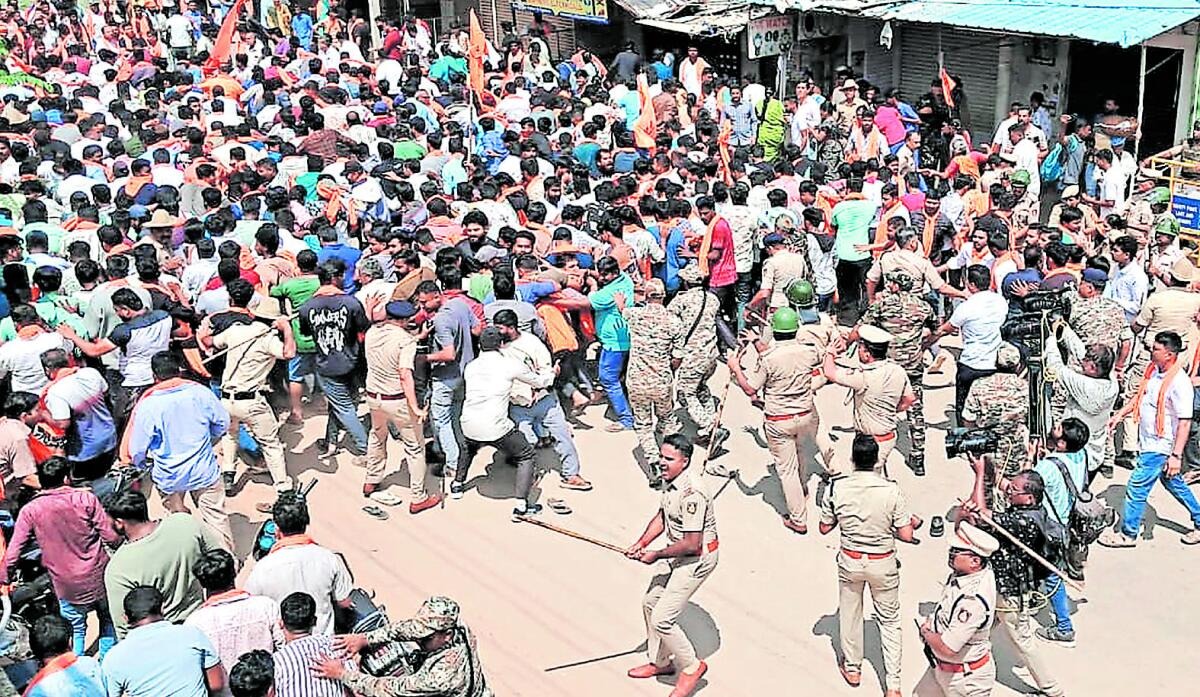
The disturbing events in Maddur, Mandya district, show how deeply this rot has spread. What should have been a joyous immersion procession ended in violence, with stone-pelting and a police lathi-charge. Videos now reveal that miscreants within the procession itself hurled stones at a mosque, while hurling filthy, abusive slogans against an entire community. These were not acts of devotion but calculated attempts to provoke communal clashes. Even senior police officials have clarified that no stones came from the mosque, exposing the false claims made by Sangh Parivar groups.
This was no spontaneous outburst. The videos show it was premeditated. Instead of chanting prayers to Lord Ganesha, a group led by a woman weaponised obscenities to vilify Muslims. When their provocations failed, they turned to stoning the mosque. Shockingly, BJP workers are now parading these very miscreants as “Hindu activists.” By legitimising such impostors, leaders themselves are desecrating Ganesh Chathurthi and reducing it to a political weapon.
What happened in Maddur is not an isolated episode. In Raichur, two young men pelted stones during a procession not out of communal hatred but personal enmity. Yet, communal groups were ready to exploit the incident to blame Muslims and incite violence. In Sagara too, when two children spat from a terrace, miscreants tried to spin it into a riot. These repeated attempts reveal a dangerous pattern: festivals are being hijacked by troublemakers whose only aim is to ignite divisions.
If those behind such actions truly valued the festival, they would never indulge in such behaviour. It is now the responsibility of genuine devotees to reclaim Ganesh Chathurthi from impostors in saffron scarves who pollute its sacredness with hatred. True devotion lies in humility, respect, and unity, not in manufactured clashes.
Mandya, once proudly known as the “Sugar Bowl” of Karnataka, is paying a heavy price for this toxic politics. Farmers and ordinary citizens, who once made this region flourish, are being pushed into the background while communal poison takes centre stage. The tragic example of Mangaluru, once celebrated for education and healthcare but later scarred by communal strife, stands as a warning. If Mandya’s people do not resist these forces now, they risk the same fate.
The JD(S), weakened and desperate to retain political ground, has now taken refuge in communal politics. By joining hands with these forces, it is sacrificing Mandya’s harmony for survival. The farmers of this land must rise above these divisive games and protect the soul of their district.
Lord Ganesha has always symbolised prosperity and bounty. For Mandya’s farmers, his blessing should mean better harvests, not police curfews. The festival must return to its roots of devotion and unity. The obstacles planted by politicians and miscreants must be removed, so that Mandya once again sweetens lives, not with hatred, but with sugar and prosperity.
Let the Truth be known. If you read VB and like VB, please be a VB Supporter and Help us deliver the Truth to one and all.
Real Madrid fines Valverde and Tchouaméni half a million euros each for altercation

Barcelona (AP): Real Madrid slapped players Federico Valverde and Aurélien Tchouaméni with half-a-million-euro ($588,000) fines on Friday for their altercation during practice.
The massive fines came a day after the midfielders tussled when the team trained. Valverde said in a post on social media on Thursday that no punches were thrown. But Valverde knocked his head on a table and he suffered a small cut that required a brief hospital visit.
On social media, Valverde initially called it a “meaningless fight” with a teammate and said “everything has been blown out of proportion."
His employers, however, considered it a significant enough breach of team discipline to nail both Valverde and Tchouaméni with fines that bite even the bank account of a top soccer player. The half-a-million euro penalties reflect the reputational damage the club was enduring in a chaotic end to a disappointing season.
In a statement, the 15-time European champion said its disciplinary action was concluded after both players expressed to the club “their complete remorse for what happened and apologized to one another.”
Madrid added they also apologized to their teammates, the coaching staff and club supporters, as well as showing their willingness to accept whatever disciplinary action the club deemed “opportune.”
Tchouaméni was back training with Madrid on Friday, two days before they play at Barcelona in a clasico. Madrid has to win otherwise Barcelona will be crowned La Liga champion.
After being notified of the fine, he posted a public apology to the club and its fans on social media.
“What happened this week in training is unacceptable,” Tchouaméni wrote. "I say this while thinking about the example we are expected to set for young people, whether in football or at school.
“Above all, I am sorry for the image we projected of the club.”
Valverde was not at practice due to the head knock.
Both players are set to play in the World Cup next month, with Tchouaméni playing for France and Valverde for Uruguay.
Chaotic end to a poor season
===================
The run-in between the players, who for seasons have played side by side in Madrid's midfield, came after they argued this week in previous training sessions. But tempers boiled over on Thursday. Spanish media was rife with reports that the players previously disagreed over the club's decision to let coach Xabi Alonso go after just months on the job.
It was not the only altercation involving Madrid players during training this week. Álvaro Carreras confirmed he was in a “minor” incident with a teammate. Spanish media said he and fellow defender Antonio Rüdiger got into a scuffle.
Álvaro Arbeloa, the coach who was promoted from Madrid's reserve team when Alonso was fired in January, will face tough questions on what went wrong inside the changing room when he gives a press conference on Saturday ahead of the clasico at Camp Nou.
Madrid is facing a second consecutive campaign without a major trophy amid rumors in the Spanish media that club president Florentino Pérez is considering bringing back Jose Mourinho to straighten out his underperforming team.